Auditor: HB151 reforms didn't close gaps as Alaska's child-welfare agency struggles with vacancies and caseloads
February 27, 2026 | 2026 Legislature Alaska, Alaska
This article was created by AI summarizing key points discussed. AI makes mistakes, so for full details and context, please refer to the video of the full meeting. Please report any errors so we can fix them. Report an error »
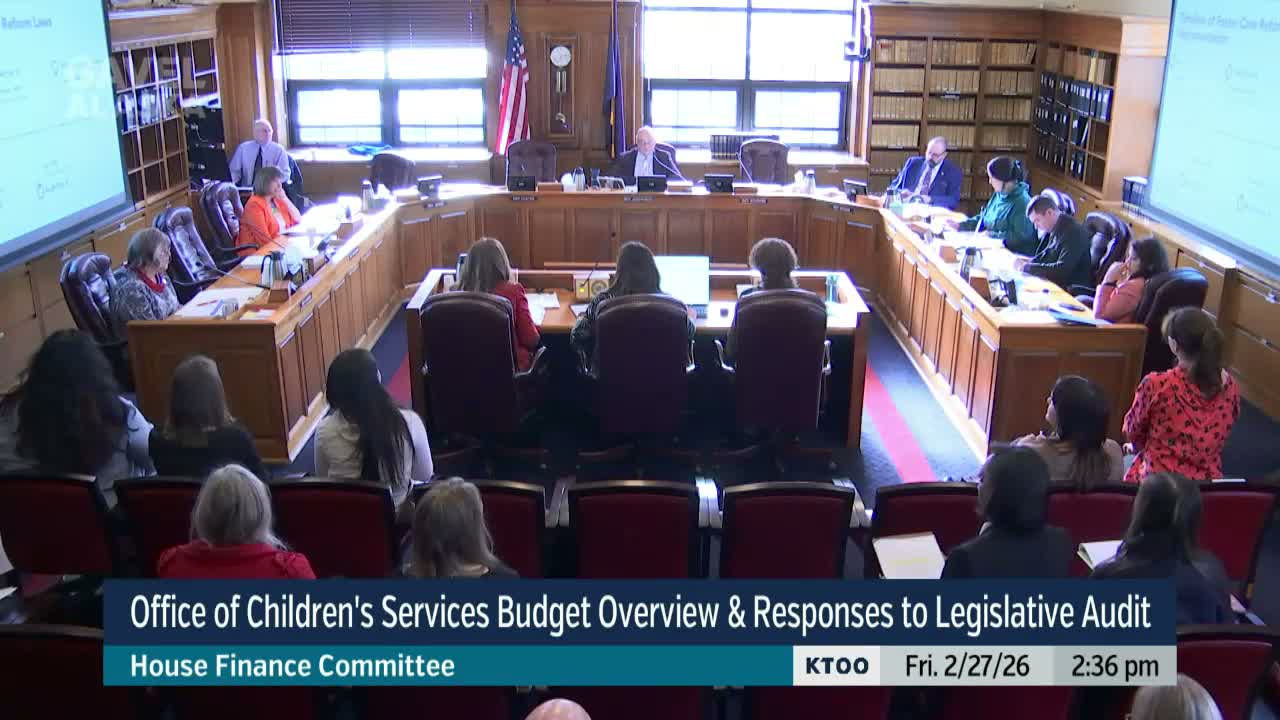
For the record, Kim Guay, director of the Office of Children's Services, told the House Finance Committee on Feb. 27 that a series of legislative audits show the agency has made many technical fixes but that staffing shortages have prevented HB151's caseload limits from producing better outcomes for children.
"The passage was when Governor Walker signed it," Guay said, describing HB151 as a law with strong intent that has not produced the intended results because "our caseloads are high, and we have not been able to do that due to the volume of work and the lack of employees." Director Kim Guay.
Why it matters: House Bill 151, passed in 2018, set caseload standards and other reforms intended to stabilize foster placements and child-welfare outcomes. At a February hearing on the Department of Family and Community Services budget, Guay, Commissioner Tracy Dompling and the legislative auditor described a persistent gap between the law's requirements and the agency's capacity to implement them.
The legislative auditor, Chris Curtis, told the committee the audits concluded HB151 and subsequent investments have not "translated into addressing the core problem for OCS which is vacancies and turnover." Curtis said some legislative retention incentives likely mitigated worse outcomes, but overall the staffing and caseload problems remain unresolved.
Guay and the department described a spike in turnover during the pandemic (a peak turnover rate cited at about 59%), subsequent retention bonuses and changes under the "People's First" initiative that added positions and mental-health supports, and a shift to competency-based hiring designed to increase applicant pools. Guay said those steps helped retain many staff but did not fully close the staffing gap.
Auditors and invited witnesses pushed back on several program-level tradeoffs. Former state representative Les Gara and Amanda Mativier, executive director of Facing Foster Care in Alaska, said the state has watered down hiring qualifications and shifted training online in ways that reduced frontline preparedness. "If you can't hire the right people at the right pay, caseworkers will not be able to carry complex foster-care caseloads," Gara said, urging the legislature to prioritize PSS-3 (protective service specialist 3) hiring and faster implementation of caseload caps.
Key numbers and department response: The department reported an OCS budget of about $111.1 million and roughly 608 full-time positions. Director Guay told the committee the vacancy rate for case-carrying protective service specialists is about 40%, with roughly 211 case-carrying positions currently unfilled; overall OCS vacancy was reported near 32%. Guay said the starting wage for a PSS-1 is $28.50 an hour. Auditors and lawmakers discussed whether existing appropriations are being converted into overtime, on-call, or temporary placements when full hiring is not possible.
What was proposed: Witnesses and several committee members urged a two- to three-year bridge plan that would (1) prioritize hiring more PSS-3 professionals who can handle complex child-welfare cases, (2) restore stronger in-person training consistent with HB151's six-week training expectation, and (3) use targeted retention bonuses and recruitment advertising while the department builds a multi-year hiring plan.
Reaction from the department: Commissioner Tracy Dompling said the department has taken multiple steps to recruit and retain staff, including a talent-acquisition team, paid internships, revised hiring practices and retention bonuses, and that some improvements were visible. She also said some recommendations in the audit were technical (for example, documentation fields in the ORCA case system) and that fixing an older system would be costly; Guay noted many relatives are being identified and placed even where supervisory documentation was incomplete.
Next steps: The department offered to provide a written response clarifying data and implementation plans; lawmakers signaled intent to consider legislative language and budget options to accelerate hiring, training and retention efforts. The committee adjourned with an invitation for the department to submit written follow-up before further action.
Ending: The hearing underscored the gap between statutory reform and operational capacity: lawmakers, auditors and child-welfare advocates agreed on the goal of smaller caseloads and better outcomes, but they differed on the pace and mechanisms — funding, workforce classification changes, or required supervisory practices — needed to get there.
"The passage was when Governor Walker signed it," Guay said, describing HB151 as a law with strong intent that has not produced the intended results because "our caseloads are high, and we have not been able to do that due to the volume of work and the lack of employees." Director Kim Guay.
Why it matters: House Bill 151, passed in 2018, set caseload standards and other reforms intended to stabilize foster placements and child-welfare outcomes. At a February hearing on the Department of Family and Community Services budget, Guay, Commissioner Tracy Dompling and the legislative auditor described a persistent gap between the law's requirements and the agency's capacity to implement them.
The legislative auditor, Chris Curtis, told the committee the audits concluded HB151 and subsequent investments have not "translated into addressing the core problem for OCS which is vacancies and turnover." Curtis said some legislative retention incentives likely mitigated worse outcomes, but overall the staffing and caseload problems remain unresolved.
Guay and the department described a spike in turnover during the pandemic (a peak turnover rate cited at about 59%), subsequent retention bonuses and changes under the "People's First" initiative that added positions and mental-health supports, and a shift to competency-based hiring designed to increase applicant pools. Guay said those steps helped retain many staff but did not fully close the staffing gap.
Auditors and invited witnesses pushed back on several program-level tradeoffs. Former state representative Les Gara and Amanda Mativier, executive director of Facing Foster Care in Alaska, said the state has watered down hiring qualifications and shifted training online in ways that reduced frontline preparedness. "If you can't hire the right people at the right pay, caseworkers will not be able to carry complex foster-care caseloads," Gara said, urging the legislature to prioritize PSS-3 (protective service specialist 3) hiring and faster implementation of caseload caps.
Key numbers and department response: The department reported an OCS budget of about $111.1 million and roughly 608 full-time positions. Director Guay told the committee the vacancy rate for case-carrying protective service specialists is about 40%, with roughly 211 case-carrying positions currently unfilled; overall OCS vacancy was reported near 32%. Guay said the starting wage for a PSS-1 is $28.50 an hour. Auditors and lawmakers discussed whether existing appropriations are being converted into overtime, on-call, or temporary placements when full hiring is not possible.
What was proposed: Witnesses and several committee members urged a two- to three-year bridge plan that would (1) prioritize hiring more PSS-3 professionals who can handle complex child-welfare cases, (2) restore stronger in-person training consistent with HB151's six-week training expectation, and (3) use targeted retention bonuses and recruitment advertising while the department builds a multi-year hiring plan.
Reaction from the department: Commissioner Tracy Dompling said the department has taken multiple steps to recruit and retain staff, including a talent-acquisition team, paid internships, revised hiring practices and retention bonuses, and that some improvements were visible. She also said some recommendations in the audit were technical (for example, documentation fields in the ORCA case system) and that fixing an older system would be costly; Guay noted many relatives are being identified and placed even where supervisory documentation was incomplete.
Next steps: The department offered to provide a written response clarifying data and implementation plans; lawmakers signaled intent to consider legislative language and budget options to accelerate hiring, training and retention efforts. The committee adjourned with an invitation for the department to submit written follow-up before further action.
Ending: The hearing underscored the gap between statutory reform and operational capacity: lawmakers, auditors and child-welfare advocates agreed on the goal of smaller caseloads and better outcomes, but they differed on the pace and mechanisms — funding, workforce classification changes, or required supervisory practices — needed to get there.
Don't Miss a Word: See the Full Meeting!
Go beyond summaries. Unlock every video, transcript, and key insight with a Founder Membership.
✓
Get instant access to full meeting videos
✓
Search and clip any phrase from complete transcripts
✓
Receive AI-powered summaries & custom alerts
✓
Enjoy lifetime, unrestricted access to government data
30-day money-back guarantee
