DFCS FY27 budget overview: Pioneer Homes, API and juvenile justice funding and technical adjustments
February 27, 2026 | 2026 Legislature Alaska, Alaska
This article was created by AI summarizing key points discussed. AI makes mistakes, so for full details and context, please refer to the video of the full meeting. Please report any errors so we can fix them. Report an error »
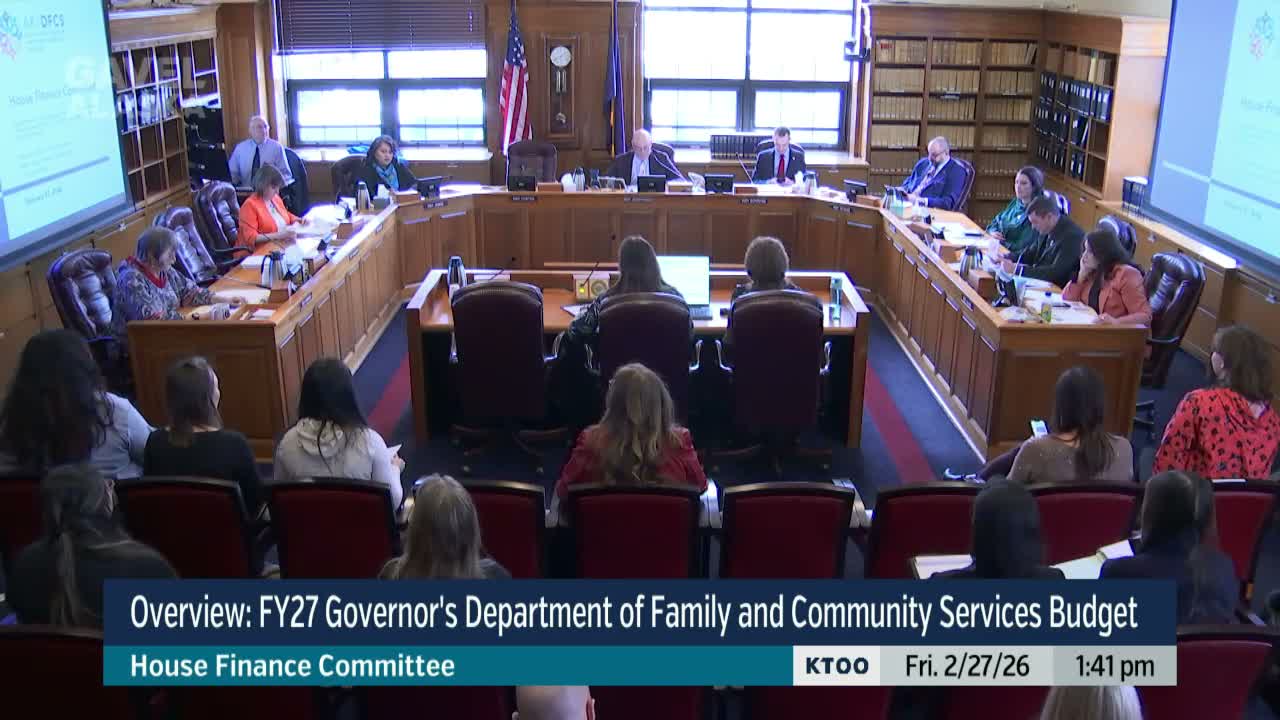
Acting Commissioner Tracy Dompling and Assistant Commissioner Marion Sweet presented the Department of Family and Community Services FY27 proposed governor's budget to the House Finance Committee on Feb. 27, describing program-level budgets, funding sources and technical adjustments.
"The Department of Family and Community Services has a total overall budget of $511,200,000," Marion Sweet said, detailing funding for four direct-service divisions (Pioneer Homes, Alaska Psychiatric Institute, Office of Children's Services, Division of Juvenile Justice), the commissioner's office and departmental support services.
Why it matters: The department's budget funds elder care, hospital psychiatric services, juvenile justice and child services statewide; small changes in restricted revenue classifications and receipt authority affect what the department may expend without reducing direct services.
Pioneer Homes: Sweet said the six-state Pioneer Homes have capacity for about 506 residents and a FY27 budget request of approximately $118 million, funded primarily by interagency receipts, Medicaid collections and the payment assistance program; Palmer has veteran designation allowing VA reimbursement discussions that the department is exploring further.
Alaska Psychiatric Institute (API): Sweet reported API has 80 licensed beds (60 civil, 10 youth, 10 forensic) with a proposed FY27 budget of about $66.9 million. The department noted a prior FY26 request of roughly $4.4 million was partially funded ($2.2M) and that revenue collection improvements and a contractor review have helped API's financial position. A $200,000 proposal to sustain and expand the SHARP program was not funded in FY26.
Division of Juvenile Justice: The DJJ proposed FY27 budget is roughly $73 million, supporting six facilities, 13 probation offices and about 421 full-time positions, with major funding in General Fund and match dollars for federal grants such as Title II and reentry programs.
Budget items and technical changes: The department described FY27 asks largely as receipt-authority adjustments and technical reclassifications including an IT classification study (interagency receipts increase of about $5.45M), adjustments to mental-health trust and SDPR authority, and reductions in uncollectible federal receipt authority where the department deemed the authority beyond expected collections.
Workforce and operations: Sweet and Dompling described recruitment and retention efforts: employee resilience committees, wellness officers, critical incident support, a talent-acquisition team, and use of retention bonuses and targeted hiring to mitigate turnover; they emphasized that many of these steps are intended to maintain services even where restricted revenue authority must be adjusted.
Ending: Sweet told the committee that more detailed follow-up data and slide attachments were available on five-year trends, adoption/subsidy materials and additional budget pages, and invited questions and subsequent review. The hearing then moved to a focused OCS audit discussion.
"The Department of Family and Community Services has a total overall budget of $511,200,000," Marion Sweet said, detailing funding for four direct-service divisions (Pioneer Homes, Alaska Psychiatric Institute, Office of Children's Services, Division of Juvenile Justice), the commissioner's office and departmental support services.
Why it matters: The department's budget funds elder care, hospital psychiatric services, juvenile justice and child services statewide; small changes in restricted revenue classifications and receipt authority affect what the department may expend without reducing direct services.
Pioneer Homes: Sweet said the six-state Pioneer Homes have capacity for about 506 residents and a FY27 budget request of approximately $118 million, funded primarily by interagency receipts, Medicaid collections and the payment assistance program; Palmer has veteran designation allowing VA reimbursement discussions that the department is exploring further.
Alaska Psychiatric Institute (API): Sweet reported API has 80 licensed beds (60 civil, 10 youth, 10 forensic) with a proposed FY27 budget of about $66.9 million. The department noted a prior FY26 request of roughly $4.4 million was partially funded ($2.2M) and that revenue collection improvements and a contractor review have helped API's financial position. A $200,000 proposal to sustain and expand the SHARP program was not funded in FY26.
Division of Juvenile Justice: The DJJ proposed FY27 budget is roughly $73 million, supporting six facilities, 13 probation offices and about 421 full-time positions, with major funding in General Fund and match dollars for federal grants such as Title II and reentry programs.
Budget items and technical changes: The department described FY27 asks largely as receipt-authority adjustments and technical reclassifications including an IT classification study (interagency receipts increase of about $5.45M), adjustments to mental-health trust and SDPR authority, and reductions in uncollectible federal receipt authority where the department deemed the authority beyond expected collections.
Workforce and operations: Sweet and Dompling described recruitment and retention efforts: employee resilience committees, wellness officers, critical incident support, a talent-acquisition team, and use of retention bonuses and targeted hiring to mitigate turnover; they emphasized that many of these steps are intended to maintain services even where restricted revenue authority must be adjusted.
Ending: Sweet told the committee that more detailed follow-up data and slide attachments were available on five-year trends, adoption/subsidy materials and additional budget pages, and invited questions and subsequent review. The hearing then moved to a focused OCS audit discussion.
Don't Miss a Word: See the Full Meeting!
Go beyond summaries. Unlock every video, transcript, and key insight with a Founder Membership.
✓
Get instant access to full meeting videos
✓
Search and clip any phrase from complete transcripts
✓
Receive AI-powered summaries & custom alerts
✓
Enjoy lifetime, unrestricted access to government data
30-day money-back guarantee
