Committee weighs bill to allow electronic signatures for totaled-vehicle title transfers
February 27, 2026 | 2026 Legislature Alaska, Alaska
This article was created by AI summarizing key points discussed. AI makes mistakes, so for full details and context, please refer to the video of the full meeting. Please report any errors so we can fix them. Report an error »
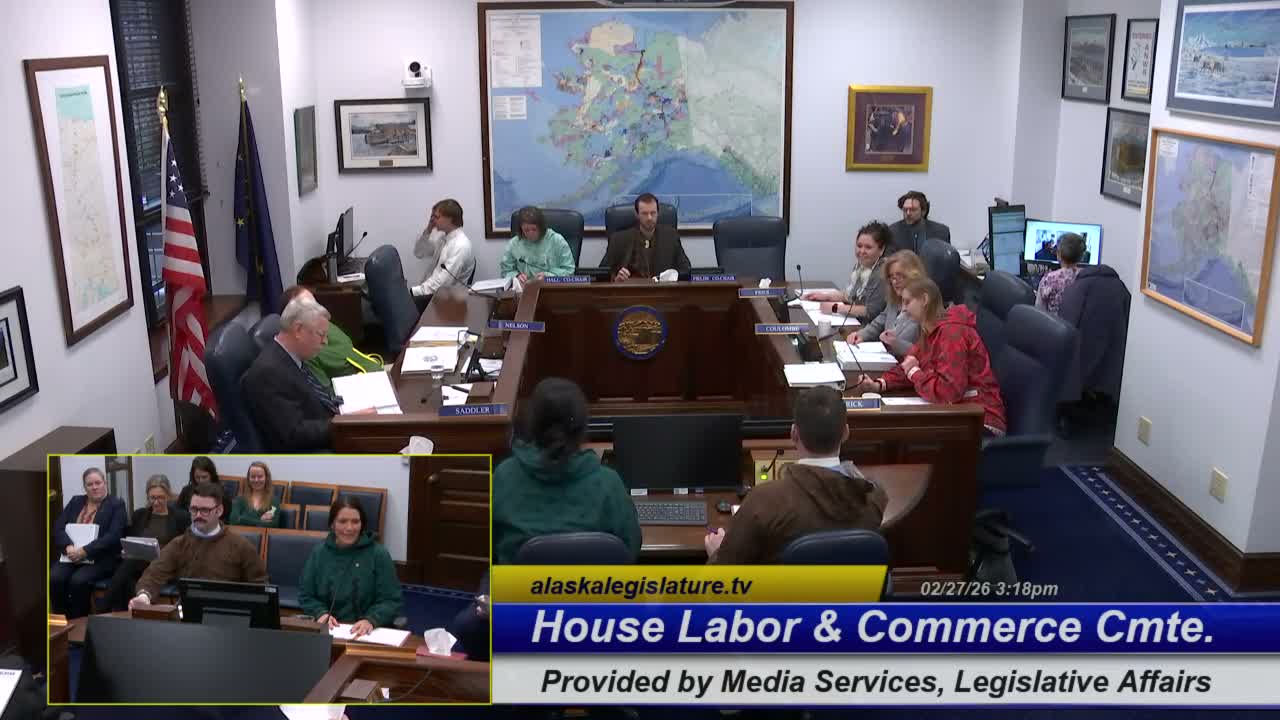
Representative Alexi Moore told the House Labor and Commerce Committee on Feb. 7 that HB249 is "pretty simple in its intent": to modernize statutes to allow an electronic signature, rather than a notary, for title transfers when an insurance company or salvage auction acquires a totaled vehicle. Moore asked her staff and an aide to walk members through the bill's sections.
Myo Harbison, staff to Representative Moore, summarized the change as adding a new section under AS 28.10 (recorded in the bill as adding a section numbered 285) that (a) permits title transfer to an insurance company using an electronic signature and (b) contains an indemnification clause holding the department harmless for claims within that section. "This indemnification section does only apply to this section," Harbison told the committee, citing a Legislative Legal memorandum included with the draft.
Mark Binder of Copart (the salvage auction operator invited to testify) said the bill aims to simplify a stressful, time-sensitive part of a total-loss claim so that settlement and signature can be completed in one phone call. Binder told the committee that electronic-title or electronic-signature practices are already in place in many states, sometimes by statute and sometimes by DMV regulation, and that a move away from a required notary would be especially valuable to rural Alaskans who lack ready access to notaries. On the scale of the problem, Binder said Copart handles what he estimated is roughly half of the state's salvage volume and offered a rough annual figure between about 3,500 and 5,000 total-loss claims processed in Alaska, noting he could provide a more exact number to the committee.
Committee members probed the origin and scope of the indemnification language. One lawmaker asked whether Legislative Legal or industry requested the clause; staff replied the clause was included in the bill text as submitted and that other states vary in whether they use similar language. Lawmakers asked staff to collect comparative examples of how other states handle indemnities and whether those clauses have produced claims.
Binder also clarified why a notary is typically involved: in many total-loss settlements the owner signs a limited power of attorney and an odometer statement, and those documents are currently required to be notarized under Alaska law. HB249 would not change what counts as a total loss, a committee member emphasized; it would only streamline the paperwork once a total-loss determination has been made.
The committee did not vote on HB249. Members said they would set an amendment deadline after receiving additional information about other states' practices on indemnity and promised to return to the bill. The committee opened public testimony on HB249, heard that no one present wished to testify and that no one online had signed up, and closed the public record before recessing to subcommittee.
Myo Harbison, staff to Representative Moore, summarized the change as adding a new section under AS 28.10 (recorded in the bill as adding a section numbered 285) that (a) permits title transfer to an insurance company using an electronic signature and (b) contains an indemnification clause holding the department harmless for claims within that section. "This indemnification section does only apply to this section," Harbison told the committee, citing a Legislative Legal memorandum included with the draft.
Mark Binder of Copart (the salvage auction operator invited to testify) said the bill aims to simplify a stressful, time-sensitive part of a total-loss claim so that settlement and signature can be completed in one phone call. Binder told the committee that electronic-title or electronic-signature practices are already in place in many states, sometimes by statute and sometimes by DMV regulation, and that a move away from a required notary would be especially valuable to rural Alaskans who lack ready access to notaries. On the scale of the problem, Binder said Copart handles what he estimated is roughly half of the state's salvage volume and offered a rough annual figure between about 3,500 and 5,000 total-loss claims processed in Alaska, noting he could provide a more exact number to the committee.
Committee members probed the origin and scope of the indemnification language. One lawmaker asked whether Legislative Legal or industry requested the clause; staff replied the clause was included in the bill text as submitted and that other states vary in whether they use similar language. Lawmakers asked staff to collect comparative examples of how other states handle indemnities and whether those clauses have produced claims.
Binder also clarified why a notary is typically involved: in many total-loss settlements the owner signs a limited power of attorney and an odometer statement, and those documents are currently required to be notarized under Alaska law. HB249 would not change what counts as a total loss, a committee member emphasized; it would only streamline the paperwork once a total-loss determination has been made.
The committee did not vote on HB249. Members said they would set an amendment deadline after receiving additional information about other states' practices on indemnity and promised to return to the bill. The committee opened public testimony on HB249, heard that no one present wished to testify and that no one online had signed up, and closed the public record before recessing to subcommittee.
Don't Miss a Word: See the Full Meeting!
Go beyond summaries. Unlock every video, transcript, and key insight with a Founder Membership.
✓
Get instant access to full meeting videos
✓
Search and clip any phrase from complete transcripts
✓
Receive AI-powered summaries & custom alerts
✓
Enjoy lifetime, unrestricted access to government data
30-day money-back guarantee
