Bill would let conflicted Board of Fisheries and Game members speak in deliberations but still bar them from voting
February 27, 2026 | 2026 Legislature Alaska, Alaska
This article was created by AI summarizing key points discussed. AI makes mistakes, so for full details and context, please refer to the video of the full meeting. Please report any errors so we can fix them. Report an error »
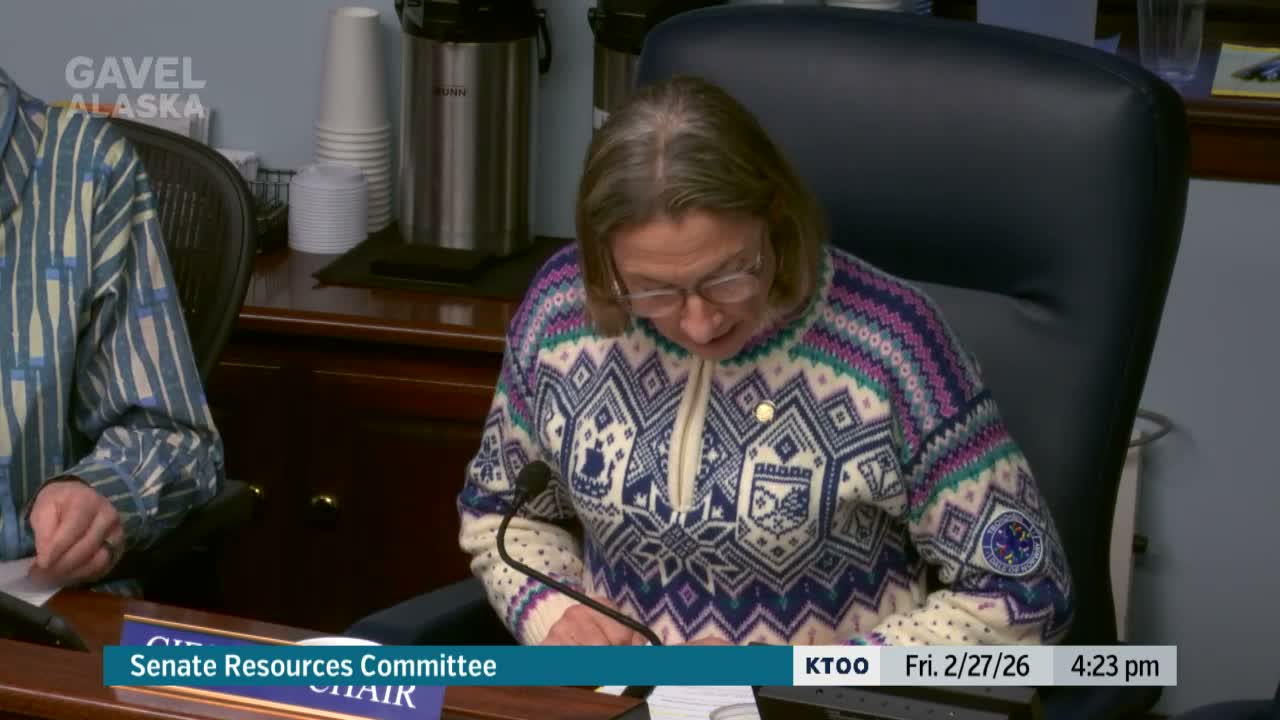
Representative Louise Stutes told the Senate Resources Committee on Feb. 27 that House Bill 33 is intended to let members of the Board of Fisheries and the Board of Game who have declared a personal or financial conflict remain at the deliberation table and impart their knowledge during final deliberations while still being prohibited from voting.
"This bill is about fairness for all user groups," Stutes said, explaining the change is intended to ensure expertise is available during deliberations and that conflicted members still would be barred from voting.
Matt Greening, staff to the House Fisheries Committee, detailed how current practice requires conflicted members to leave the table and sit with the public, which can silence experienced members whose knowledge is critical to nuanced proposals. Greening cited the Executive Branch Ethics Act (AS 39.52) and said a financial interest is considered significant at $5,000 or more; personal interests are broader and often harder to prove.
Committee members asked whether frequent recusals have previously led to loss of quorum; Art Nelson, executive director of the Board of Fisheries, said he is not aware of any time the board lost quorum because of recusals, but acknowledged situations where two members were conflicted on particular proposals, which can complicate decisions that require four affirmative votes.
Testimony from Kodiak stakeholders—Nate Rose (Kodiak Seniors Association) and Bruce Schachtler (commercial fisherman)—supported the bill, saying small coastal communities have a limited pool of qualified board members and that on‑the‑water expertise improves the quality of deliberations.
The committee set HB 33 aside for future deliberation (it was not noticed for public testimony that day) and set amendment and scheduling deadlines for related items; no final vote was taken at the Feb. 27 hearing.
"This bill is about fairness for all user groups," Stutes said, explaining the change is intended to ensure expertise is available during deliberations and that conflicted members still would be barred from voting.
Matt Greening, staff to the House Fisheries Committee, detailed how current practice requires conflicted members to leave the table and sit with the public, which can silence experienced members whose knowledge is critical to nuanced proposals. Greening cited the Executive Branch Ethics Act (AS 39.52) and said a financial interest is considered significant at $5,000 or more; personal interests are broader and often harder to prove.
Committee members asked whether frequent recusals have previously led to loss of quorum; Art Nelson, executive director of the Board of Fisheries, said he is not aware of any time the board lost quorum because of recusals, but acknowledged situations where two members were conflicted on particular proposals, which can complicate decisions that require four affirmative votes.
Testimony from Kodiak stakeholders—Nate Rose (Kodiak Seniors Association) and Bruce Schachtler (commercial fisherman)—supported the bill, saying small coastal communities have a limited pool of qualified board members and that on‑the‑water expertise improves the quality of deliberations.
The committee set HB 33 aside for future deliberation (it was not noticed for public testimony that day) and set amendment and scheduling deadlines for related items; no final vote was taken at the Feb. 27 hearing.
View the Full Meeting & All Its Details
This article offers just a summary. Unlock complete video, transcripts, and insights as a Founder Member.
✓
Watch full, unedited meeting videos
✓
Search every word spoken in unlimited transcripts
✓
AI summaries & real-time alerts (all government levels)
✓
Permanent access to expanding government content
30-day money-back guarantee
