State development corporation outlines 3D seismic plans for coastal-plain leases after court reinstatement
March 02, 2026 | 2026 Legislature Alaska, Alaska
This article was created by AI summarizing key points discussed. AI makes mistakes, so for full details and context, please refer to the video of the full meeting. Please report any errors so we can fix them. Report an error »
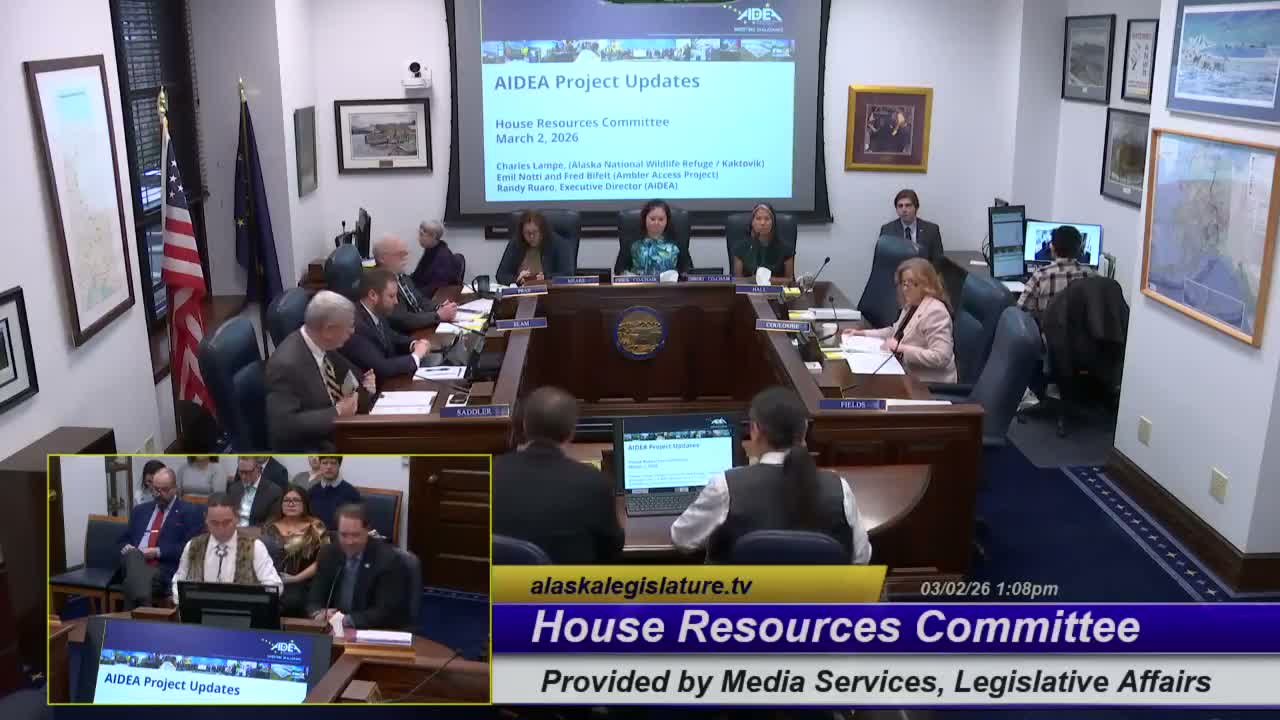
The Alaska Industrial Development and Export Authority said it will prepare permits and run a targeted 3D seismic program on its Anwar coastal‑plain leases and expects to complete acquisition and processing by the end of next winter, ADA executive director Randy Raro told the House Resources Committee on March 2, 2026. The work, Raro said, is meant to "prove up" reserves so ADA can seek private partners to develop the leases.
The plan follows a court decision reversing the cancellation of ADA's coastal‑plain leases; Raro told the committee that a federal district court judge restored the leases and ADA is moving forward with seismic and follow‑on work. "We have roughly 4 to 4 and a half billion barrels of recoverable oil and 7,000,000,000,000 cubic feet of recoverable gas on our leases," Raro said, describing consultant estimates that still require confirmation by 3D data.
Why it matters: ADA frames the seismic program as a preliminary, lower‑risk step that will allow the state corporation to demonstrate reservoir presence before inviting joint ventures. Committee members pressed ADA on whether the state intends to become a long‑term operator; Raro said ADA's role is to de‑risk and attract industry partners, not to become an oil‑producing company itself.
Key details: ADA said the original lease terms are 10 years but that the clock paused while litigation was pending; with litigation resolved the leases' effective term resumes and ADA estimates the leases would expire in 2035 absent production. ADA told the committee it will center 3D acquisition on the most prospective lots (identified in the presentation as Lots 27, 26 and 31). Raro said ADA expects processing to be rapid and possibly assisted by AI techniques.
Potential returns and fiscal context: Citing federal work (the 2024 environmental impact statement), ADA presented annual state revenue scenarios in the millions to billions of dollars, including roughly $2 billion a year in taxes and royalties under some development scenarios. Raro said ADA would negotiate a share of production or proceeds with a development partner; statutory dividend rules could send 25% to 50% of some ADA receipts to the Permanent Fund, and other royalties and taxes would flow to the state treasury.
Community testimony and stewardship: Charles Lampy, who identified himself as president of Coctovik Anipad Corporation and a tribal member, told the committee his community supports engagement with ADA but insisted operations include local subsistence representatives, cultural‑resource experts and wildlife protections. Lampy pushed back on what he called misinformation about winter seismic, saying satellite overlays show winter lines that fade by late summer and arguing that careful planning and local participation can limit subsistence impacts.
Limits and next steps: ADA told lawmakers it already has statutory authority to enter contracts and joint ventures but said additional legislative action could be required for major bonding or capital requests. The committee was offered a public version of ADA's technical report; ADA said it will pursue permits, complete 3D acquisition and then seek partnerships based on the seismic results. The committee did not take a vote on any proposal.
The plan follows a court decision reversing the cancellation of ADA's coastal‑plain leases; Raro told the committee that a federal district court judge restored the leases and ADA is moving forward with seismic and follow‑on work. "We have roughly 4 to 4 and a half billion barrels of recoverable oil and 7,000,000,000,000 cubic feet of recoverable gas on our leases," Raro said, describing consultant estimates that still require confirmation by 3D data.
Why it matters: ADA frames the seismic program as a preliminary, lower‑risk step that will allow the state corporation to demonstrate reservoir presence before inviting joint ventures. Committee members pressed ADA on whether the state intends to become a long‑term operator; Raro said ADA's role is to de‑risk and attract industry partners, not to become an oil‑producing company itself.
Key details: ADA said the original lease terms are 10 years but that the clock paused while litigation was pending; with litigation resolved the leases' effective term resumes and ADA estimates the leases would expire in 2035 absent production. ADA told the committee it will center 3D acquisition on the most prospective lots (identified in the presentation as Lots 27, 26 and 31). Raro said ADA expects processing to be rapid and possibly assisted by AI techniques.
Potential returns and fiscal context: Citing federal work (the 2024 environmental impact statement), ADA presented annual state revenue scenarios in the millions to billions of dollars, including roughly $2 billion a year in taxes and royalties under some development scenarios. Raro said ADA would negotiate a share of production or proceeds with a development partner; statutory dividend rules could send 25% to 50% of some ADA receipts to the Permanent Fund, and other royalties and taxes would flow to the state treasury.
Community testimony and stewardship: Charles Lampy, who identified himself as president of Coctovik Anipad Corporation and a tribal member, told the committee his community supports engagement with ADA but insisted operations include local subsistence representatives, cultural‑resource experts and wildlife protections. Lampy pushed back on what he called misinformation about winter seismic, saying satellite overlays show winter lines that fade by late summer and arguing that careful planning and local participation can limit subsistence impacts.
Limits and next steps: ADA told lawmakers it already has statutory authority to enter contracts and joint ventures but said additional legislative action could be required for major bonding or capital requests. The committee was offered a public version of ADA's technical report; ADA said it will pursue permits, complete 3D acquisition and then seek partnerships based on the seismic results. The committee did not take a vote on any proposal.
View the Full Meeting & All Its Details
This article offers just a summary. Unlock complete video, transcripts, and insights as a Founder Member.
✓
Watch full, unedited meeting videos
✓
Search every word spoken in unlimited transcripts
✓
AI summaries & real-time alerts (all government levels)
✓
Permanent access to expanding government content
30-day money-back guarantee
