Officials explain Alaska disaster‑declaration process, FEMA cost shares and one‑time federal appeal
March 02, 2026 | 2026 Legislature Alaska, Alaska
This article was created by AI summarizing key points discussed. AI makes mistakes, so for full details and context, please refer to the video of the full meeting. Please report any errors so we can fix them. Report an error »
Juneau — In a technical briefing to the House Finance Committee on March 2, Department of Military and Veterans Affairs officials walked lawmakers through Alaska's disaster‑declaration authorities, state assistance programs and the federal appeal process under the Stafford Act.
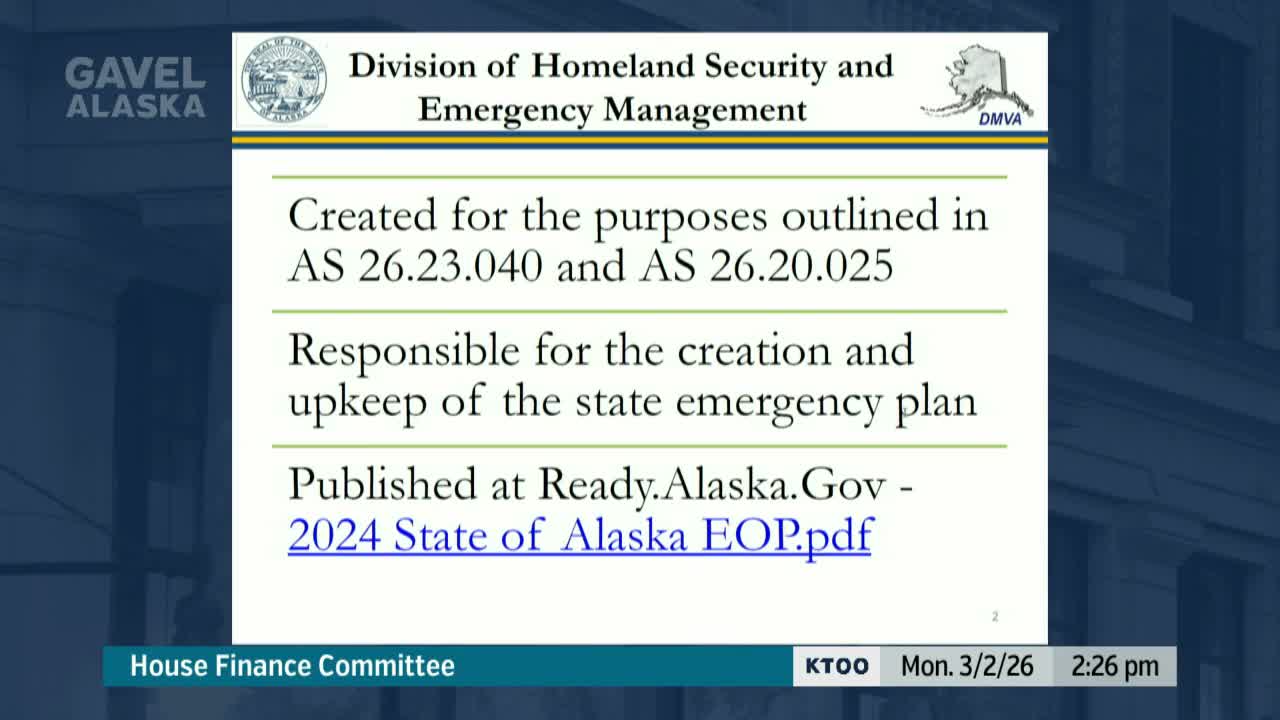
Angela LaFlamme, DMVA legislative liaison, summarized relevant state law and the State Emergency Operations Plan, saying DHSEM coordinates the state's emergency operations and mirrors federal frameworks "so that this process can be as smooth as possible" for federal reimbursement. She told the committee the state plan follows the National Incident Management System and other national frameworks used by FEMA.
LaFlamme described the usual federal cost share for a declared disaster: "The minimum amount that FEMA would respond with is a 75 25 split," she said, and noted thresholds or special waivers can increase the federal share. Director Brian Fisher clarified the appeals path: "There is a 1 time appeal for that non federal share," referencing the governor's request and a subsequent federal decision under the Stafford Act.
The witnesses explained the sequence: local incident assessment, state disaster declaration (which authorizes limited state spending and access to the disaster relief fund), a joint preliminary damage assessment with FEMA, and then a governor's request for a federal declaration within 30 days. LaFlamme also described authorities the governor may use during a state declaration (30‑day limit, suspension of some permitting and fee requirements) and the financing‑plan process the legislature uses if expenditures will exceed statutory thresholds.
Committee members asked about the state's statutory caps for assistance. Fisher said the state statute currently limits the state program to no more than half of FEMA's maximum individual assistance amount, and noted the state program amount adjusts with FEMA's federal maximum each year. He described the federal 'permanent housing construction' authority (Section 528) as a tool FEMA may invoke to rebuild destroyed homes, and said DMVA has requested FEMA consider invoking that authority for Halong.
Lawmakers asked for timelines and clarity on appeals; Fisher said the governor had 30 days to file the appeal but the federal side has no statutory timeline and that the agency will pursue discussions in Washington as needed. The committee requested written citations and program details to accompany future briefings.
Angela LaFlamme, DMVA legislative liaison, summarized relevant state law and the State Emergency Operations Plan, saying DHSEM coordinates the state's emergency operations and mirrors federal frameworks "so that this process can be as smooth as possible" for federal reimbursement. She told the committee the state plan follows the National Incident Management System and other national frameworks used by FEMA.
LaFlamme described the usual federal cost share for a declared disaster: "The minimum amount that FEMA would respond with is a 75 25 split," she said, and noted thresholds or special waivers can increase the federal share. Director Brian Fisher clarified the appeals path: "There is a 1 time appeal for that non federal share," referencing the governor's request and a subsequent federal decision under the Stafford Act.
The witnesses explained the sequence: local incident assessment, state disaster declaration (which authorizes limited state spending and access to the disaster relief fund), a joint preliminary damage assessment with FEMA, and then a governor's request for a federal declaration within 30 days. LaFlamme also described authorities the governor may use during a state declaration (30‑day limit, suspension of some permitting and fee requirements) and the financing‑plan process the legislature uses if expenditures will exceed statutory thresholds.
Committee members asked about the state's statutory caps for assistance. Fisher said the state statute currently limits the state program to no more than half of FEMA's maximum individual assistance amount, and noted the state program amount adjusts with FEMA's federal maximum each year. He described the federal 'permanent housing construction' authority (Section 528) as a tool FEMA may invoke to rebuild destroyed homes, and said DMVA has requested FEMA consider invoking that authority for Halong.
Lawmakers asked for timelines and clarity on appeals; Fisher said the governor had 30 days to file the appeal but the federal side has no statutory timeline and that the agency will pursue discussions in Washington as needed. The committee requested written citations and program details to accompany future briefings.
View the Full Meeting & All Its Details
This article offers just a summary. Unlock complete video, transcripts, and insights as a Founder Member.
✓
Watch full, unedited meeting videos
✓
Search every word spoken in unlimited transcripts
✓
AI summaries & real-time alerts (all government levels)
✓
Permanent access to expanding government content
30-day money-back guarantee
