ADA officials outline bonding limits, project plans and financing models for Ambler and ANWR leases
March 02, 2026 | 2026 Legislature Alaska, Alaska
This article was created by AI summarizing key points discussed. AI makes mistakes, so for full details and context, please refer to the video of the full meeting. Please report any errors so we can fix them. Report an error »
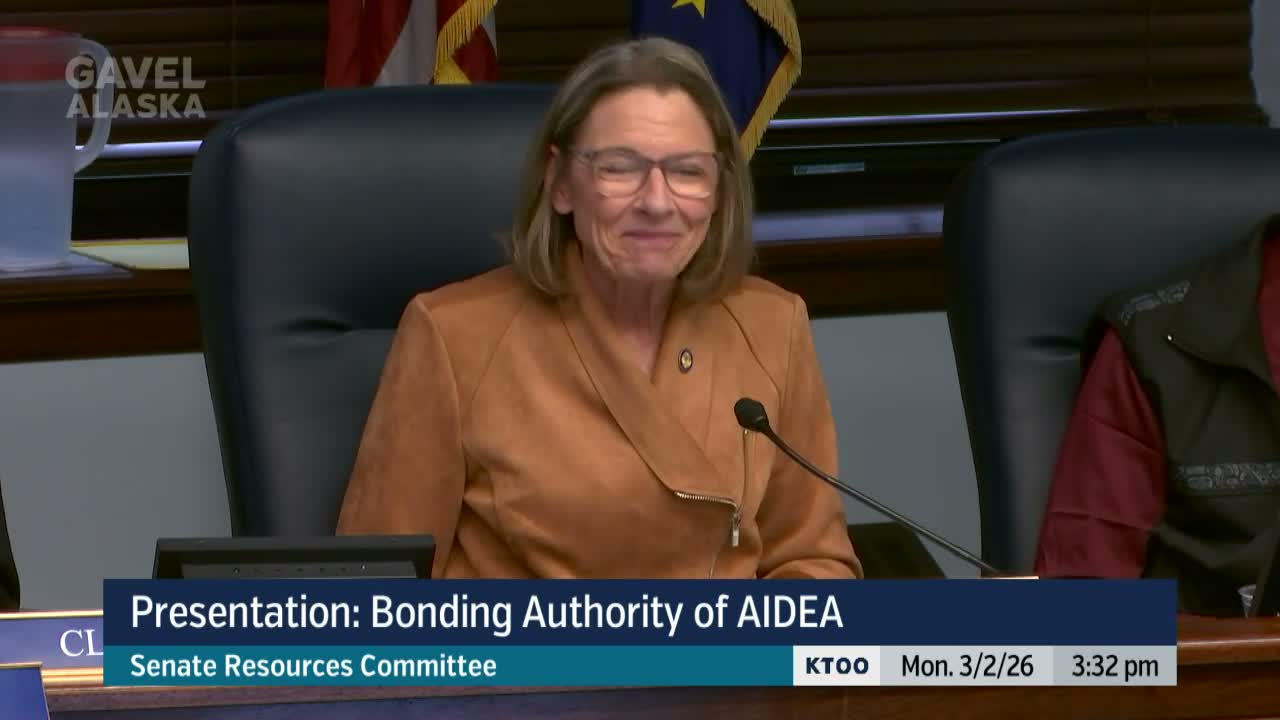
Senator Giesel convened the Senate Resources Committee and heard a detailed presentation from the Alaska Industrial Development and Export Authority on the legal and practical limits of ADA’s bond authority, ADA’s recent finances, and plans for several large projects.
Randy Ruro, who identified himself as ADA’s executive director, told the committee that Alaska’s Constitution (art. IX, §11) and state statutes create a targeted exception for public corporations that allows ADA to issue revenue bonds whose only source of repayment is the authority’s receipts. He said ADA bonds are issued by board resolution, are negotiable instruments, and are separated in statute from state debt so that ADA obligations do not become state obligations.
Ruro summarized statutory caps that restrict ADA bond issuance: ADA may not issue bonds in a 12‑month period exceeding $400,000,000, and some fund-specific programs (for example, the economic development account) carry lower limits (a $25,000,000 cap was cited). He said capital reserve requirements commonly produce a reserve fund on the order of one‑third of the bond issuance amount and noted that the board must follow statutory dividend brackets when setting distributions to the state.
The presentation included FY2025 financial figures Ruro described as "roughly gross revenue of over $100,000,000" and "statutory net income of 67,400,000." He said ADA will provide $17,000,000 in an aid dividend plus $6,500,000 in revenue sharing from ANWR/Anwar leases (a $23,500,000 total contribution to the state budget this year). Ruro framed those figures against large prospective projects—he cited the possibility that successful ANWR/Anwar development could return roughly $2,000,000,000 a year in combined royalties and taxes—saying the board factored prospective mega‑projects into dividend decisions.
Committee members pressed ADA on project history and accountability. Senator Sandra Wilikowski cited a critical report (attributed in the hearing to Milt Barker and Greg Erickson) alleging that nearly half of ADA participations in a recent period produced no permanent jobs; Ruro disputed those specific numbers, said Northern Economics produced a rebuttal with different figures, and offered to provide the committee with underlying drafts and correspondence to clarify the record. "I can provide…what we believe are the accurate numbers to you and the committee," Ruro said.
On large infrastructure projects, Ruro described two financing approaches for the Ambler Access Road: a Red Dog model in which mining companies commit to back bonds, or participation under the U.S. Department of Energy Section 1703 model where ADA could contribute about 5% equity, private parties 15% and the federal government provide an 80% loan. He said geotechnical work was planned for the year, with construction possibly beginning next year and a roughly 2–3 year construction window (placing completion roughly 4–5 years out if timelines hold).
Ruro also discussed ADA’s acquisition of some Arctic leases and preliminary resource estimates ADA prepared: he said ADA’s public preliminary report estimated about 4,000,000,000 barrels of recoverable oil on ADA leases and roughly 7,000,000,000,000 cubic feet of gas, and that 3‑D seismic work was planned to confirm resource estimates before seeking a development partner.
Committee members asked about governance: Ruro said ADA’s seven‑member board includes two executive‑branch commissioner seats (commerce and revenue) and five public members appointed by the governor through Boards & Commissions who are not subject to legislative confirmation; Ruro said he believes the governor has removal authority and that statutory limits on board autonomy exist (for example, the Executive Budget Act applies in certain respects).
Other items covered: ADA’s Loan Participation Program (Ruro said it has financed over 800 Alaska businesses and can participate up to 75% in loans), ADA’s involvement in litigation and amicus briefs (including filings related to Pebble Mine), and smaller projects such as Cordova equipment financing for a Greenspark hydro project and exploratory geothermal and data center efforts.
Ruro repeatedly offered to provide the committee written follow‑ups, including detailed rebuttal figures to the critical report and drafts of exchanges with Northern Economics. The presentation closed with members thanking the ADA speakers and moving on to the next agenda item.
The committee did not take formal votes on ADA policy during this meeting; members requested follow‑up documentation and clarity on several statistics and past project histories.
Randy Ruro, who identified himself as ADA’s executive director, told the committee that Alaska’s Constitution (art. IX, §11) and state statutes create a targeted exception for public corporations that allows ADA to issue revenue bonds whose only source of repayment is the authority’s receipts. He said ADA bonds are issued by board resolution, are negotiable instruments, and are separated in statute from state debt so that ADA obligations do not become state obligations.
Ruro summarized statutory caps that restrict ADA bond issuance: ADA may not issue bonds in a 12‑month period exceeding $400,000,000, and some fund-specific programs (for example, the economic development account) carry lower limits (a $25,000,000 cap was cited). He said capital reserve requirements commonly produce a reserve fund on the order of one‑third of the bond issuance amount and noted that the board must follow statutory dividend brackets when setting distributions to the state.
The presentation included FY2025 financial figures Ruro described as "roughly gross revenue of over $100,000,000" and "statutory net income of 67,400,000." He said ADA will provide $17,000,000 in an aid dividend plus $6,500,000 in revenue sharing from ANWR/Anwar leases (a $23,500,000 total contribution to the state budget this year). Ruro framed those figures against large prospective projects—he cited the possibility that successful ANWR/Anwar development could return roughly $2,000,000,000 a year in combined royalties and taxes—saying the board factored prospective mega‑projects into dividend decisions.
Committee members pressed ADA on project history and accountability. Senator Sandra Wilikowski cited a critical report (attributed in the hearing to Milt Barker and Greg Erickson) alleging that nearly half of ADA participations in a recent period produced no permanent jobs; Ruro disputed those specific numbers, said Northern Economics produced a rebuttal with different figures, and offered to provide the committee with underlying drafts and correspondence to clarify the record. "I can provide…what we believe are the accurate numbers to you and the committee," Ruro said.
On large infrastructure projects, Ruro described two financing approaches for the Ambler Access Road: a Red Dog model in which mining companies commit to back bonds, or participation under the U.S. Department of Energy Section 1703 model where ADA could contribute about 5% equity, private parties 15% and the federal government provide an 80% loan. He said geotechnical work was planned for the year, with construction possibly beginning next year and a roughly 2–3 year construction window (placing completion roughly 4–5 years out if timelines hold).
Ruro also discussed ADA’s acquisition of some Arctic leases and preliminary resource estimates ADA prepared: he said ADA’s public preliminary report estimated about 4,000,000,000 barrels of recoverable oil on ADA leases and roughly 7,000,000,000,000 cubic feet of gas, and that 3‑D seismic work was planned to confirm resource estimates before seeking a development partner.
Committee members asked about governance: Ruro said ADA’s seven‑member board includes two executive‑branch commissioner seats (commerce and revenue) and five public members appointed by the governor through Boards & Commissions who are not subject to legislative confirmation; Ruro said he believes the governor has removal authority and that statutory limits on board autonomy exist (for example, the Executive Budget Act applies in certain respects).
Other items covered: ADA’s Loan Participation Program (Ruro said it has financed over 800 Alaska businesses and can participate up to 75% in loans), ADA’s involvement in litigation and amicus briefs (including filings related to Pebble Mine), and smaller projects such as Cordova equipment financing for a Greenspark hydro project and exploratory geothermal and data center efforts.
Ruro repeatedly offered to provide the committee written follow‑ups, including detailed rebuttal figures to the critical report and drafts of exchanges with Northern Economics. The presentation closed with members thanking the ADA speakers and moving on to the next agenda item.
The committee did not take formal votes on ADA policy during this meeting; members requested follow‑up documentation and clarity on several statistics and past project histories.
View the Full Meeting & All Its Details
This article offers just a summary. Unlock complete video, transcripts, and insights as a Founder Member.
✓
Watch full, unedited meeting videos
✓
Search every word spoken in unlimited transcripts
✓
AI summaries & real-time alerts (all government levels)
✓
Permanent access to expanding government content
30-day money-back guarantee
