Neighbors urge denial as Bloomington board grants limited variances for 2511 North Dunn 'North Grove' subdivision
February 27, 2026 | Bloomington City, Monroe County, Indiana
This article was created by AI summarizing key points discussed. AI makes mistakes, so for full details and context, please refer to the video of the full meeting. Please report any errors so we can fix them. Report an error »
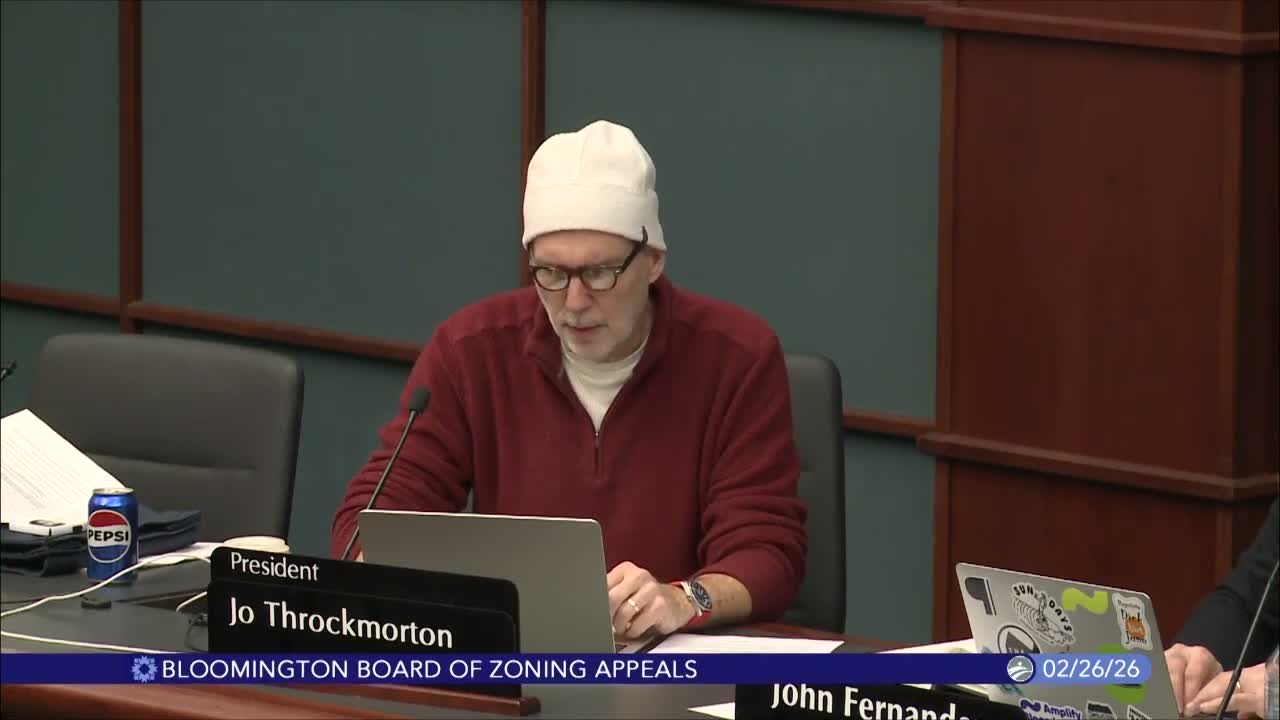
The Bloomington Board of Zoning Appeals voted Feb. 26 to adopt staff findings on the North Grove subdivision, approving variances tied to tree protection fencing and riparian‑buffer disturbance activities while denying requested reductions to minimum lot area, lot width and side‑building setbacks.
Jamie Kranle, the city’s senior zoning planner, told the board the petition for 15 single‑family lots on a four‑acre R‑2 site requests seven variances. Staff recommended approval of variances related to tree‑canopy preservation, tree‑protection fencing and disturbance activity in riparian intermediate and fringe zones — subject to conditions including a tree remediation plan, additional plantings and final acceptance by City of Bloomington Utilities — because findings showed practical difficulties tied to topography, a 75‑foot riparian buffer and existing canopy cover. Staff recommended denial of variances for minimum lot area, lot width and side setbacks because the Unified Development Ordinance (UDO) contains a by‑right sustainable‑development path that could achieve similar outcomes with higher third‑party sustainability certifications.
Petitioner Paul Pruitt said the project’s required public improvements — an 8‑inch water line, extension of a road and sidewalks totalling roughly $300,000 — make the economics work only if 15 lots are permitted. “We purchased the property in September ’22 … the additional work with the street, sidewalk and water line add approximately $300,000 to the cost of this project,” Pruitt told the board.
Neighbors and conservation advocates urged denial. Julia Livingston, a nearby resident, described the site as an “urban forest” planted by a former owner and said the proposal would remove more than 100 mature trees and damage wildlife habitat. “This proposal would cut down 103 trees, mature trees, and destroy the diverse ecology of that land,” Livingston said. Others cited public‑safety and infrastructure concerns — including the potential for increased stormwater runoff and a neighborhood road without a turnaround for emergency vehicles — and questioned whether replacement plantings can restore mature canopy.
Several speakers, including a planning‑commission representative participating online, urged the board to consider sustainability tradeoffs: staff and some commissioners pointed to UDO incentives that would produce more sustainable homes if the petitioner pursued the by‑right path; commissioners and neighbors debated whether the incremental four houses (11 versus 15) are materially injurious to public welfare.
After deliberation, one commissioner moved to adopt staff findings: approve the variances for tree canopy preservation exceptions, tree protection fencing and riparian disturbance (with the eight staff conditions), and deny the variances for minimum lot area, lot width and side building setback. The board recorded votes of Ballard — Yes; Burrell — Yes; Fernandez — Yes; Throckmorton — Yes.
The board’s action leaves the petitioner able to proceed under the staff‑approved conditions for the environmental‑related variances; the denied bulk variances mean the project cannot rely on the requested reductions in lot area, width and setbacks. The petitioner may pursue further remedies available under local rules (e.g., redesign under the UDO sustainable‑development path or other approvals). The board announced the signature for an earlier litigation settlement would be applied at the meeting for a separate old‑business item discussed earlier.
The board adjourned the North Grove hearing and moved on to other agenda items, including several conditional‑use and variance petitions.
Jamie Kranle, the city’s senior zoning planner, told the board the petition for 15 single‑family lots on a four‑acre R‑2 site requests seven variances. Staff recommended approval of variances related to tree‑canopy preservation, tree‑protection fencing and disturbance activity in riparian intermediate and fringe zones — subject to conditions including a tree remediation plan, additional plantings and final acceptance by City of Bloomington Utilities — because findings showed practical difficulties tied to topography, a 75‑foot riparian buffer and existing canopy cover. Staff recommended denial of variances for minimum lot area, lot width and side setbacks because the Unified Development Ordinance (UDO) contains a by‑right sustainable‑development path that could achieve similar outcomes with higher third‑party sustainability certifications.
Petitioner Paul Pruitt said the project’s required public improvements — an 8‑inch water line, extension of a road and sidewalks totalling roughly $300,000 — make the economics work only if 15 lots are permitted. “We purchased the property in September ’22 … the additional work with the street, sidewalk and water line add approximately $300,000 to the cost of this project,” Pruitt told the board.
Neighbors and conservation advocates urged denial. Julia Livingston, a nearby resident, described the site as an “urban forest” planted by a former owner and said the proposal would remove more than 100 mature trees and damage wildlife habitat. “This proposal would cut down 103 trees, mature trees, and destroy the diverse ecology of that land,” Livingston said. Others cited public‑safety and infrastructure concerns — including the potential for increased stormwater runoff and a neighborhood road without a turnaround for emergency vehicles — and questioned whether replacement plantings can restore mature canopy.
Several speakers, including a planning‑commission representative participating online, urged the board to consider sustainability tradeoffs: staff and some commissioners pointed to UDO incentives that would produce more sustainable homes if the petitioner pursued the by‑right path; commissioners and neighbors debated whether the incremental four houses (11 versus 15) are materially injurious to public welfare.
After deliberation, one commissioner moved to adopt staff findings: approve the variances for tree canopy preservation exceptions, tree protection fencing and riparian disturbance (with the eight staff conditions), and deny the variances for minimum lot area, lot width and side building setback. The board recorded votes of Ballard — Yes; Burrell — Yes; Fernandez — Yes; Throckmorton — Yes.
The board’s action leaves the petitioner able to proceed under the staff‑approved conditions for the environmental‑related variances; the denied bulk variances mean the project cannot rely on the requested reductions in lot area, width and setbacks. The petitioner may pursue further remedies available under local rules (e.g., redesign under the UDO sustainable‑development path or other approvals). The board announced the signature for an earlier litigation settlement would be applied at the meeting for a separate old‑business item discussed earlier.
The board adjourned the North Grove hearing and moved on to other agenda items, including several conditional‑use and variance petitions.
View the Full Meeting & All Its Details
This article offers just a summary. Unlock complete video, transcripts, and insights as a Founder Member.
✓
Watch full, unedited meeting videos
✓
Search every word spoken in unlimited transcripts
✓
AI summaries & real-time alerts (all government levels)
✓
Permanent access to expanding government content
30-day money-back guarantee
