Colleton board weighs moving sixth grade to elementary schools as enrollment drops and $2.1M hole looms
March 03, 2026 | Colleton 01, School Districts, South Carolina
This article was created by AI summarizing key points discussed. AI makes mistakes, so for full details and context, please refer to the video of the full meeting. Please report any errors so we can fix them. Report an error »
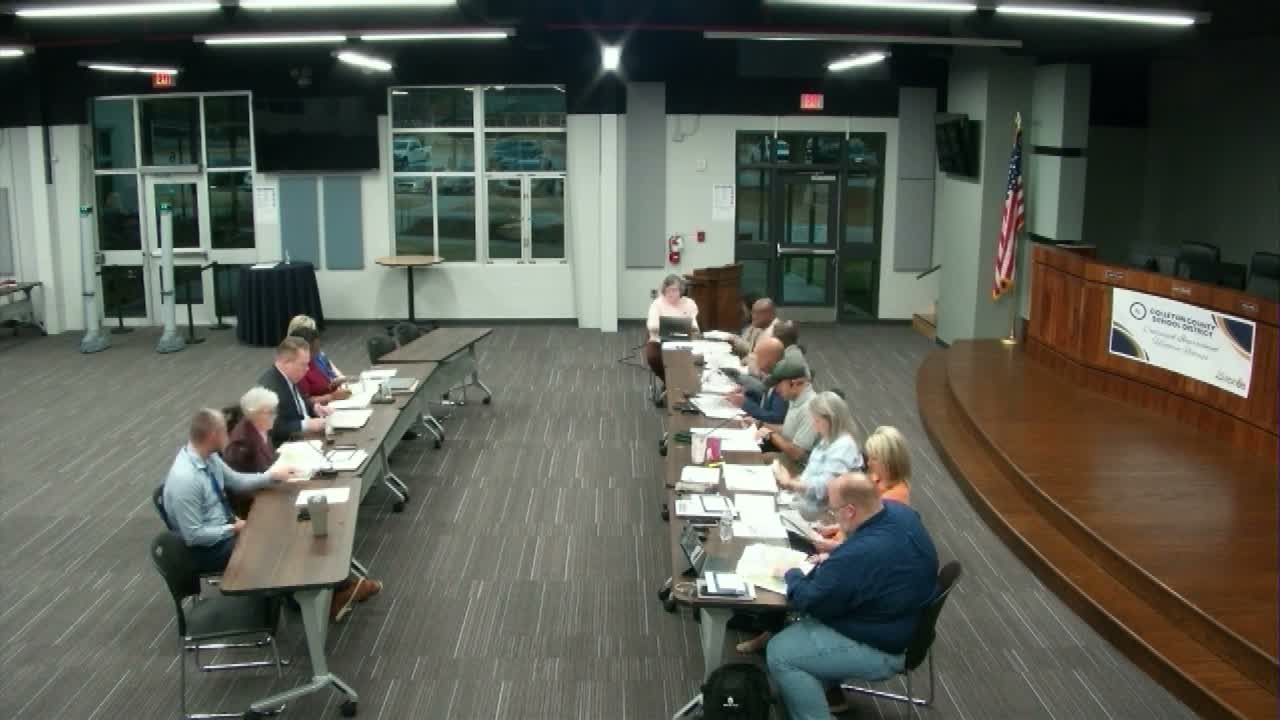
At a special‑call Colleton County School District meeting, trustees reviewed administration data on declining enrollment and debated a recommendation to return sixth‑grade students to elementary schools districtwide as one way to address an estimated $2.1 million budget shortfall.
Superintendent Susan Bennett Williams told the board the administration had prepared a packet with a Q&A, presentation slides and town‑hall survey results and that the recommendation from district leadership was to move sixth grade into elementary schools. "The recommendation coming to you this evening, from the district leadership, is to move sixth grade to the elementary schools district wide," she said.
District consultant Dr. Bagley presented longitudinal and cross‑sectional analyses drawn from PowerSchool and state Department of Education extractions, showing substantial cohort and headcount losses across several years. She summarized multiple cohort losses (examples included a cohort loss of 71 students in one span and a longitudinal ADM net loss of roughly 118 units) and reported that Collinson Middle School enrollment declined from 1,291 in 2020–21 to about 896 in 2024–25 on the cited count day. "When you track this you see...there is a loss of students throughout," Dr. Bagley said, explaining that ADM (average daily membership) uses weighted units that drive funding.
Trustees pressed operational questions about classroom configuration and schedules if sixth graders were returned to elementary campuses. The administration explained schools could adopt different instructional models — self‑contained classrooms or departmentalized schedules — and that principals typically decide configuration based on local data. A trustee asked, "So if we send sixth graders back to the elementary schools...how is that gonna work for those [schools with] only two classes?" The administration replied that staffing and scheduling options exist but that configurations would not be uniform across all campuses.
Budget pressures framed the board discussion. Trustees cited an approximate $2.1 million deficit; the superintendent said attrition previously yielded about $1.7 million in savings and identified closure of Black Street Early Childhood Center as an option that could save "about 500 and some odd thousand dollars," while also noting staff impacts and community opposition. Several trustees emphasized Black Street's long community history and warned that selling the building could prompt local unrest.
The board debated multiple motions. Trustee Strobel moved to accept the administration's recommendation to move sixth grade back to elementary schools while continuing to study in‑town capacity; after discussion that motion was rescinded by its maker on procedural grounds. Trustee Murdoch later moved that the superintendent be allowed to place sixth graders into elementary schools (keeping the middle school for seventh and eighth grades); that motion was seconded but "did not carry," according to the meeting record. A subsequent motion to keep the district configuration unchanged for the next school year also failed (the clerk recorded three in favor; the motion did not pass). No binding, districtwide decision to reconfigure was adopted at the meeting.
Trustees asked the administration to return with more detailed capacity, food‑service and transportation analyses; the superintendent estimated those stakeholder meetings and follow‑up work could take at least a month. The meeting closed without a final vote on restructuring; a motion to adjourn passed and the board ended the special‑call session.
What happens next: Trustees instructed administration to continue exploration and return with clearer capacity studies and stakeholder feedback; no timetable for a final decision was adopted during the meeting.
Superintendent Susan Bennett Williams told the board the administration had prepared a packet with a Q&A, presentation slides and town‑hall survey results and that the recommendation from district leadership was to move sixth grade into elementary schools. "The recommendation coming to you this evening, from the district leadership, is to move sixth grade to the elementary schools district wide," she said.
District consultant Dr. Bagley presented longitudinal and cross‑sectional analyses drawn from PowerSchool and state Department of Education extractions, showing substantial cohort and headcount losses across several years. She summarized multiple cohort losses (examples included a cohort loss of 71 students in one span and a longitudinal ADM net loss of roughly 118 units) and reported that Collinson Middle School enrollment declined from 1,291 in 2020–21 to about 896 in 2024–25 on the cited count day. "When you track this you see...there is a loss of students throughout," Dr. Bagley said, explaining that ADM (average daily membership) uses weighted units that drive funding.
Trustees pressed operational questions about classroom configuration and schedules if sixth graders were returned to elementary campuses. The administration explained schools could adopt different instructional models — self‑contained classrooms or departmentalized schedules — and that principals typically decide configuration based on local data. A trustee asked, "So if we send sixth graders back to the elementary schools...how is that gonna work for those [schools with] only two classes?" The administration replied that staffing and scheduling options exist but that configurations would not be uniform across all campuses.
Budget pressures framed the board discussion. Trustees cited an approximate $2.1 million deficit; the superintendent said attrition previously yielded about $1.7 million in savings and identified closure of Black Street Early Childhood Center as an option that could save "about 500 and some odd thousand dollars," while also noting staff impacts and community opposition. Several trustees emphasized Black Street's long community history and warned that selling the building could prompt local unrest.
The board debated multiple motions. Trustee Strobel moved to accept the administration's recommendation to move sixth grade back to elementary schools while continuing to study in‑town capacity; after discussion that motion was rescinded by its maker on procedural grounds. Trustee Murdoch later moved that the superintendent be allowed to place sixth graders into elementary schools (keeping the middle school for seventh and eighth grades); that motion was seconded but "did not carry," according to the meeting record. A subsequent motion to keep the district configuration unchanged for the next school year also failed (the clerk recorded three in favor; the motion did not pass). No binding, districtwide decision to reconfigure was adopted at the meeting.
Trustees asked the administration to return with more detailed capacity, food‑service and transportation analyses; the superintendent estimated those stakeholder meetings and follow‑up work could take at least a month. The meeting closed without a final vote on restructuring; a motion to adjourn passed and the board ended the special‑call session.
What happens next: Trustees instructed administration to continue exploration and return with clearer capacity studies and stakeholder feedback; no timetable for a final decision was adopted during the meeting.
View the Full Meeting & All Its Details
This article offers just a summary. Unlock complete video, transcripts, and insights as a Founder Member.
✓
Watch full, unedited meeting videos
✓
Search every word spoken in unlimited transcripts
✓
AI summaries & real-time alerts (all government levels)
✓
Permanent access to expanding government content
30-day money-back guarantee
