Bear Valley Unified staff report widened 2025–26 deficit, urge attrition-based cuts if one-time state funds don’t appear
March 03, 2026 | Bear Valley Unified, School Districts, California
This article was created by AI summarizing key points discussed. AI makes mistakes, so for full details and context, please refer to the video of the full meeting. Please report any errors so we can fix them. Report an error »
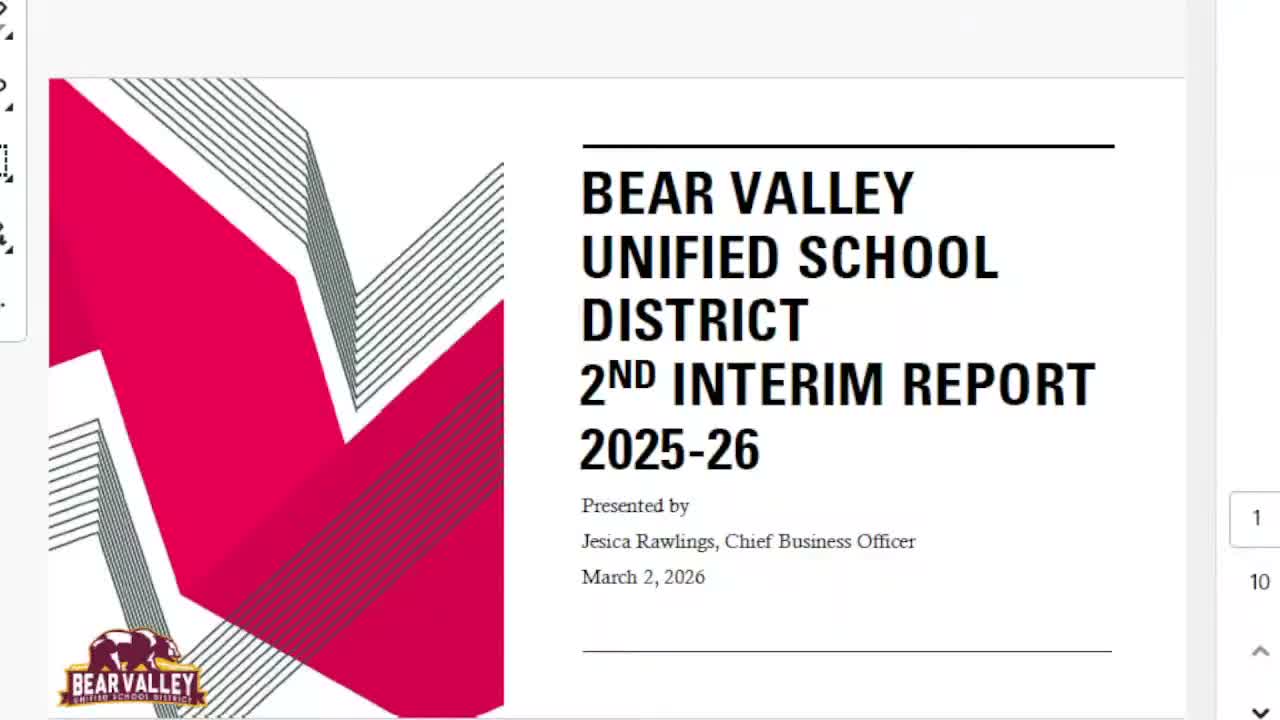
Bear Valley Unified School District officials presented their second interim financial report and warned the board on Wednesday that the district is operating with planned deficit spending and could need staff reductions through attrition if anticipated one-time state funding does not arrive.
Dr. Crow, who introduced the second interim presentation, told trustees the district is maintaining a positive certification for the 2025–26 fiscal year but that revenues and expenditures shifted slightly between the first and second interim. She said Local Control Funding Formula (LCFF) revenues fell by about $73,000 after an attendance audit, Title I funding rose by roughly $18,000, and restricted lottery apportionments fell about $21,000; redevelopment (RDA) receipts rose and helped push overall revenues up about $17,000 from the prior interim.
On the expenditure side, Dr. Crow said certificated salaries increased in part because items previously budgeted as travel and conference costs were reclassified to extra-duty and salary lines (roughly $60,000). Classified salaries rose by about $120,000, driven mainly by two additional 1:1 special-education aides and the addition of an English-learner family coordinator funded through a federal CCSPP grant. She also reported about $27,000 in increased services costs tied to an initial outlay for new Zoom/phone services and a substantial capital outlay increase largely attributable to the Fallsville turf project.
Taken together, Dr. Crow said overall expenditures grew by about $633,000 and the district’s net deficit widened from about $1.4 million at first interim to roughly $2.1 million at second interim. She framed that increase as planned deficit spending and said staff would present further detail on options to preserve fund balance.
Dr. Crow walked trustees through restricted-fund balances backing some of the district’s reserves and programs: a 4% reserve for economic uncertainties at about $1.7 million; ELOP at $2.1 million; CCSPP at approximately $457,000 (paid out in tiers over five years); early-intervention special-education funds at about $558,000; Prop 28 arts and music funds near $500,000; learning recovery funds near $500,000; and Medi‑Cal reimbursements at about $337,000. She said total restricted balances were roughly $4.6 million, leaving about $792,000 unassigned and appropriated.
Asked about the discretionary block grant the state has signaled, Dr. Crow said the district has been given a projection based on ADA and anticipates a one-time block grant in 2026–27, but because the grant is not yet in writing staff cannot count on it in multiyear projections. “We can’t budget on the hope,” she said, describing the district’s fiscal plan as conservatively based on confirmed revenues.
To maintain an adequate ending fund balance under current projections, Dr. Crow outlined possible reductions achieved through attrition rather than layoffs: the equivalent of six certificated full‑time positions and six classified instructional aides in 2026–27, and further reductions in 2027–28 equivalent to three certificated FTE and two classified aides. She emphasized the district is looking at vacancy review and position restructuring before any refilling takes place and said staff do not plan layoffs.
Board members asked whether a governor’s holdback of state funds would alter the budget; Dr. Crow said the action functions as a cash‑flow issue — a timing/deferral risk — rather than an immediate change in budgeted revenues, and described cash‑management tools (temporary borrowing or constitutional advances) the district could use to manage short‑term timing gaps.
Dr. Crow also reviewed other funds and projects: Fund 25 (RDA) expenditures, including stadium debt service and architect/inspection fees tied to a stadium and modular-building projects (RDA expenditures reported near $1.4 million); Fund 13 (child nutrition) projected ending balance about $961,000; developer‑fee revenues projected at $310,000 with an ending balance near $398,000 (these fees are restricted to classroom/housing‑of‑students uses); and a $300,000 transfer into the Fund 40 tech refresh program with planned expenditures in the same amount.
The presentation closed with trustees noting that the new CIO had reviewed the district’s tech‑refresh plan and e‑rate strategy. Dr. Crow said staff would continue to monitor revenue confirmations, refine the multiyear projections and bring options to the board for preserving fund balance if the one‑time block grant does not materialize.
The board adopted the meeting agenda at the start of the session; no formal budget adoption or board vote on the interim certification was recorded in the transcript.
Dr. Crow, who introduced the second interim presentation, told trustees the district is maintaining a positive certification for the 2025–26 fiscal year but that revenues and expenditures shifted slightly between the first and second interim. She said Local Control Funding Formula (LCFF) revenues fell by about $73,000 after an attendance audit, Title I funding rose by roughly $18,000, and restricted lottery apportionments fell about $21,000; redevelopment (RDA) receipts rose and helped push overall revenues up about $17,000 from the prior interim.
On the expenditure side, Dr. Crow said certificated salaries increased in part because items previously budgeted as travel and conference costs were reclassified to extra-duty and salary lines (roughly $60,000). Classified salaries rose by about $120,000, driven mainly by two additional 1:1 special-education aides and the addition of an English-learner family coordinator funded through a federal CCSPP grant. She also reported about $27,000 in increased services costs tied to an initial outlay for new Zoom/phone services and a substantial capital outlay increase largely attributable to the Fallsville turf project.
Taken together, Dr. Crow said overall expenditures grew by about $633,000 and the district’s net deficit widened from about $1.4 million at first interim to roughly $2.1 million at second interim. She framed that increase as planned deficit spending and said staff would present further detail on options to preserve fund balance.
Dr. Crow walked trustees through restricted-fund balances backing some of the district’s reserves and programs: a 4% reserve for economic uncertainties at about $1.7 million; ELOP at $2.1 million; CCSPP at approximately $457,000 (paid out in tiers over five years); early-intervention special-education funds at about $558,000; Prop 28 arts and music funds near $500,000; learning recovery funds near $500,000; and Medi‑Cal reimbursements at about $337,000. She said total restricted balances were roughly $4.6 million, leaving about $792,000 unassigned and appropriated.
Asked about the discretionary block grant the state has signaled, Dr. Crow said the district has been given a projection based on ADA and anticipates a one-time block grant in 2026–27, but because the grant is not yet in writing staff cannot count on it in multiyear projections. “We can’t budget on the hope,” she said, describing the district’s fiscal plan as conservatively based on confirmed revenues.
To maintain an adequate ending fund balance under current projections, Dr. Crow outlined possible reductions achieved through attrition rather than layoffs: the equivalent of six certificated full‑time positions and six classified instructional aides in 2026–27, and further reductions in 2027–28 equivalent to three certificated FTE and two classified aides. She emphasized the district is looking at vacancy review and position restructuring before any refilling takes place and said staff do not plan layoffs.
Board members asked whether a governor’s holdback of state funds would alter the budget; Dr. Crow said the action functions as a cash‑flow issue — a timing/deferral risk — rather than an immediate change in budgeted revenues, and described cash‑management tools (temporary borrowing or constitutional advances) the district could use to manage short‑term timing gaps.
Dr. Crow also reviewed other funds and projects: Fund 25 (RDA) expenditures, including stadium debt service and architect/inspection fees tied to a stadium and modular-building projects (RDA expenditures reported near $1.4 million); Fund 13 (child nutrition) projected ending balance about $961,000; developer‑fee revenues projected at $310,000 with an ending balance near $398,000 (these fees are restricted to classroom/housing‑of‑students uses); and a $300,000 transfer into the Fund 40 tech refresh program with planned expenditures in the same amount.
The presentation closed with trustees noting that the new CIO had reviewed the district’s tech‑refresh plan and e‑rate strategy. Dr. Crow said staff would continue to monitor revenue confirmations, refine the multiyear projections and bring options to the board for preserving fund balance if the one‑time block grant does not materialize.
The board adopted the meeting agenda at the start of the session; no formal budget adoption or board vote on the interim certification was recorded in the transcript.
Don't Miss a Word: See the Full Meeting!
Go beyond summaries. Unlock every video, transcript, and key insight with a Founder Membership.
✓
Get instant access to full meeting videos
✓
Search and clip any phrase from complete transcripts
✓
Receive AI-powered summaries & custom alerts
✓
Enjoy lifetime, unrestricted access to government data
30-day money-back guarantee
