Senate roundtable in Hollywood spotlights Florida homeowners-insurance crisis and pushes federal reinsurance
September 15, 2024 | Hollywood City, Broward County, Florida
This article was created by AI summarizing key points discussed. AI makes mistakes, so for full details and context, please refer to the video of the full meeting. Please report any errors so we can fix them. Report an error »
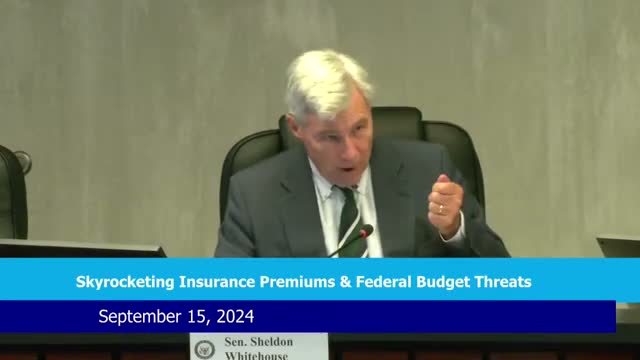
Senator White house, chair of the Senate Budget Committee, opened a roundtable in Hollywood, Florida, warning that the states homeowners-insurance crisis is a preview of risks facing other coastal states and could cascade into mortgage market strain and broader economic harm.
The committee heard personal testimony from homeowners and local leaders who said premiums have surged, private carriers have withdrawn, and many residents are being shifted into Citizens (Floridas insurer of last resort) or forced to choose unfamiliar private options. "When that bill from the insurance company comes through your mail slot, tripling your rates, that is climate denial coming into your home," Senator White house said, linking insurer actions to climate-driven risk.
Why it matters: committee members and witnesses described a sequence: climate change increases flood and storm risk, insurers raise rates or cancel coverage where risk is unpredictable, properties become harder to insure and mortgage, and that in turn can depress local markets and strain the national economy. Congresswoman Wasserman Schultz highlighted the scale of exposure, saying South Florida alone holds roughly $636,000,000,000 in property value at risk, and urged federal action.
Residents and local officials gave concrete examples. Joan Babcock, a Hollywood homeowner, said her private homeowner premium rose from about $7,400 in 2021 to roughly $13,200 in 2023 after mitigation work; she said she ultimately moved into Citizens and later received a mandatory reassignment order that left her uncertain about coverage. "We have been given 4 weeks to choose from 3 new unknown companies with no historical data to prove their worthiness," Babcock said.
Jackie Raley, president of the Winmore Community Council and vice mayor of Coconut Creek, told the committee that monthly maintenance and insurance costs in her 55+ community have jumped, forcing retirees back into the labor force or to sell. Representative Robin Bartleman and other officials described how statutory thresholds and replacement-value calculators have pushed policyholders into excess-line carriers that lack the same regulatory protections.
On policy responses, witnesses urged a two-track approach: stronger mitigation to slow emissions and urgency on adaptation and market stabilization. The discussion repeatedly returned to proposed federal reinsurance. Congresswoman Wasserman Schultz and witnesses cited pending federal proposals such as the Insure Act (referred to in testimony as Congressman Adam Schiffs bill) as one tool to stabilize markets by backstopping catastrophic risk. Local leaders and scientists also urged using federal resilience funds to finance large infrastructure projects.
The committee heard that some state-level reform attempts have been blocked or limited. Multiple speakers criticized actions by Floridas executive and legislative branches for declining federal funds or writing replacement-value thresholds and regulations that they say disadvantage Broward County homeowners.
Whats next: senators thanked local leaders and homeowners for testimony and committed to continued work on federal options, including a possible catastrophic reinsurance program, while underscoring that long-term solutions also require reducing greenhouse-gas emissions.
Ending: The roundtable closed with a pledge to keep exploring policy options in Washington and to coordinate federal support for local adaptation projects; no formal federal action was taken at the event.
The committee heard personal testimony from homeowners and local leaders who said premiums have surged, private carriers have withdrawn, and many residents are being shifted into Citizens (Floridas insurer of last resort) or forced to choose unfamiliar private options. "When that bill from the insurance company comes through your mail slot, tripling your rates, that is climate denial coming into your home," Senator White house said, linking insurer actions to climate-driven risk.
Why it matters: committee members and witnesses described a sequence: climate change increases flood and storm risk, insurers raise rates or cancel coverage where risk is unpredictable, properties become harder to insure and mortgage, and that in turn can depress local markets and strain the national economy. Congresswoman Wasserman Schultz highlighted the scale of exposure, saying South Florida alone holds roughly $636,000,000,000 in property value at risk, and urged federal action.
Residents and local officials gave concrete examples. Joan Babcock, a Hollywood homeowner, said her private homeowner premium rose from about $7,400 in 2021 to roughly $13,200 in 2023 after mitigation work; she said she ultimately moved into Citizens and later received a mandatory reassignment order that left her uncertain about coverage. "We have been given 4 weeks to choose from 3 new unknown companies with no historical data to prove their worthiness," Babcock said.
Jackie Raley, president of the Winmore Community Council and vice mayor of Coconut Creek, told the committee that monthly maintenance and insurance costs in her 55+ community have jumped, forcing retirees back into the labor force or to sell. Representative Robin Bartleman and other officials described how statutory thresholds and replacement-value calculators have pushed policyholders into excess-line carriers that lack the same regulatory protections.
On policy responses, witnesses urged a two-track approach: stronger mitigation to slow emissions and urgency on adaptation and market stabilization. The discussion repeatedly returned to proposed federal reinsurance. Congresswoman Wasserman Schultz and witnesses cited pending federal proposals such as the Insure Act (referred to in testimony as Congressman Adam Schiffs bill) as one tool to stabilize markets by backstopping catastrophic risk. Local leaders and scientists also urged using federal resilience funds to finance large infrastructure projects.
The committee heard that some state-level reform attempts have been blocked or limited. Multiple speakers criticized actions by Floridas executive and legislative branches for declining federal funds or writing replacement-value thresholds and regulations that they say disadvantage Broward County homeowners.
Whats next: senators thanked local leaders and homeowners for testimony and committed to continued work on federal options, including a possible catastrophic reinsurance program, while underscoring that long-term solutions also require reducing greenhouse-gas emissions.
Ending: The roundtable closed with a pledge to keep exploring policy options in Washington and to coordinate federal support for local adaptation projects; no formal federal action was taken at the event.
Don't Miss a Word: See the Full Meeting!
Go beyond summaries. Unlock every video, transcript, and key insight with a Founder Membership.
✓
Get instant access to full meeting videos
✓
Search and clip any phrase from complete transcripts
✓
Receive AI-powered summaries & custom alerts
✓
Enjoy lifetime, unrestricted access to government data
30-day money-back guarantee
