Hollywood and Broward officials lay out $2 billion stormwater plan and warn limits of local adaptation
September 15, 2024 | Hollywood City, Broward County, Florida
This article was created by AI summarizing key points discussed. AI makes mistakes, so for full details and context, please refer to the video of the full meeting. Please report any errors so we can fix them. Report an error »
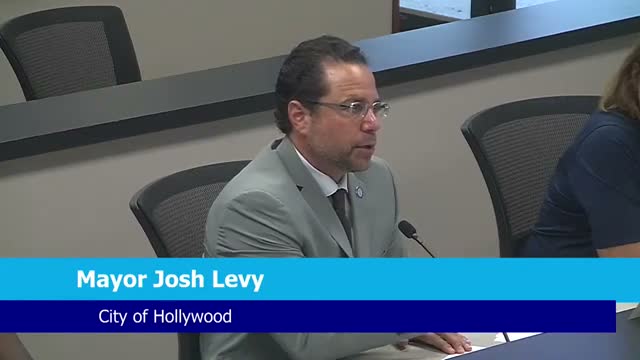
Mayor Josh Levy of Hollywood and Broward County officials told a Senate roundtable that South Florida is ground zero for the effects of sea-level rise and extreme rainfall and described large, near-term adaptation needs that local governments cannot meet without federal assistance.
Mayor Levy said Hollywoods recently completed stormwater master plan identifies roughly $2,000,000,000 in projects over the next 20 years to raise streets, add drainage and install check valves aimed at limiting seawater from backing into storm systems. "In our stormwater master plan alone that we recently completed, $2,000,000,000 worth of projects projected over the next 20 years," Levy said.
Broward County Chief Resilience Officer Dr. Jennifer Hirado said FEMAs most recent flood-map update added about 90,000 parcels to the special flood-hazard area and that roughly 50% of Broward parcels now lie in FEMAs 100-year zone. She warned that as groundwater levels rise and systems are constrained by sea level, some parcels may become impracticable to keep dry by pumping alone. "There are clear limitations on certain aspects of our adaptation," Dr. Hirado said, noting that groundwater rise can make pumping ineffective and that early, tiered investments can preserve ability to insure properties.
Scientists in the hearing added that sunny-day flooding and intensified rainfall events are becoming far more frequent; Dr. Ben Kirtman described model runs showing a large increase in days with nighttime temperatures above 75 degrees and more frequent episodes of several inches of standing water lasting hours. Those climatic changes increase both acute storm losses and chronic flooding, the panelists said, and have direct consequences for stormwater infrastructure planning.
Local officials and state representatives described a cascade mechanism: rising sea levels complicate drainage and pump operations, FEMA reclassifications increase demand for flood insurance, and private carriers react by tightening underwriting and exiting markets, which in turn pressures municipal budgets and affordable housing. Representative Robin Bartleman and Commissioner Nancy Mateo Bowen pressed for state policy changes and for local control to implement resilience measures.
Next steps: local officials asked for federal aid (including funds from the Inflation Reduction Act that some speakers said the state declined) and urged Congress to consider programs that lower insurance costs for homeowners while enabling municipalities to fund large-scale infrastructure upgrades. No new federal commitments were announced at the hearing.
Ending: Officials said adaptation can buy time and lower losses but emphasized that adaptation alone has limits: without aggressive mitigation of greenhouse-gas emissions and continued federal investment, some communities may face escalating costs and reduced viability over coming decades.
Mayor Levy said Hollywoods recently completed stormwater master plan identifies roughly $2,000,000,000 in projects over the next 20 years to raise streets, add drainage and install check valves aimed at limiting seawater from backing into storm systems. "In our stormwater master plan alone that we recently completed, $2,000,000,000 worth of projects projected over the next 20 years," Levy said.
Broward County Chief Resilience Officer Dr. Jennifer Hirado said FEMAs most recent flood-map update added about 90,000 parcels to the special flood-hazard area and that roughly 50% of Broward parcels now lie in FEMAs 100-year zone. She warned that as groundwater levels rise and systems are constrained by sea level, some parcels may become impracticable to keep dry by pumping alone. "There are clear limitations on certain aspects of our adaptation," Dr. Hirado said, noting that groundwater rise can make pumping ineffective and that early, tiered investments can preserve ability to insure properties.
Scientists in the hearing added that sunny-day flooding and intensified rainfall events are becoming far more frequent; Dr. Ben Kirtman described model runs showing a large increase in days with nighttime temperatures above 75 degrees and more frequent episodes of several inches of standing water lasting hours. Those climatic changes increase both acute storm losses and chronic flooding, the panelists said, and have direct consequences for stormwater infrastructure planning.
Local officials and state representatives described a cascade mechanism: rising sea levels complicate drainage and pump operations, FEMA reclassifications increase demand for flood insurance, and private carriers react by tightening underwriting and exiting markets, which in turn pressures municipal budgets and affordable housing. Representative Robin Bartleman and Commissioner Nancy Mateo Bowen pressed for state policy changes and for local control to implement resilience measures.
Next steps: local officials asked for federal aid (including funds from the Inflation Reduction Act that some speakers said the state declined) and urged Congress to consider programs that lower insurance costs for homeowners while enabling municipalities to fund large-scale infrastructure upgrades. No new federal commitments were announced at the hearing.
Ending: Officials said adaptation can buy time and lower losses but emphasized that adaptation alone has limits: without aggressive mitigation of greenhouse-gas emissions and continued federal investment, some communities may face escalating costs and reduced viability over coming decades.
View the Full Meeting & All Its Details
This article offers just a summary. Unlock complete video, transcripts, and insights as a Founder Member.
✓
Watch full, unedited meeting videos
✓
Search every word spoken in unlimited transcripts
✓
AI summaries & real-time alerts (all government levels)
✓
Permanent access to expanding government content
30-day money-back guarantee
