Waunakee committee adopts draft cellphone restrictions aligned with state law; high school needs assessment planned
March 03, 2026 | Waunakee Community School District, School Districts, Wisconsin
This article was created by AI summarizing key points discussed. AI makes mistakes, so for full details and context, please refer to the video of the full meeting. Please report any errors so we can fix them. Report an error »
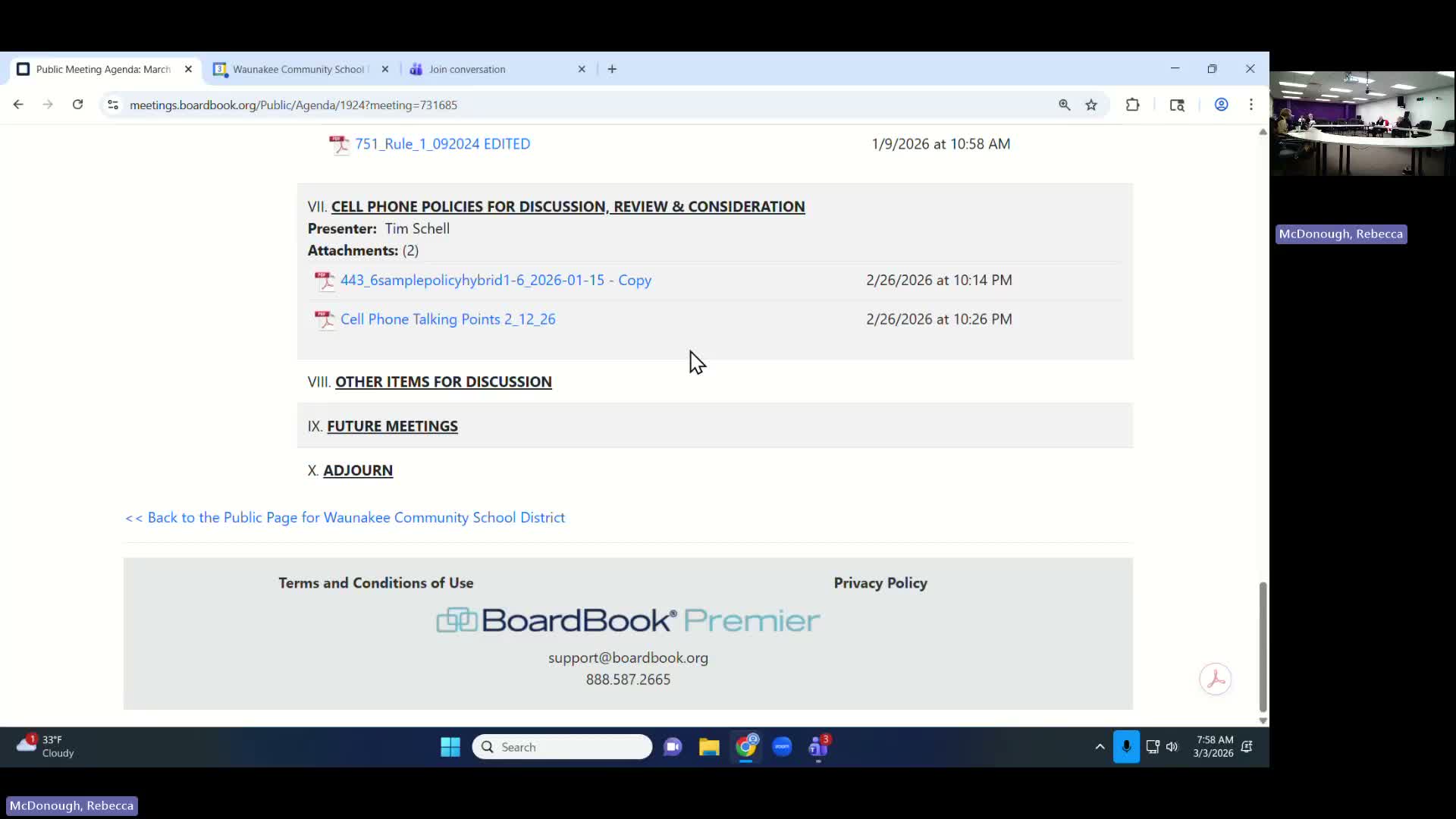
District administrators told the Waunakee Community School District policy committee that a new state law taking effect July 1 requires districts to restrict cell-phone use during instructional time and to adopt four specific carve-outs.
"The state law requires districts to adopt policies that do a few different things," Tim (S6) said, listing the four exceptions the law requires: classroom use by direct teacher permission for instructional purposes; authorized use for students with disabilities documented in an IEP or 504 plan; use required for health-care management (for example, glucose monitoring); and emergency use under staff direction. Tim said the district's current policies are mostly aligned with the law but needed clearer language about those exceptions.
Tim explained the district will continue a bell-to-bell restriction for K–8 and retain an "instructional-time" restriction for the high school while conducting a high-school needs assessment and broader stakeholder engagement next fall before deciding on any stricter high-school rules. "We'll do a needs assessment with students, families, other stakeholders starting in the fall at the high school," Tim said.
The committee discussed how to handle ancillary devices as technology evolves. Tim said the draft limits smartwatch use to clock-face functions for now and flagged smart glasses and other wearables as items the district will monitor and refine in future updates. Members pressed about medical-device accommodations; Tim said medical-device use should be documented with the health office and that handbooks will contain the procedural details rather than the high-level policy.
Committee members also spotted a typographical issue in the draft policy language (a duplicated word in a sentence), which Tim said staff and the policy service (WASB) would correct before the packet goes to the full board.
Next steps: staff will finalize the policy language to capture the four state exceptions, add the clarifying handbook procedures for medical-device accommodations and reporting, run the planned high-school needs assessment starting in the fall, and return the corrected policy to the full board for adoption.
"The state law requires districts to adopt policies that do a few different things," Tim (S6) said, listing the four exceptions the law requires: classroom use by direct teacher permission for instructional purposes; authorized use for students with disabilities documented in an IEP or 504 plan; use required for health-care management (for example, glucose monitoring); and emergency use under staff direction. Tim said the district's current policies are mostly aligned with the law but needed clearer language about those exceptions.
Tim explained the district will continue a bell-to-bell restriction for K–8 and retain an "instructional-time" restriction for the high school while conducting a high-school needs assessment and broader stakeholder engagement next fall before deciding on any stricter high-school rules. "We'll do a needs assessment with students, families, other stakeholders starting in the fall at the high school," Tim said.
The committee discussed how to handle ancillary devices as technology evolves. Tim said the draft limits smartwatch use to clock-face functions for now and flagged smart glasses and other wearables as items the district will monitor and refine in future updates. Members pressed about medical-device accommodations; Tim said medical-device use should be documented with the health office and that handbooks will contain the procedural details rather than the high-level policy.
Committee members also spotted a typographical issue in the draft policy language (a duplicated word in a sentence), which Tim said staff and the policy service (WASB) would correct before the packet goes to the full board.
Next steps: staff will finalize the policy language to capture the four state exceptions, add the clarifying handbook procedures for medical-device accommodations and reporting, run the planned high-school needs assessment starting in the fall, and return the corrected policy to the full board for adoption.
View the Full Meeting & All Its Details
This article offers just a summary. Unlock complete video, transcripts, and insights as a Founder Member.
✓
Watch full, unedited meeting videos
✓
Search every word spoken in unlimited transcripts
✓
AI summaries & real-time alerts (all government levels)
✓
Permanent access to expanding government content
30-day money-back guarantee
