Committee advances bill to curb cryptocurrency kiosk scams after law-enforcement testimony
March 03, 2026 | 2026 Legislature SD, South Dakota
This article was created by AI summarizing key points discussed. AI makes mistakes, so for full details and context, please refer to the video of the full meeting. Please report any errors so we can fix them. Report an error »
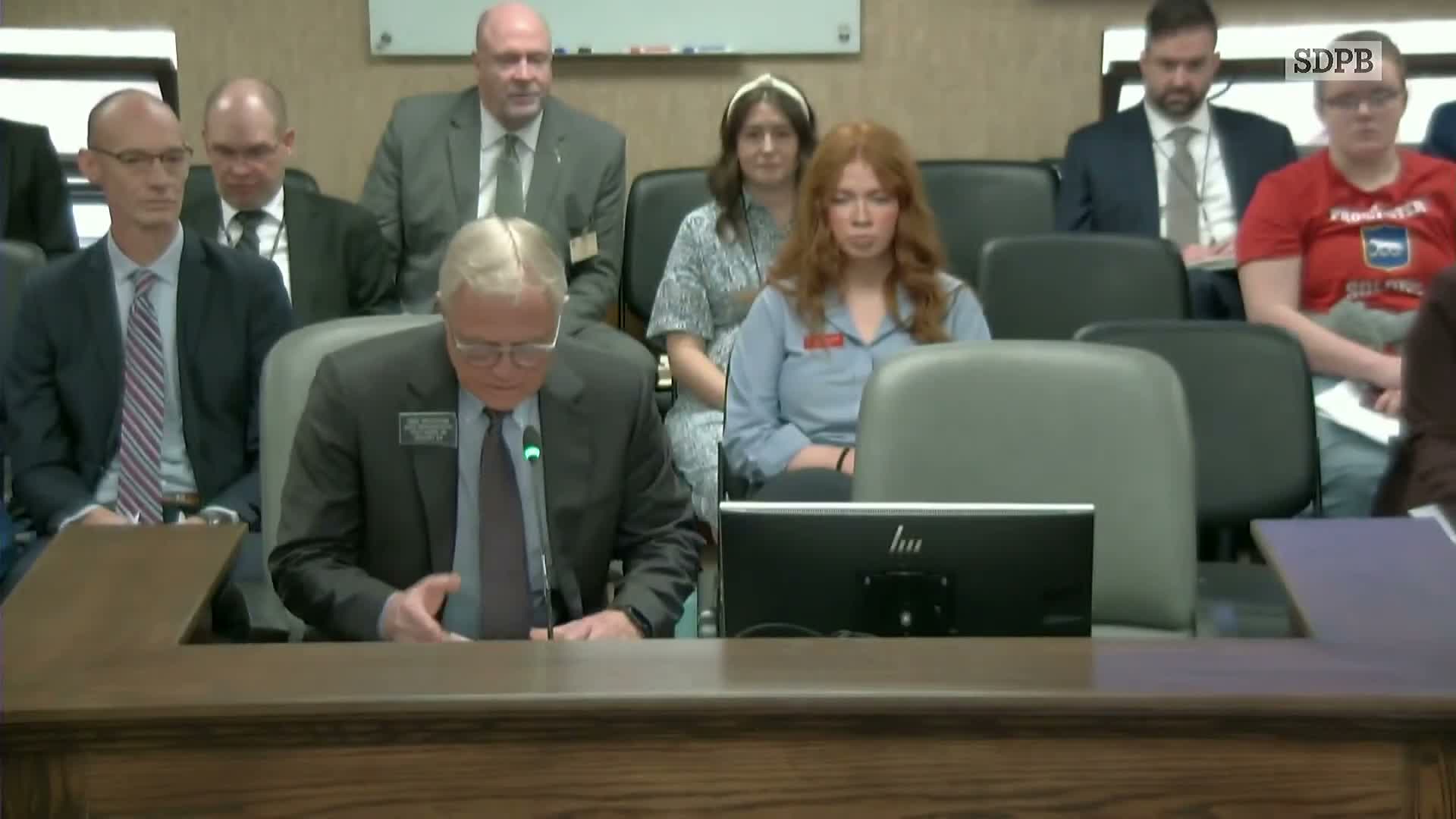
Representative Mike Weisgram introduced Senate Bill 98 as a consumer‑protection measure that would license virtual‑currency kiosk operators, require receipts and disclosures, set daily transaction limits, cap fees and mandate refunds for victims of fraud. "SB 98 is a consumer protection bill which will prevent virtual currency kiosk fraud," Weisgram said as he walked members through the bill's sections.
Why it matters: Law‑enforcement witnesses and consumer groups told the committee the kiosks are a vector for large‑scale scams that disproportionately harm older people. Jeremy Wellnitz, police chief of Clark, summarized national and state data in his testimony: "In 2024, the FBI had nearly 11,000 complaints related to cryptocurrency kiosks," with reported losses of about $246,700,000 in 2024 and $333,000,000 in 2025, he said. Wellnitz also told the committee that 72 percent of reported victims were over 60.
Local investigators and prosecutors gave concrete examples. Detective Sergeant Jeremy Bierke of the Watertown Police Department said his office logged 11 kiosk‑related investigations from 2023–2025 totaling $158,485 in reported losses and described cases in which victims began putting cash into kiosks while still on the phone with scammers. Lieutenant Casey Takedoff of Mitchell Police Department described other victims, including a mid‑20s teacher who lost $12,000.
Division of Banking witness Brett Aftel said the state needs to "flip the incentive structure" so kiosk providers are motivated to prevent fraud, and warned that an industry amendment distinguishing new and returning customers could leave a gap that scammers exploit. "If I come into that kiosk and I have somebody talking in my ear and they send me a QR code...that wallet is now pinned to me," Aftel said, arguing that a later classification as an "existing" customer could permit larger daily transactions to continue flowing to scammers.
Industry representatives said they back most of the bill but asked for targeted changes. Lara Wolfson of CoinFlip (testifying remotely) said her company supports roughly "95 percent" of the proposed law and described internal safeguards such as pop‑up warning screens, 24/7 U.S.‑based customer support and blockchain analytics. She told the committee the industry prefers a bifurcated approach to daily limits — lower limits for first‑time users and higher thresholds for returning, identified customers.
Committee action: Representative Yuri Balk moved a do‑pass recommendation; after discussion the committee approved the motion by roll call, 10 yeas, 2 nays, 1 excused. The committee clerk announced: "Having received a majority of the members elect, Senate Bill 98 will move to the floor."
What remains: The bill, as presented, includes licensing and reporting requirements, a requirement to provide receipts and disclosures, anti‑fraud policies and staff training. Opponents and industry witnesses urged refinements to the daily‑limit and existing‑customer provisions; proponents warned those changes could weaken refund and prevention provisions. The committee vote sends the bill to the chamber floor for further consideration.
Ending: The committee recorded the procedural vote to move SB 98 to the floor; further amendments and floor debate are now possible.
Why it matters: Law‑enforcement witnesses and consumer groups told the committee the kiosks are a vector for large‑scale scams that disproportionately harm older people. Jeremy Wellnitz, police chief of Clark, summarized national and state data in his testimony: "In 2024, the FBI had nearly 11,000 complaints related to cryptocurrency kiosks," with reported losses of about $246,700,000 in 2024 and $333,000,000 in 2025, he said. Wellnitz also told the committee that 72 percent of reported victims were over 60.
Local investigators and prosecutors gave concrete examples. Detective Sergeant Jeremy Bierke of the Watertown Police Department said his office logged 11 kiosk‑related investigations from 2023–2025 totaling $158,485 in reported losses and described cases in which victims began putting cash into kiosks while still on the phone with scammers. Lieutenant Casey Takedoff of Mitchell Police Department described other victims, including a mid‑20s teacher who lost $12,000.
Division of Banking witness Brett Aftel said the state needs to "flip the incentive structure" so kiosk providers are motivated to prevent fraud, and warned that an industry amendment distinguishing new and returning customers could leave a gap that scammers exploit. "If I come into that kiosk and I have somebody talking in my ear and they send me a QR code...that wallet is now pinned to me," Aftel said, arguing that a later classification as an "existing" customer could permit larger daily transactions to continue flowing to scammers.
Industry representatives said they back most of the bill but asked for targeted changes. Lara Wolfson of CoinFlip (testifying remotely) said her company supports roughly "95 percent" of the proposed law and described internal safeguards such as pop‑up warning screens, 24/7 U.S.‑based customer support and blockchain analytics. She told the committee the industry prefers a bifurcated approach to daily limits — lower limits for first‑time users and higher thresholds for returning, identified customers.
Committee action: Representative Yuri Balk moved a do‑pass recommendation; after discussion the committee approved the motion by roll call, 10 yeas, 2 nays, 1 excused. The committee clerk announced: "Having received a majority of the members elect, Senate Bill 98 will move to the floor."
What remains: The bill, as presented, includes licensing and reporting requirements, a requirement to provide receipts and disclosures, anti‑fraud policies and staff training. Opponents and industry witnesses urged refinements to the daily‑limit and existing‑customer provisions; proponents warned those changes could weaken refund and prevention provisions. The committee vote sends the bill to the chamber floor for further consideration.
Ending: The committee recorded the procedural vote to move SB 98 to the floor; further amendments and floor debate are now possible.
View the Full Meeting & All Its Details
This article offers just a summary. Unlock complete video, transcripts, and insights as a Founder Member.
✓
Watch full, unedited meeting videos
✓
Search every word spoken in unlimited transcripts
✓
AI summaries & real-time alerts (all government levels)
✓
Permanent access to expanding government content
30-day money-back guarantee
