Committee previews broad farm-package bill that would expand state purchasing, add exemptions and fund programs
March 03, 2026 | Legislative Sessions, Washington
This article was created by AI summarizing key points discussed. AI makes mistakes, so for full details and context, please refer to the video of the full meeting. Please report any errors so we can fix them. Report an error »
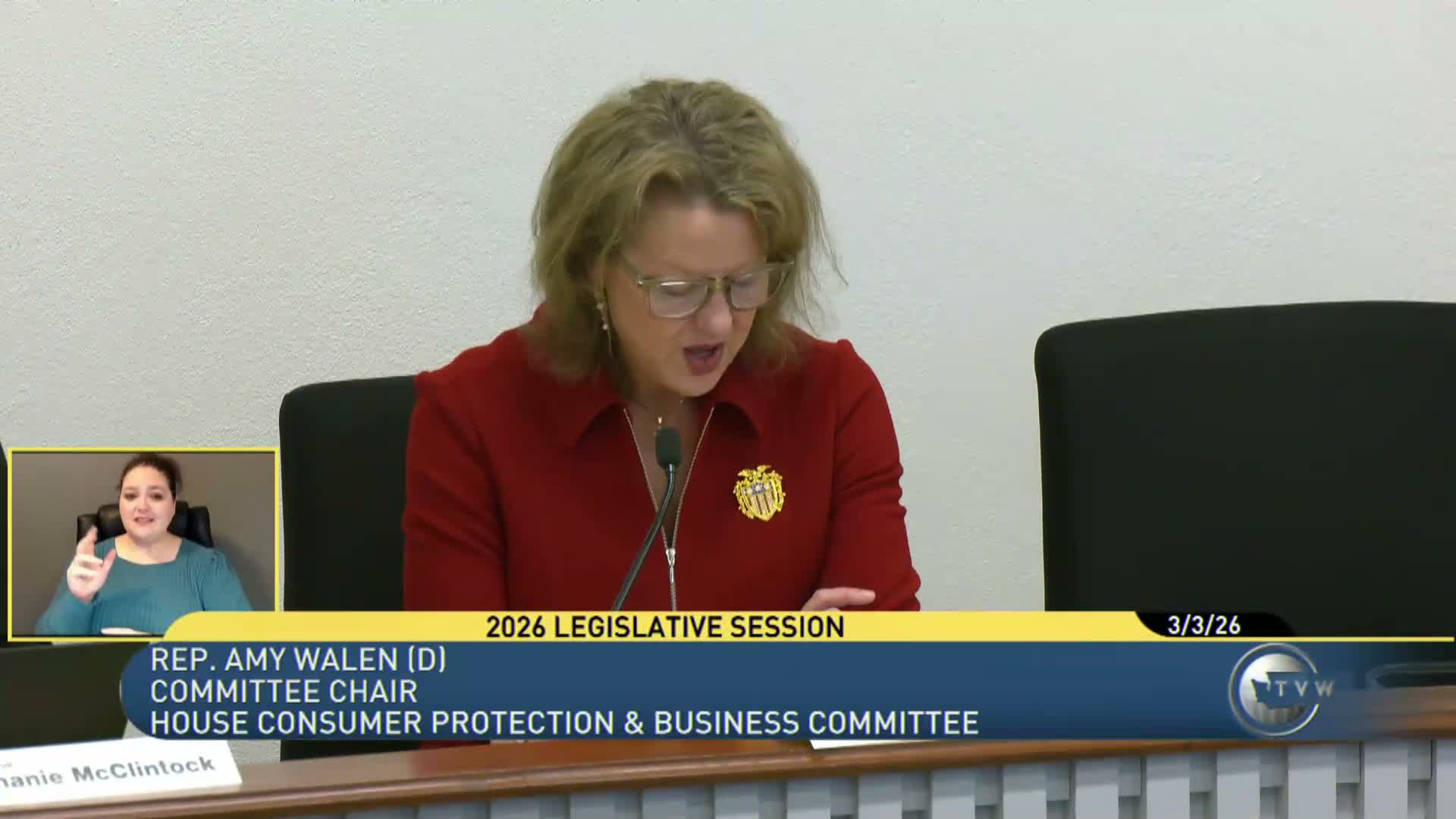
Representative Christine Reeves, the prime sponsor, and committee staff walked members and the public through House Bill 2616 during a March 3 public hearing of the Consumer Protection Business Committee.
"House Bill 26 16 would enact the framework for agriculturally resilient markets act," committee staff Peter Clodfelter told the committee in a staff briefing. He said the bill would require state agencies to convene to develop a strategy to expand institutional purchasing of Washington-grown food — naming the Department of Agriculture, Department of Enterprise Services, Department of Corrections and the Office of the Superintendent of Public Instruction — and would require a report due in 2028.
Clodfelter outlined other provisions, including a temporary exemption from the 2025 producer-responsibility program law for packaging used to store perishable agricultural products "until the Department of Ecology determines that commercially viable alternatives are reasonably available," and changes to exemptions under the Climate Commitment Act that would remove a scheduled expiration for an agricultural fuel exemption and add an exemption for emissions related to lubricants.
"This bill would remove the expiration date so that exemption would continue to apply in the future as it does now," Clodfelter said.
The bill would also exclude certain substitute refrigerants and equipment used in agricultural production or food storage from Department of Ecology refrigerant-management requirements, create several grant programs (including retrofits for equipment used to protect food quality), mandate multiple studies and reports produced with Washington State University, and transfer licensing authority for cannabis production, processing and testing to the Department of Agriculture while keeping retail licensing with the Liquor and Cannabis Board. It includes a fiscal-2027 appropriation of $885,000 to the Department of Agriculture for costs associated with a tree-fruit leadership program.
Representative Reeves framed the measure as an attempt to craft a state-level "farm bill" that treats farms as small businesses. "Over the last 5 years ... we've lost 3,700 farms," Reeves told the committee, urging the measure as a starting point to support family-owned producers and to address concerns about food security and market volatility.
Chair Wallen announced there were 441 people signed in on the bill (366 pro, 75 con). Dozens of in-person supporters described local market pressures, the cost of replacing refrigeration systems and the loss of processing capacity. John Devaney, president of the Washington State Tree Fruit Association, praised the bill and referenced a State Department of Agriculture preliminary report, "Washington Agriculture at a Crossroads," that the association says highlights declining profit margins and farm attrition.
Supporters from commodity groups — including the Washington Potato and Onion Association, the Washington Association of Wheat Growers and the Washington Cattlemen’s Association — emphasized a collaborative drafting process and urged that new regulations avoid catastrophic costs for producers. Mark Struelly told the committee that replacing large refrigeration systems could cost about $500,000 each and noted approximately 500 potato and onion sheds in the state as an example of potential retrofit needs.
Farmers and commodity representatives also raised processing losses: Jay Gordon of the Washington State Dairy Federation described how the closure of a malting facility removed a market for tens of thousands of acres of barley, tying processing capacity to farm viability.
Committee members asked about stakeholder outreach, WSU research and whether the bill would address market consolidation through co-ops or other market access supports. Reeves said the bill resulted from conversations with roughly 35–40 stakeholder groups and that sponsors would continue stakeholder meetings over the summer to refine the proposal.
The committee closed the public hearing on HB 2616 without taking action and moved on to a second bill on the agenda.
The bill will receive additional stakeholdering and review; sponsors said they do not intend to move it forward this year and will continue discussions and interim meetings ahead of any possible 2027 return.
"House Bill 26 16 would enact the framework for agriculturally resilient markets act," committee staff Peter Clodfelter told the committee in a staff briefing. He said the bill would require state agencies to convene to develop a strategy to expand institutional purchasing of Washington-grown food — naming the Department of Agriculture, Department of Enterprise Services, Department of Corrections and the Office of the Superintendent of Public Instruction — and would require a report due in 2028.
Clodfelter outlined other provisions, including a temporary exemption from the 2025 producer-responsibility program law for packaging used to store perishable agricultural products "until the Department of Ecology determines that commercially viable alternatives are reasonably available," and changes to exemptions under the Climate Commitment Act that would remove a scheduled expiration for an agricultural fuel exemption and add an exemption for emissions related to lubricants.
"This bill would remove the expiration date so that exemption would continue to apply in the future as it does now," Clodfelter said.
The bill would also exclude certain substitute refrigerants and equipment used in agricultural production or food storage from Department of Ecology refrigerant-management requirements, create several grant programs (including retrofits for equipment used to protect food quality), mandate multiple studies and reports produced with Washington State University, and transfer licensing authority for cannabis production, processing and testing to the Department of Agriculture while keeping retail licensing with the Liquor and Cannabis Board. It includes a fiscal-2027 appropriation of $885,000 to the Department of Agriculture for costs associated with a tree-fruit leadership program.
Representative Reeves framed the measure as an attempt to craft a state-level "farm bill" that treats farms as small businesses. "Over the last 5 years ... we've lost 3,700 farms," Reeves told the committee, urging the measure as a starting point to support family-owned producers and to address concerns about food security and market volatility.
Chair Wallen announced there were 441 people signed in on the bill (366 pro, 75 con). Dozens of in-person supporters described local market pressures, the cost of replacing refrigeration systems and the loss of processing capacity. John Devaney, president of the Washington State Tree Fruit Association, praised the bill and referenced a State Department of Agriculture preliminary report, "Washington Agriculture at a Crossroads," that the association says highlights declining profit margins and farm attrition.
Supporters from commodity groups — including the Washington Potato and Onion Association, the Washington Association of Wheat Growers and the Washington Cattlemen’s Association — emphasized a collaborative drafting process and urged that new regulations avoid catastrophic costs for producers. Mark Struelly told the committee that replacing large refrigeration systems could cost about $500,000 each and noted approximately 500 potato and onion sheds in the state as an example of potential retrofit needs.
Farmers and commodity representatives also raised processing losses: Jay Gordon of the Washington State Dairy Federation described how the closure of a malting facility removed a market for tens of thousands of acres of barley, tying processing capacity to farm viability.
Committee members asked about stakeholder outreach, WSU research and whether the bill would address market consolidation through co-ops or other market access supports. Reeves said the bill resulted from conversations with roughly 35–40 stakeholder groups and that sponsors would continue stakeholder meetings over the summer to refine the proposal.
The committee closed the public hearing on HB 2616 without taking action and moved on to a second bill on the agenda.
The bill will receive additional stakeholdering and review; sponsors said they do not intend to move it forward this year and will continue discussions and interim meetings ahead of any possible 2027 return.
View the Full Meeting & All Its Details
This article offers just a summary. Unlock complete video, transcripts, and insights as a Founder Member.
✓
Watch full, unedited meeting videos
✓
Search every word spoken in unlimited transcripts
✓
AI summaries & real-time alerts (all government levels)
✓
Permanent access to expanding government content
30-day money-back guarantee
