Hospital board approves nine contracts including emergency physicians, radiology and IT purchases
September 27, 2024 | Hospital Authority Board Meetings, Nashville, Davidson County, Tennessee
This article was created by AI summarizing key points discussed. AI makes mistakes, so for full details and context, please refer to the video of the full meeting. Please report any errors so we can fix them. Report an error »
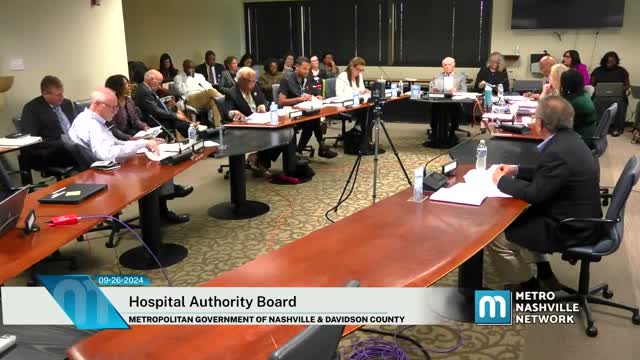
The Hospital Authority Board voted to approve nine contracts presented by the finance committee and summarized to the full board, encompassing clinical services, capital equipment and IT purchases.
Board members were presented capsule summaries of each agreement and then voted on each contract. Among the largest or most operationally significant items were a rate adjustment for Southeastern Emergency Physicians (a requested hourly increase that translates to a board-noted total of about $372,855), an extension or replacement MRI-services arrangement to return to the original equipment manufacturer (Phillips) to accelerate service and repairs, a Radiology Dynamics amendment to bolster radiologist coverage tied to the hospital's trauma level 3 designation (noted as about $477,000 per year), a capital purchase for a coagulation analyzer (Diagnostica Stago), and an HVAC construction contract for the cath lab (~$533,928). The board also approved an Oracle clinical-trial management system implementation (one-time implementation fees plus tiered service fees intended to support an expanding clinical-trials portfolio) and a related hardware/equipment purchase to support an upcoming Cerner implementation.
Presenters explained clinical context for several items: the emergency physicians group has long served the hospital and seeks an hourly increase to address market rates after no increase since 2016; radiology coverage was characterized as needed for trauma-level staffing requirements; the MRI vendor move was described as a service-quality choice tied to the age of existing equipment. The pharmacy surveillance and infection-prevention software (Pharmacy OneSource) was presented as a five-year agreement at roughly $35,502.11 per year (five-year total reported at about $196,171.58). A separate five-year revenue-share agreement with ProHealth Pharmacy would build out a specialty-pharmacy presence at Metro Center and requires no direct capital contribution from the hospital; presenters said the contract had received multiple bids.
Board members asked operational questions (e.g., cath lab timing and status; whether the MRI machine would need replacement soon; where hardware funds came from for Cerner) and were told budgeted capital and reserve funds had been earmarked. Each contract was moved, seconded and approved by voice vote; no formal roll-call vote was recorded in the transcript for these items.
The board recorded that the finance committee had reviewed the contracts in advance and recommended approval; the chair thanked staff for the packet and capsule summaries.
The board also approved a separate resolution to adopt the hospital's assumed/trade names for filing with the Tennessee Secretary of State.
The board did not attach any additional conditions to the approvals in public session; staff were asked to continue operational follow-up and vendor management as required.
Board members were presented capsule summaries of each agreement and then voted on each contract. Among the largest or most operationally significant items were a rate adjustment for Southeastern Emergency Physicians (a requested hourly increase that translates to a board-noted total of about $372,855), an extension or replacement MRI-services arrangement to return to the original equipment manufacturer (Phillips) to accelerate service and repairs, a Radiology Dynamics amendment to bolster radiologist coverage tied to the hospital's trauma level 3 designation (noted as about $477,000 per year), a capital purchase for a coagulation analyzer (Diagnostica Stago), and an HVAC construction contract for the cath lab (~$533,928). The board also approved an Oracle clinical-trial management system implementation (one-time implementation fees plus tiered service fees intended to support an expanding clinical-trials portfolio) and a related hardware/equipment purchase to support an upcoming Cerner implementation.
Presenters explained clinical context for several items: the emergency physicians group has long served the hospital and seeks an hourly increase to address market rates after no increase since 2016; radiology coverage was characterized as needed for trauma-level staffing requirements; the MRI vendor move was described as a service-quality choice tied to the age of existing equipment. The pharmacy surveillance and infection-prevention software (Pharmacy OneSource) was presented as a five-year agreement at roughly $35,502.11 per year (five-year total reported at about $196,171.58). A separate five-year revenue-share agreement with ProHealth Pharmacy would build out a specialty-pharmacy presence at Metro Center and requires no direct capital contribution from the hospital; presenters said the contract had received multiple bids.
Board members asked operational questions (e.g., cath lab timing and status; whether the MRI machine would need replacement soon; where hardware funds came from for Cerner) and were told budgeted capital and reserve funds had been earmarked. Each contract was moved, seconded and approved by voice vote; no formal roll-call vote was recorded in the transcript for these items.
The board recorded that the finance committee had reviewed the contracts in advance and recommended approval; the chair thanked staff for the packet and capsule summaries.
The board also approved a separate resolution to adopt the hospital's assumed/trade names for filing with the Tennessee Secretary of State.
The board did not attach any additional conditions to the approvals in public session; staff were asked to continue operational follow-up and vendor management as required.
View the Full Meeting & All Its Details
This article offers just a summary. Unlock complete video, transcripts, and insights as a Founder Member.
✓
Watch full, unedited meeting videos
✓
Search every word spoken in unlimited transcripts
✓
AI summaries & real-time alerts (all government levels)
✓
Permanent access to expanding government content
30-day money-back guarantee
