Oak Harbor outlines steps to address rising pedestrian deaths, cites funding limits and state coordination
March 02, 2026 | Oak Harbor, Island County, Washington
This article was created by AI summarizing key points discussed. AI makes mistakes, so for full details and context, please refer to the video of the full meeting. Please report any errors so we can fix them. Report an error »
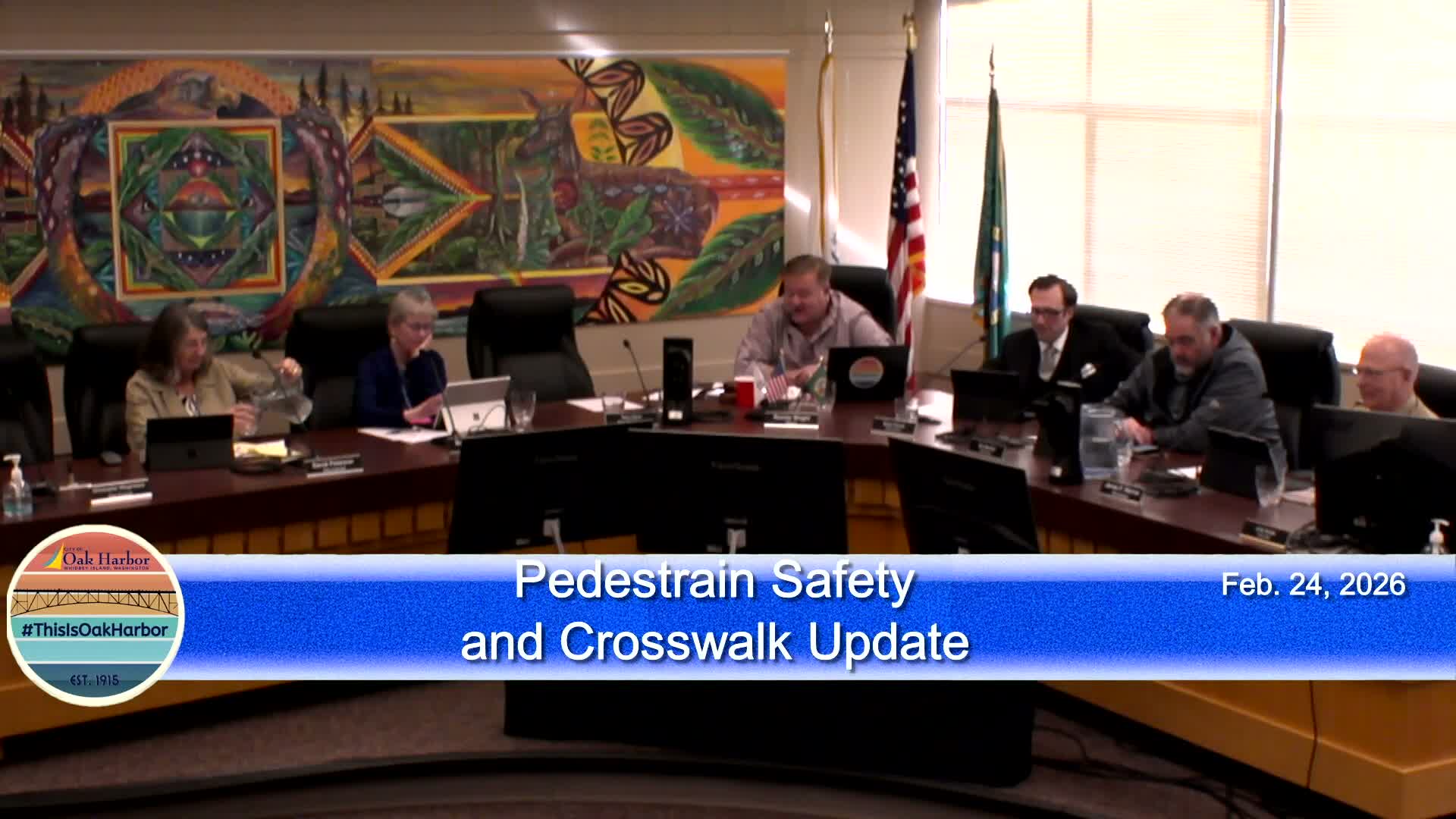
Oak Harbor city staff briefed the council on a range of pedestrian‑safety measures and funding challenges, saying pedestrian fatalities have risen sharply despite modest population growth.
City Engineer Alex Warner told the council the city adopted a Comprehensive Safety Action Plan last May with a goal to “reduce the number of traffic deaths and serious injuries to 0 by the year 2045,” and that staff will monitor progress. Warner said the city’s population has grown roughly 7% over the past decade while pedestrian fatalities and severe accidents have climbed by about 48%, depending on the baseline year used.
Warner summarized capital and operational work the city has completed or planned: since 2019 the city has installed 15 rectangular rapid flashing beacons (RRFBs), six in school areas; it has built more than 2,500 feet of shared‑use paths; and staff are evaluating thermoplastic pavement markings for crosswalks and stop bars because they last longer than regular paint. "We’re going to generally, for crosswalks and stop bars, go with this thermoplastic product," Warner said.
On funding, Warner said the city applied last year for a $5,000,000 federal Safe Streets for All grant but did not receive an award; local funds for pedestrian work are about $100,000 per year. He said the city will continue to pursue competitive grant opportunities and to look for ways to leverage other capital projects (for example, adding pedestrian work during water‑main replacements).
Council members raised neighborhood concerns and technical questions. One council member warned that painted bike lanes can give users a “false security” and urged engineering solutions such as physical separations or rumble treatments; another asked about continuity of bike lanes and sidewalk gaps near recent infill developments where 20–30 children walk to school daily. Warner said a transportation comprehensive plan update is underway and that staff will present consultant selection and implementation options to the council in the coming weeks to help prioritize gaps and frontage improvements.
Councilors and staff repeatedly flagged Highway 20 as a collision hotspot. Warner said heat‑map analysis from the comprehensive safety plan shows the bulk of incidents occurring on Highway 20 from Whidbey Avenue to Erie, and he emphasized that the highway is a state facility that requires coordination with the Washington State Department of Transportation (WSDOT) for any design changes. Kat Kamak, the city’s principal planner, said the city uses adopted local plans to communicate community preferences to WSDOT when the state prepares designs and funding windows.
On operations, staff noted recent hiring in the streets/operations team (increasing from four to five people), new equipment needs for thermoplastic applications, and discussion about whether to perform repainting in‑house or contract it out. A council member praised the resident‑action form used by the public to report potholes and crosswalk issues; staff said they are revamping the form to make it easier to find on the city website.
No formal motions or votes occurred during the briefing. Staff said they will return with consultant recommendations and plan materials, continue pursuing grant funding, and coordinate with WSDOT on Highway 20 design opportunities. The meeting adjourned at 02:43.
City Engineer Alex Warner told the council the city adopted a Comprehensive Safety Action Plan last May with a goal to “reduce the number of traffic deaths and serious injuries to 0 by the year 2045,” and that staff will monitor progress. Warner said the city’s population has grown roughly 7% over the past decade while pedestrian fatalities and severe accidents have climbed by about 48%, depending on the baseline year used.
Warner summarized capital and operational work the city has completed or planned: since 2019 the city has installed 15 rectangular rapid flashing beacons (RRFBs), six in school areas; it has built more than 2,500 feet of shared‑use paths; and staff are evaluating thermoplastic pavement markings for crosswalks and stop bars because they last longer than regular paint. "We’re going to generally, for crosswalks and stop bars, go with this thermoplastic product," Warner said.
On funding, Warner said the city applied last year for a $5,000,000 federal Safe Streets for All grant but did not receive an award; local funds for pedestrian work are about $100,000 per year. He said the city will continue to pursue competitive grant opportunities and to look for ways to leverage other capital projects (for example, adding pedestrian work during water‑main replacements).
Council members raised neighborhood concerns and technical questions. One council member warned that painted bike lanes can give users a “false security” and urged engineering solutions such as physical separations or rumble treatments; another asked about continuity of bike lanes and sidewalk gaps near recent infill developments where 20–30 children walk to school daily. Warner said a transportation comprehensive plan update is underway and that staff will present consultant selection and implementation options to the council in the coming weeks to help prioritize gaps and frontage improvements.
Councilors and staff repeatedly flagged Highway 20 as a collision hotspot. Warner said heat‑map analysis from the comprehensive safety plan shows the bulk of incidents occurring on Highway 20 from Whidbey Avenue to Erie, and he emphasized that the highway is a state facility that requires coordination with the Washington State Department of Transportation (WSDOT) for any design changes. Kat Kamak, the city’s principal planner, said the city uses adopted local plans to communicate community preferences to WSDOT when the state prepares designs and funding windows.
On operations, staff noted recent hiring in the streets/operations team (increasing from four to five people), new equipment needs for thermoplastic applications, and discussion about whether to perform repainting in‑house or contract it out. A council member praised the resident‑action form used by the public to report potholes and crosswalk issues; staff said they are revamping the form to make it easier to find on the city website.
No formal motions or votes occurred during the briefing. Staff said they will return with consultant recommendations and plan materials, continue pursuing grant funding, and coordinate with WSDOT on Highway 20 design opportunities. The meeting adjourned at 02:43.
Don't Miss a Word: See the Full Meeting!
Go beyond summaries. Unlock every video, transcript, and key insight with a Founder Membership.
✓
Get instant access to full meeting videos
✓
Search and clip any phrase from complete transcripts
✓
Receive AI-powered summaries & custom alerts
✓
Enjoy lifetime, unrestricted access to government data
30-day money-back guarantee
