Docket roundup: judge denies probation for Melissa Paez, hands sentences and sets bonds; veterans‑court timetables ordered
March 02, 2026 | Judge Stephanie Boyd 187th District, District Court Judges, Judicial, Texas
This article was created by AI summarizing key points discussed. AI makes mistakes, so for full details and context, please refer to the video of the full meeting. Please report any errors so we can fix them. Report an error »
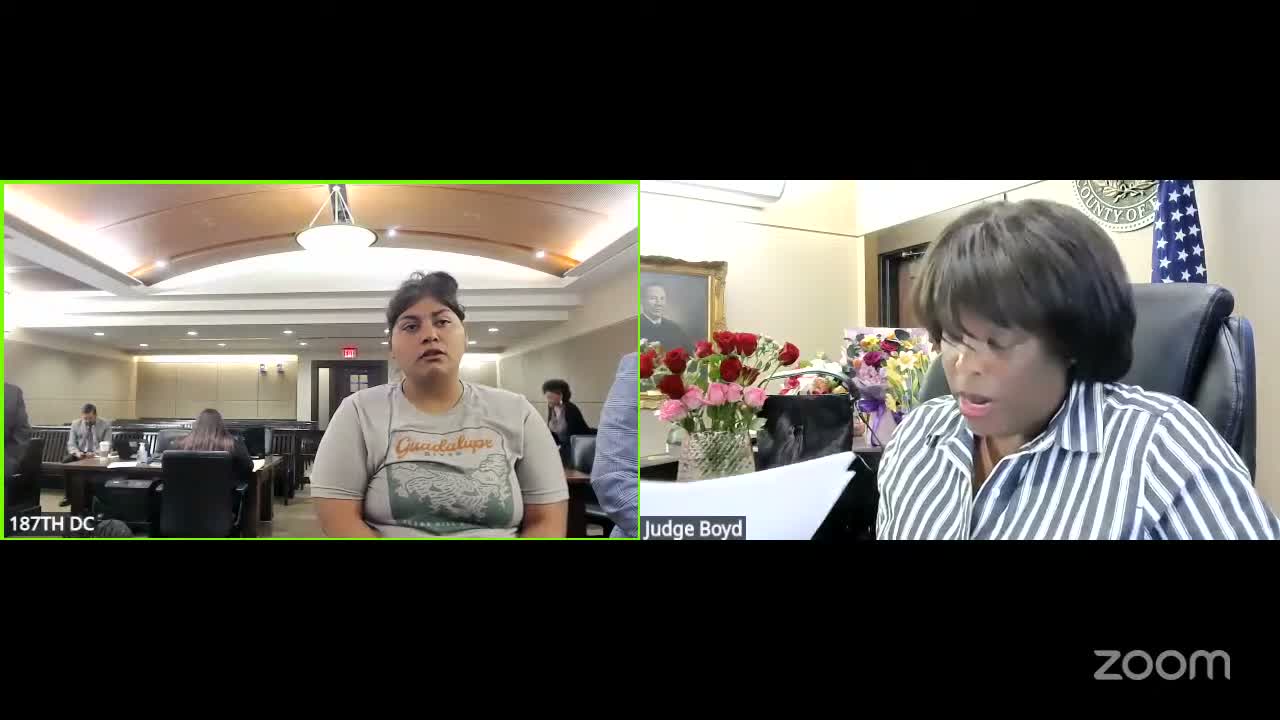
A judge on the Bexar County docket handled a bundle of pleas, resets and sentencing decisions, including denial of probation and prison time in one case, guilty pleas in others, and bond and treatment conditions tied to Veterans Treatment Court.
Melissa Paez told the court she should receive probation because she has four children and “I have no issue with submitting drugs for analysis,” but the court, relying on the TAP evaluation and the state’s recommendation, denied her application for probation and found her guilty on the listed causes. The judge ordered concurrent prison terms and monetary fines tied to the plea bargain and said she would request placement in a therapeutic community in the judgment (but acknowledged she cannot force placement). The judge notified Paez of the waiver of appeal and that the convictions carry weapon‑possession restrictions.
In other notable dispositions, Allen J. Hernandez pleaded guilty in a third‑degree felony DWI matter; the court accepted stipulations and sentenced him under the plea agreement to 4 years in prison, a $1,400 fine and a two‑year license suspension, to run concurrent with earlier cases. The court recommended therapeutic community placement where appropriate.
Troy Moore’s matter produced a schedule and bond orders. Probation reported Moore’s VTC evaluation is scheduled for March 27; later the court set bonds ($3,500 on one cause and $2,500 on another), ordered supportive outpatient treatment with regular UAs (fees waived), and directed Moore to meet Veterans Treatment Court on March 27 at 11 a.m.
The court also handled several deferred‑adjudication offers. Mariah Munoz pleaded to an attempted possession less‑included offense and received one year deferred adjudication, an $800 probated fine and 100 hours of community service that can be satisfied by parenting classes; the court ordered DOEP and regular UAs and asked probation to assist with housing resources.
Why it matters: the docket shows routine but consequential outcomes — denial of probation and multi‑year sentences, conditions tying defendants into treatment programs such as Veterans Treatment Court and therapeutic community recommendations, and plea bargains that resolve multiple cause numbers. Those outcomes affect custody, treatment access and future sentencing exposure.
What to watch: the state’s decision following the suppression ruling in another matter (Juan Alberto Martinez) and whether defendants successfully access recommended treatment programs.
Provenance: coverage draws on hearing discussion from SEG 948–1246 (Paez), SEG 1334–1490 (Hernandez), SEG 1709–1815 (Moore), and SEG 3830–3919 (Munoz).
Melissa Paez told the court she should receive probation because she has four children and “I have no issue with submitting drugs for analysis,” but the court, relying on the TAP evaluation and the state’s recommendation, denied her application for probation and found her guilty on the listed causes. The judge ordered concurrent prison terms and monetary fines tied to the plea bargain and said she would request placement in a therapeutic community in the judgment (but acknowledged she cannot force placement). The judge notified Paez of the waiver of appeal and that the convictions carry weapon‑possession restrictions.
In other notable dispositions, Allen J. Hernandez pleaded guilty in a third‑degree felony DWI matter; the court accepted stipulations and sentenced him under the plea agreement to 4 years in prison, a $1,400 fine and a two‑year license suspension, to run concurrent with earlier cases. The court recommended therapeutic community placement where appropriate.
Troy Moore’s matter produced a schedule and bond orders. Probation reported Moore’s VTC evaluation is scheduled for March 27; later the court set bonds ($3,500 on one cause and $2,500 on another), ordered supportive outpatient treatment with regular UAs (fees waived), and directed Moore to meet Veterans Treatment Court on March 27 at 11 a.m.
The court also handled several deferred‑adjudication offers. Mariah Munoz pleaded to an attempted possession less‑included offense and received one year deferred adjudication, an $800 probated fine and 100 hours of community service that can be satisfied by parenting classes; the court ordered DOEP and regular UAs and asked probation to assist with housing resources.
Why it matters: the docket shows routine but consequential outcomes — denial of probation and multi‑year sentences, conditions tying defendants into treatment programs such as Veterans Treatment Court and therapeutic community recommendations, and plea bargains that resolve multiple cause numbers. Those outcomes affect custody, treatment access and future sentencing exposure.
What to watch: the state’s decision following the suppression ruling in another matter (Juan Alberto Martinez) and whether defendants successfully access recommended treatment programs.
Provenance: coverage draws on hearing discussion from SEG 948–1246 (Paez), SEG 1334–1490 (Hernandez), SEG 1709–1815 (Moore), and SEG 3830–3919 (Munoz).
Don't Miss a Word: See the Full Meeting!
Go beyond summaries. Unlock every video, transcript, and key insight with a Founder Membership.
✓
Get instant access to full meeting videos
✓
Search and clip any phrase from complete transcripts
✓
Receive AI-powered summaries & custom alerts
✓
Enjoy lifetime, unrestricted access to government data
30-day money-back guarantee
