Fairfax County staff and developer propose townhomes at Roland Clark Place; residents raise traffic and noise concerns
March 03, 2026 | Fairfax County, Virginia
This article was created by AI summarizing key points discussed. AI makes mistakes, so for full details and context, please refer to the video of the full meeting. Please report any errors so we can fix them. Report an error »
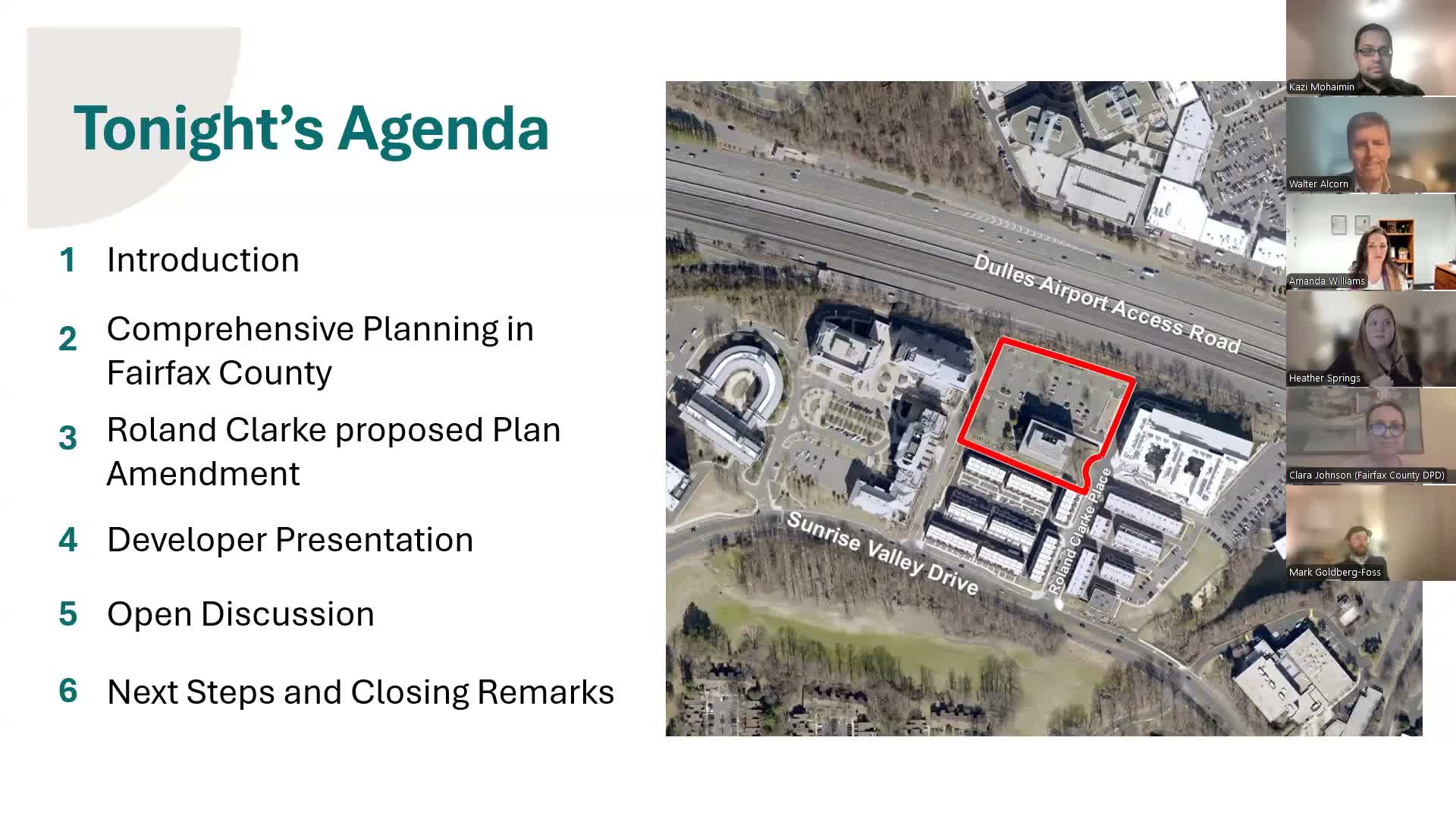
County planners and a developer on Monday presented a revised proposal to amend the Reston plan guidance for 1950 Roland Clark Place, shifting from a previously considered higher-density multifamily concept to a lower-density townhome concept that the developer says would better fit surrounding neighborhoods.
Heather Springs, a planner with the Fairfax County Department of Planning and Development, told attendees the site is currently shown on the county plan at up to 3.55 floor-area ratio (FAR), and staff’s impacts analysis considered transportation, schools, parks and environmental factors. Staff said it is generally supportive of a transition to housing but emphasized that any redevelopment would require a rezoning and additional studies, and that a final staff recommendation will be published ahead of public hearings.
The developer’s representative, Amanda Williams, a land-use attorney with Cooley speaking on behalf of Stewart Investment Partners, said the owner filed the plan-amendment request in 2022 and has revised its concept in response to community feedback. The new illustrative concept would place about 70–75 townhomes on the roughly 3.5-acre site (approximately 20 dwelling units per acre) rather than the earlier multifamily option that had been analyzed at roughly 325–350 units. Williams said the site contains a late-1970s/early-1980s office building with about 90,000 square feet and roughly 50% vacancy, and that the townhome approach would reduce daily vehicle trips substantially compared with the multifamily scenario.
"This concept change represents about a 70% decrease in daily trips from the multifamily proposal," Amanda Williams said, noting the plan-stage concept is illustrative and that detailed layout, traffic analysis and design features would be addressed during a future rezoning.
Residents used the discussion period to press the county and developer on several recurring concerns. Neighboring homeowners and association leaders urged preservation or relocation of an existing, actively used pedestrian trail, clarity about garage and driveway orientation and parking, and stronger protections against noise from the adjacent Dulles Toll Road. One resident who identified himself as Greg, president of The Mercer at Reston Heights, described early-morning noise near the back of his building and urged installation of a sound wall.
County staff and the developer said noise mitigation will be required and studied during the zoning phase; options discussed included building design and, if necessary, a sound wall. "That would be something the applicant would consider through the zoning stage," Heather Springs said. The developer cited a nearby townhouse development that successfully used a sound wall as an example.
Several residents also pushed for a cross-connection to the west to provide an alternative circulation route and reduce pressure on Roland Clark Place. Staff said the current Reston plan calls for a westward connection and that the staff recommendation is likely to carry language encouraging or requiring pursuit of that connection; Amanda Williams said existing easements may facilitate such a connection but that any expansion or design details would be settled during rezoning and in coordination with neighboring property owners.
Traffic-signal justification and speed-limit authority were also discussed. Greg asked about a traffic signal at Roland Clark Place and Sunrise Valley Drive; the developer said a signal justification had been proffered with previous approvals and that the project would be required to complete any needed follow-on studies during rezoning. John King, a transportation planner with the Fairfax County Department of Transportation, clarified that changes to speed limits and final signal approvals lie with the Virginia Department of Transportation (VDOT), and that a signal-justification report (SJR) is an engineering study submitted through VDOT’s process.
Supervisor Alcorn told listeners that site-specific tax-revenue calculations are not part of county staff’s project-level analyses. He and staff encouraged continued engagement and follow-up outside the meeting for unresolved technical questions such as HOA documents and easement specifics.
Next steps: staff said it will publish a staff report and final recommendation ahead of public hearings that will be scheduled in the coming months, and that detailed design, traffic analysis, noise mitigation and access arrangements will be addressed in the rezoning process. The county will post the presentation materials on the project webpage and will notify local homeowners associations when hearing dates are set.
There was no formal vote or action at the community meeting; the session was an information and feedback step within the county’s comprehensive-plan amendment process.
Heather Springs, a planner with the Fairfax County Department of Planning and Development, told attendees the site is currently shown on the county plan at up to 3.55 floor-area ratio (FAR), and staff’s impacts analysis considered transportation, schools, parks and environmental factors. Staff said it is generally supportive of a transition to housing but emphasized that any redevelopment would require a rezoning and additional studies, and that a final staff recommendation will be published ahead of public hearings.
The developer’s representative, Amanda Williams, a land-use attorney with Cooley speaking on behalf of Stewart Investment Partners, said the owner filed the plan-amendment request in 2022 and has revised its concept in response to community feedback. The new illustrative concept would place about 70–75 townhomes on the roughly 3.5-acre site (approximately 20 dwelling units per acre) rather than the earlier multifamily option that had been analyzed at roughly 325–350 units. Williams said the site contains a late-1970s/early-1980s office building with about 90,000 square feet and roughly 50% vacancy, and that the townhome approach would reduce daily vehicle trips substantially compared with the multifamily scenario.
"This concept change represents about a 70% decrease in daily trips from the multifamily proposal," Amanda Williams said, noting the plan-stage concept is illustrative and that detailed layout, traffic analysis and design features would be addressed during a future rezoning.
Residents used the discussion period to press the county and developer on several recurring concerns. Neighboring homeowners and association leaders urged preservation or relocation of an existing, actively used pedestrian trail, clarity about garage and driveway orientation and parking, and stronger protections against noise from the adjacent Dulles Toll Road. One resident who identified himself as Greg, president of The Mercer at Reston Heights, described early-morning noise near the back of his building and urged installation of a sound wall.
County staff and the developer said noise mitigation will be required and studied during the zoning phase; options discussed included building design and, if necessary, a sound wall. "That would be something the applicant would consider through the zoning stage," Heather Springs said. The developer cited a nearby townhouse development that successfully used a sound wall as an example.
Several residents also pushed for a cross-connection to the west to provide an alternative circulation route and reduce pressure on Roland Clark Place. Staff said the current Reston plan calls for a westward connection and that the staff recommendation is likely to carry language encouraging or requiring pursuit of that connection; Amanda Williams said existing easements may facilitate such a connection but that any expansion or design details would be settled during rezoning and in coordination with neighboring property owners.
Traffic-signal justification and speed-limit authority were also discussed. Greg asked about a traffic signal at Roland Clark Place and Sunrise Valley Drive; the developer said a signal justification had been proffered with previous approvals and that the project would be required to complete any needed follow-on studies during rezoning. John King, a transportation planner with the Fairfax County Department of Transportation, clarified that changes to speed limits and final signal approvals lie with the Virginia Department of Transportation (VDOT), and that a signal-justification report (SJR) is an engineering study submitted through VDOT’s process.
Supervisor Alcorn told listeners that site-specific tax-revenue calculations are not part of county staff’s project-level analyses. He and staff encouraged continued engagement and follow-up outside the meeting for unresolved technical questions such as HOA documents and easement specifics.
Next steps: staff said it will publish a staff report and final recommendation ahead of public hearings that will be scheduled in the coming months, and that detailed design, traffic analysis, noise mitigation and access arrangements will be addressed in the rezoning process. The county will post the presentation materials on the project webpage and will notify local homeowners associations when hearing dates are set.
There was no formal vote or action at the community meeting; the session was an information and feedback step within the county’s comprehensive-plan amendment process.
Don't Miss a Word: See the Full Meeting!
Go beyond summaries. Unlock every video, transcript, and key insight with a Founder Membership.
✓
Get instant access to full meeting videos
✓
Search and clip any phrase from complete transcripts
✓
Receive AI-powered summaries & custom alerts
✓
Enjoy lifetime, unrestricted access to government data
30-day money-back guarantee
