Narberth planning commission advances code recodification and debates 4A zoning changes amid public concerns over impervious cover and parking
March 03, 2026 | Narberth, Montgomery County, Pennsylvania
This article was created by AI summarizing key points discussed. AI makes mistakes, so for full details and context, please refer to the video of the full meeting. Please report any errors so we can fix them. Report an error »
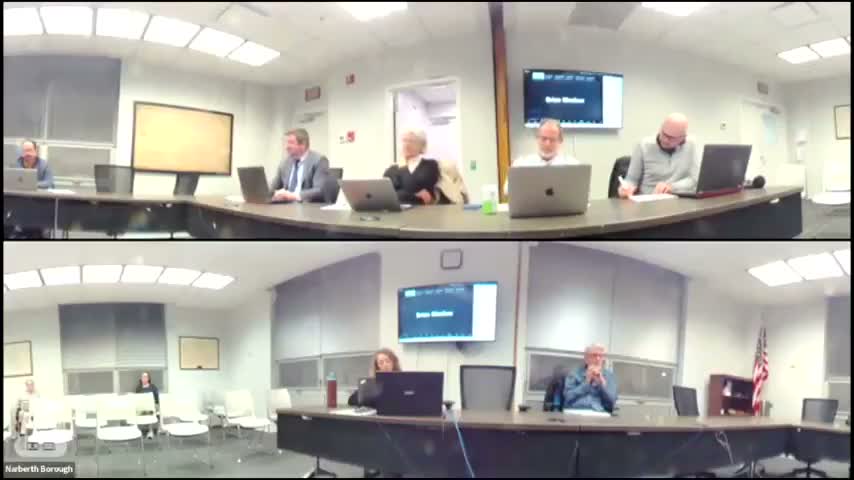
The Narberth Planning Commission on March 2 reviewed a near-final recodification of the borough zoning code and debated proposed changes to the 4A zoning district that would make it easier to build townhouses and apartment buildings in areas near downtown.
Chair Adam Prav said the revisions are intended to make the code easier to navigate and to differentiate rules by housing type so the law can encourage both affordability and compatibility with existing neighborhoods. "Supply does correlate to demand," Prav said, summarizing the commission's rationale for allowing more housing types and flexibility.
Residents who spoke at the meeting urged caution. Carson Clark, a Narberth resident who serves on the Shade Tree Commission, told the panel the draft increases in lot coverage and impervious-surface limits worry longtime neighbors. He said the draft raises building coverage from the current 45% to 50% and would allow impervious cover as high as 70%, up from 60%, and asked commissioners to consider narrower or geographically targeted changes to avoid harming stormwater management and tree canopy.
Commissioners and staff framed those trade-offs as part of a larger effort to permit cottages, rowhouses, twins and small multifamily formats while limiting impacts on single-family blocks. Staff members said many of the proposed coverage and setback changes would apply primarily to multifamily formats (apartment buildings and townhouses) and not broadly to all single-family houses, and that performance standards and stormwater rules remain in place.
The commission discussed specific draft provisions: a base 35-foot height with a fourth-floor bonus tied to affordable housing, a potential front setback measured from sidewalks (not lot lines), and a reduced baseline parking requirement of 0.7 spaces per apartment unit — with parking waivers proposed for units under 750 square feet and for income-restricted units. Commissioners said the 0.7 figure is meant to reduce development cost where there is no parking subsidy, not to force developers to provide less parking for market-rate projects.
Several commissioners urged written precision before forwarding recommendations to borough council. One commissioner said any allowance of a 10-foot setback for part of a facade must be paired with rules requiring modulation, planting and limits on continuous façade length, to avoid a monolithic appearance. Staff noted that the draft code already contains many of the component rules (maximum run length, stepbacks, landscaping requirements) but that the provisions need to be assembled and clarified for 4A.
Commission discussion included site-specific context. Staff identified a small number of developable parcels in 4A — including a Rite Aid parcel and a large church parcel near the train station — and said those sites, rather than the entire district, would most likely host denser redevelopment. Commissioners discussed design strategies — modulating facades, adding green buffers and using pervious or engineered surfacing for parking — to mitigate increased impervious area.
On process, staff reported the recodification migration is nearly complete (about 170 pages) and that cross-references and formatting remain under review; staff expect to produce a corrected draft within a week and to recommend a policy-neutral recodification to council in April, with any separate policy changes vetted and recommended separately.
Procedural actions: the commission moved, seconded and approved the February meeting minutes and later moved to adjourn. No formal votes on the 4A policy language were taken at this meeting; the commission asked staff to prepare clarified draft language reflecting the discussion and to consult the solicitor on specific cross-reference and definition fixes before submitting a recommendation to council.
The commission said it will compile open-house posters and survey responses from a recent public outreach event and provide a written summary to commissioners ahead of the April submission to council.
Next steps: staff will post and circulate the updated draft, codify agreed façade and landscaping measures for 4A, consult the solicitor on identified glitches (cross-references and migration errors), and develop refined language to present to council.
Chair Adam Prav said the revisions are intended to make the code easier to navigate and to differentiate rules by housing type so the law can encourage both affordability and compatibility with existing neighborhoods. "Supply does correlate to demand," Prav said, summarizing the commission's rationale for allowing more housing types and flexibility.
Residents who spoke at the meeting urged caution. Carson Clark, a Narberth resident who serves on the Shade Tree Commission, told the panel the draft increases in lot coverage and impervious-surface limits worry longtime neighbors. He said the draft raises building coverage from the current 45% to 50% and would allow impervious cover as high as 70%, up from 60%, and asked commissioners to consider narrower or geographically targeted changes to avoid harming stormwater management and tree canopy.
Commissioners and staff framed those trade-offs as part of a larger effort to permit cottages, rowhouses, twins and small multifamily formats while limiting impacts on single-family blocks. Staff members said many of the proposed coverage and setback changes would apply primarily to multifamily formats (apartment buildings and townhouses) and not broadly to all single-family houses, and that performance standards and stormwater rules remain in place.
The commission discussed specific draft provisions: a base 35-foot height with a fourth-floor bonus tied to affordable housing, a potential front setback measured from sidewalks (not lot lines), and a reduced baseline parking requirement of 0.7 spaces per apartment unit — with parking waivers proposed for units under 750 square feet and for income-restricted units. Commissioners said the 0.7 figure is meant to reduce development cost where there is no parking subsidy, not to force developers to provide less parking for market-rate projects.
Several commissioners urged written precision before forwarding recommendations to borough council. One commissioner said any allowance of a 10-foot setback for part of a facade must be paired with rules requiring modulation, planting and limits on continuous façade length, to avoid a monolithic appearance. Staff noted that the draft code already contains many of the component rules (maximum run length, stepbacks, landscaping requirements) but that the provisions need to be assembled and clarified for 4A.
Commission discussion included site-specific context. Staff identified a small number of developable parcels in 4A — including a Rite Aid parcel and a large church parcel near the train station — and said those sites, rather than the entire district, would most likely host denser redevelopment. Commissioners discussed design strategies — modulating facades, adding green buffers and using pervious or engineered surfacing for parking — to mitigate increased impervious area.
On process, staff reported the recodification migration is nearly complete (about 170 pages) and that cross-references and formatting remain under review; staff expect to produce a corrected draft within a week and to recommend a policy-neutral recodification to council in April, with any separate policy changes vetted and recommended separately.
Procedural actions: the commission moved, seconded and approved the February meeting minutes and later moved to adjourn. No formal votes on the 4A policy language were taken at this meeting; the commission asked staff to prepare clarified draft language reflecting the discussion and to consult the solicitor on specific cross-reference and definition fixes before submitting a recommendation to council.
The commission said it will compile open-house posters and survey responses from a recent public outreach event and provide a written summary to commissioners ahead of the April submission to council.
Next steps: staff will post and circulate the updated draft, codify agreed façade and landscaping measures for 4A, consult the solicitor on identified glitches (cross-references and migration errors), and develop refined language to present to council.
View the Full Meeting & All Its Details
This article offers just a summary. Unlock complete video, transcripts, and insights as a Founder Member.
✓
Watch full, unedited meeting videos
✓
Search every word spoken in unlimited transcripts
✓
AI summaries & real-time alerts (all government levels)
✓
Permanent access to expanding government content
30-day money-back guarantee
