Witness: beach provides walking access; 10-foot pier recommended so users can pass
March 03, 2026 | Lake Forest Park, King County, Washington
This article was created by AI summarizing key points discussed. AI makes mistakes, so for full details and context, please refer to the video of the full meeting. Please report any errors so we can fix them. Report an error »
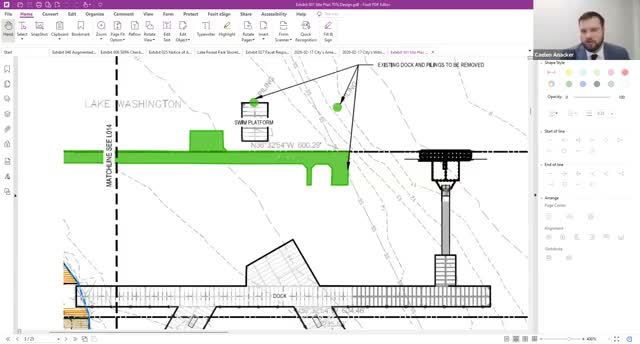
Miss McClusick, a witness at the hearing, told the panel that the site’s beach "is in great shape for accessing the water" and said a pier serves primarily to provide watercraft access for kayakers and paddlers rather than basic walking access for bathers.
She said the project’s design team concluded that "10 feet is what we determined was the minimum acceptable width for this facility" to allow two users (for example, a person in a wheelchair and a kayaker) to pass safely. When asked about narrower designs, she said a 3-foot width would not necessarily meet the Americans with Disabilities Act’s specifications in all circumstances and noted ADA guidance requires turnarounds (a 5-foot diameter circle) where widths are less than 5 feet.
The witness emphasized she has worked on multiple Shoreline Master Programs (SMPs) and recent SMP analyses related to artificial light at night but said she had not reviewed the written regulations between her prior testimony and this hearing and would need to consult the specific regulations for definitive citations. On whether a lifeguard is legally required at the pier, she said she could not speak to legal necessity and described a lifeguard as a programmatic choice rather than a requirement she had researched.
Why it matters: the exact dimensions and safety features for docks and piers inform accessibility and permitting under local shoreline rules and federal accessibility standards. City regulators and permitting staff typically use SMP rules and ADA guidance to evaluate whether a proposed pier design requires modifications, variances, or other approvals.
Details: the witness said the bulkhead on this property "is not necessary" and that, unlike projects that require substantial earthwork to reestablish natural grade, this site already has a natural shoreline transect that provides soft access for walking into the lake. She recommended pier design that supports watercraft access while preserving the existing shoreline conditions.
Next steps: the hearing was recessed until Tuesday, March 3, 2026, at 9:00 a.m., when the panel said it would permit additional public testimony and continue questioning of witnesses.
She said the project’s design team concluded that "10 feet is what we determined was the minimum acceptable width for this facility" to allow two users (for example, a person in a wheelchair and a kayaker) to pass safely. When asked about narrower designs, she said a 3-foot width would not necessarily meet the Americans with Disabilities Act’s specifications in all circumstances and noted ADA guidance requires turnarounds (a 5-foot diameter circle) where widths are less than 5 feet.
The witness emphasized she has worked on multiple Shoreline Master Programs (SMPs) and recent SMP analyses related to artificial light at night but said she had not reviewed the written regulations between her prior testimony and this hearing and would need to consult the specific regulations for definitive citations. On whether a lifeguard is legally required at the pier, she said she could not speak to legal necessity and described a lifeguard as a programmatic choice rather than a requirement she had researched.
Why it matters: the exact dimensions and safety features for docks and piers inform accessibility and permitting under local shoreline rules and federal accessibility standards. City regulators and permitting staff typically use SMP rules and ADA guidance to evaluate whether a proposed pier design requires modifications, variances, or other approvals.
Details: the witness said the bulkhead on this property "is not necessary" and that, unlike projects that require substantial earthwork to reestablish natural grade, this site already has a natural shoreline transect that provides soft access for walking into the lake. She recommended pier design that supports watercraft access while preserving the existing shoreline conditions.
Next steps: the hearing was recessed until Tuesday, March 3, 2026, at 9:00 a.m., when the panel said it would permit additional public testimony and continue questioning of witnesses.
View the Full Meeting & All Its Details
This article offers just a summary. Unlock complete video, transcripts, and insights as a Founder Member.
✓
Watch full, unedited meeting videos
✓
Search every word spoken in unlimited transcripts
✓
AI summaries & real-time alerts (all government levels)
✓
Permanent access to expanding government content
30-day money-back guarantee
