Lake Forest Park hearing examines proposed Lion Creek waterfront park, dock and missing plan pages
March 03, 2026 | Lake Forest Park, King County, Washington
This article was created by AI summarizing key points discussed. AI makes mistakes, so for full details and context, please refer to the video of the full meeting. Please report any errors so we can fix them. Report an error »
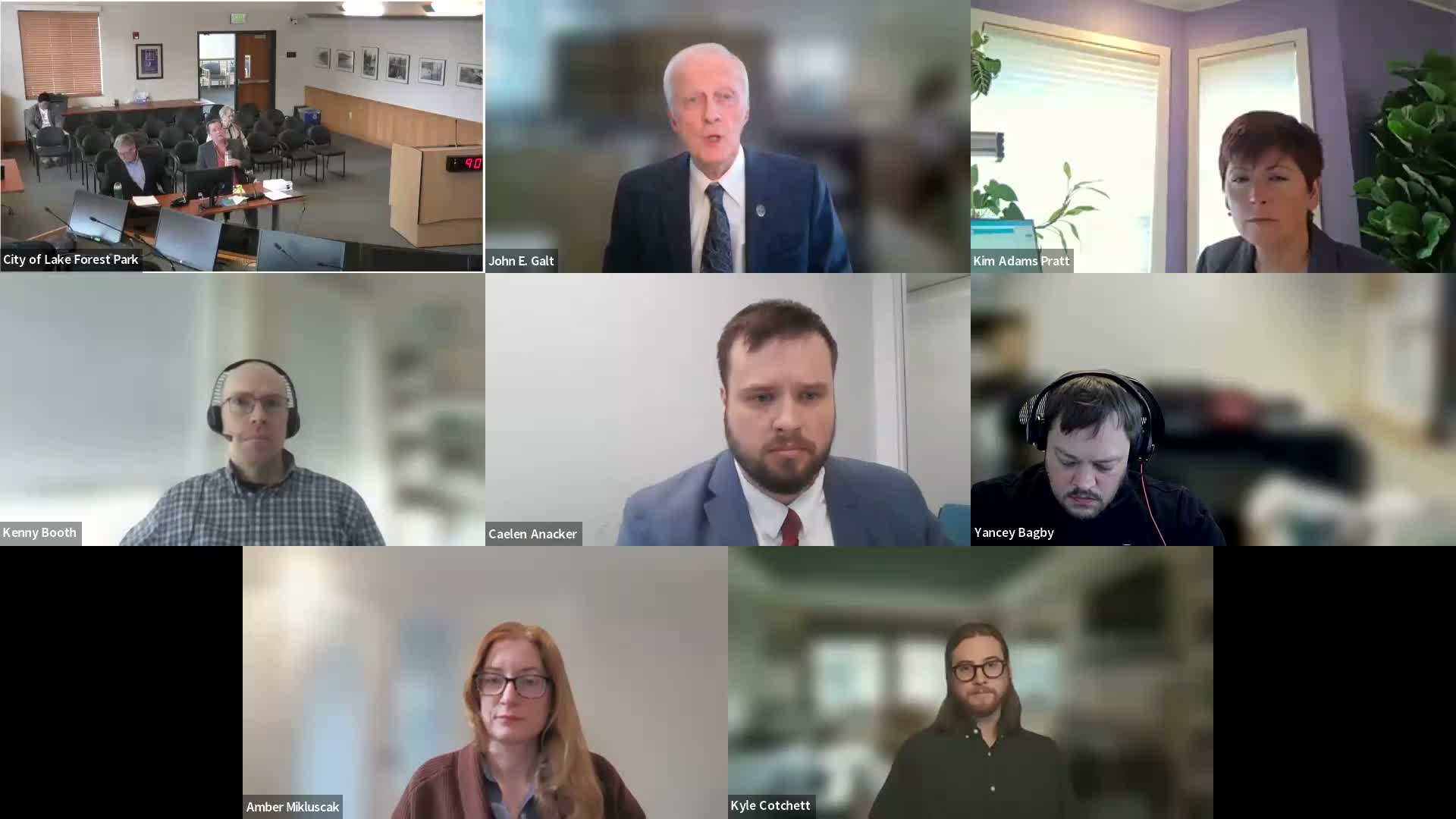
Lake Forest Park’s hearing examiner heard day‑long testimony Feb. 24 on a consolidated permit package to expand the Lion Creek Waterfront Preserve and develop adjoining parcels for lake access and recreation.
The applicant, the City of Lake Forest Park, is seeking a shoreline substantial development permit, a shoreline conditional‑use permit, a shoreline variance, a zoning conditional‑use permit and the city’s SEPA determination was appealed; the hearing will continue after the examiner ordered additional plan sheets be added to exhibit 1 for review.
The project would combine three parcels at the north end of Lake Washington — the existing Lion Creek Waterfront Preserve and two recently acquired Turner parcels — to add waterfront recreation and public water access while relocating concentrated use off the most sensitive creek buffer areas, city project manager and landscape architect Amber Miklusick said. “Roughly 85% of residents have to actually leave the city, to legally gain access to Lake Washington,” Miklusick said, describing the city’s rationale for acquiring the parcels.
Why it matters: The project would add shoreline and recreation amenities in a city that currently has almost no public water access. Neighbors and appellants, Jesse and Tyler Fudge, have appealed the city’s SEPA determination and pressed the design team and city witnesses on specifics — including dock size, wetland protections, parking and whether the city provided all relevant plan sheets before the hearing.
Key facts and design choices: The city has curated a 70% design/permit plan set for review; Miklusick presented the site history and a design that concentrates new recreation on the newly acquired parcels and retreats the preserve by installing continuous railings and graded deck overlooks. The proposed dock extends about 200 feet beyond the ordinary high‑water line and has a 10‑foot main pier with L‑shaped ends; Miklusick confirmed the L wings extend about 26 feet diagonally beyond the pier to create a float with an ADA‑compatible kayak launch. She told the examiner the consolidated dock was chosen because it best met multiple design constraints — access to deeper water, clearance from an existing sewer line and ADA ramp slope requirements — and because it reduced overwater impacts overall compared with multiple separate structures.
Neighbors’ concerns and cross‑examination: Appellants’ counsel Caelan (Cale) Anacker repeatedly pressed the city witness on whether smaller dock options, more parking or additional one‑on‑one outreach to near‑shore neighbors had been considered. Anacker began by asking, “The proposed pier is 200 feet long. Correct?” Miklusick responded that the pier is 200 feet beyond ordinary high water, and she confirmed the pier is about 10 feet wide.
Wetlands and buffer protections were a focal point: the design relocates viewing decks, closes inboard trail access at the creek, and adds fencing and rail lines in places to exclude sensitive bank areas. The team did not propose a fence along a narrow bulkhead wetland that abuts a masonry seawall because installation of a post‑supported fence in that intertidal area was judged impractical and because the bulkhead forms the wetland’s edge, Miklusick said. She also said the city will restore and prioritize higher‑value habitats while reusing and salvaging historically significant materials where safe.
Public engagement metrics and program elements: Miklusick reported extensive outreach — four community workshops, about 300 signed in‑person attendees, roughly 17,000 page views on the project website and more than 800 survey responses — and said the design program is mostly passive recreation with one active facility (a playground), a community building and a bathhouse. Existing cabins were largely removed by selective deconstruction; salvageable materials have been stored on site for reuse.
Process dispute and continuance: Late in the day, the parties and the examiner discovered the public exhibit set did not include many of the 70% plan sheets listed on the sheet index (the index lists roughly 112 potential sheets). Appellants objected to adding a large number of plan pages to the record mid‑hearing without time for their experts to review them, saying it would deny them due process; the city said it submitted a curated set for SEPA and was prepared to provide missing sheets. The examiner reviewed the sheet index, asked the city to produce a set of additional sheets he identified (roughly 40 page numbers), and recessed the hearing so the parties can obtain and review the materials; the case was continued to reconvene the next morning with a follow‑up set for scheduling and content review.
What’s next: The hearing was recessed to reconvene at 9 a.m. the next scheduled session so the city can confirm and provide the additional plan sheets the examiner requested and the parties can coordinate availability for witnesses and experts. The examiner indicated a tentative availability window beginning the week of March 10 if a short continuance is needed to allow review of the supplemented record.
Sources: Testimony and exhibits entered into the record at the Lake Forest Park Hearing Examiner’s Feb. 24, 2026 open‑record hearing, including city exhibit 42 (project presentation) and later screenshots entered as exhibits 43–44.
The applicant, the City of Lake Forest Park, is seeking a shoreline substantial development permit, a shoreline conditional‑use permit, a shoreline variance, a zoning conditional‑use permit and the city’s SEPA determination was appealed; the hearing will continue after the examiner ordered additional plan sheets be added to exhibit 1 for review.
The project would combine three parcels at the north end of Lake Washington — the existing Lion Creek Waterfront Preserve and two recently acquired Turner parcels — to add waterfront recreation and public water access while relocating concentrated use off the most sensitive creek buffer areas, city project manager and landscape architect Amber Miklusick said. “Roughly 85% of residents have to actually leave the city, to legally gain access to Lake Washington,” Miklusick said, describing the city’s rationale for acquiring the parcels.
Why it matters: The project would add shoreline and recreation amenities in a city that currently has almost no public water access. Neighbors and appellants, Jesse and Tyler Fudge, have appealed the city’s SEPA determination and pressed the design team and city witnesses on specifics — including dock size, wetland protections, parking and whether the city provided all relevant plan sheets before the hearing.
Key facts and design choices: The city has curated a 70% design/permit plan set for review; Miklusick presented the site history and a design that concentrates new recreation on the newly acquired parcels and retreats the preserve by installing continuous railings and graded deck overlooks. The proposed dock extends about 200 feet beyond the ordinary high‑water line and has a 10‑foot main pier with L‑shaped ends; Miklusick confirmed the L wings extend about 26 feet diagonally beyond the pier to create a float with an ADA‑compatible kayak launch. She told the examiner the consolidated dock was chosen because it best met multiple design constraints — access to deeper water, clearance from an existing sewer line and ADA ramp slope requirements — and because it reduced overwater impacts overall compared with multiple separate structures.
Neighbors’ concerns and cross‑examination: Appellants’ counsel Caelan (Cale) Anacker repeatedly pressed the city witness on whether smaller dock options, more parking or additional one‑on‑one outreach to near‑shore neighbors had been considered. Anacker began by asking, “The proposed pier is 200 feet long. Correct?” Miklusick responded that the pier is 200 feet beyond ordinary high water, and she confirmed the pier is about 10 feet wide.
Wetlands and buffer protections were a focal point: the design relocates viewing decks, closes inboard trail access at the creek, and adds fencing and rail lines in places to exclude sensitive bank areas. The team did not propose a fence along a narrow bulkhead wetland that abuts a masonry seawall because installation of a post‑supported fence in that intertidal area was judged impractical and because the bulkhead forms the wetland’s edge, Miklusick said. She also said the city will restore and prioritize higher‑value habitats while reusing and salvaging historically significant materials where safe.
Public engagement metrics and program elements: Miklusick reported extensive outreach — four community workshops, about 300 signed in‑person attendees, roughly 17,000 page views on the project website and more than 800 survey responses — and said the design program is mostly passive recreation with one active facility (a playground), a community building and a bathhouse. Existing cabins were largely removed by selective deconstruction; salvageable materials have been stored on site for reuse.
Process dispute and continuance: Late in the day, the parties and the examiner discovered the public exhibit set did not include many of the 70% plan sheets listed on the sheet index (the index lists roughly 112 potential sheets). Appellants objected to adding a large number of plan pages to the record mid‑hearing without time for their experts to review them, saying it would deny them due process; the city said it submitted a curated set for SEPA and was prepared to provide missing sheets. The examiner reviewed the sheet index, asked the city to produce a set of additional sheets he identified (roughly 40 page numbers), and recessed the hearing so the parties can obtain and review the materials; the case was continued to reconvene the next morning with a follow‑up set for scheduling and content review.
What’s next: The hearing was recessed to reconvene at 9 a.m. the next scheduled session so the city can confirm and provide the additional plan sheets the examiner requested and the parties can coordinate availability for witnesses and experts. The examiner indicated a tentative availability window beginning the week of March 10 if a short continuance is needed to allow review of the supplemented record.
Sources: Testimony and exhibits entered into the record at the Lake Forest Park Hearing Examiner’s Feb. 24, 2026 open‑record hearing, including city exhibit 42 (project presentation) and later screenshots entered as exhibits 43–44.
View the Full Meeting & All Its Details
This article offers just a summary. Unlock complete video, transcripts, and insights as a Founder Member.
✓
Watch full, unedited meeting videos
✓
Search every word spoken in unlimited transcripts
✓
AI summaries & real-time alerts (all government levels)
✓
Permanent access to expanding government content
30-day money-back guarantee
