Consultants outline scoring framework and outreach plan for West Sacramento bicycle, pedestrian and trails master plan
March 03, 2026 | West Sacramento, Yolo County, California
This article was created by AI summarizing key points discussed. AI makes mistakes, so for full details and context, please refer to the video of the full meeting. Please report any errors so we can fix them. Report an error »
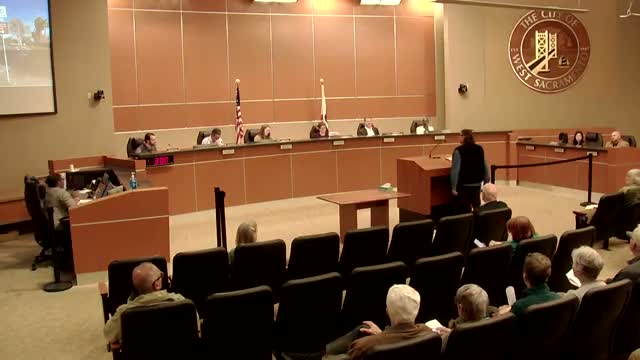
Consultants working on West Sacramento’s Bicycle, Pedestrian and Trails Master Plan told the Transportation, Mobility & Infrastructure Commission on Wednesday that they have compiled an initial list of candidate infrastructure projects and a measurable scoring framework to rank them for future funding.
Trace McMillan, a principal with Nelson Nygaard, said the prioritization approach groups previous plan goals into four measurable categories—mobility, safety and community, connectivity and culture of activity—and assigns points to objective variables such as pedestrian network density, crash history, access to key destinations and potential for mode shift. “Scoring is really what helps us to provide or develop a numerical ranking of potential projects,” McMillan said.
The consultants proposed scoring variables tied to grant-eligibility data commonly used in California, including an SB 535 disadvantaged-community threshold. Under that approach projects receive points for falling inside qualified SB 535 census areas used in many state grant programs. McMillan emphasized the threshold is implemented as a funding advantage in later grant stages but said the team is open to treating disadvantagedness with more granularity if the commission wants to rate subareas rather than use a binary cutoff.
Niru, project manager at Civic Thread, described Phase 2 engagement planned for mid-April to mid-May. Instead of asking residents to weigh individual projects, the team will use a trade-off budgeting exercise that asks participants to allocate a hypothetical budget across project categories (on-street facilities, off-street trails and intersection improvements). The exercise aims to surface priorities—safety, connectivity, mobility or access—while the technical scoring runs in the background.
Public commentators from Sacramento Area Bicycle Advocates voiced support for moving the plan forward. “We highly support this plan… and urge you to push it forward to city council for its recommendation,” Deborah Banks, executive director of SABA, told the commission. Jeremiah Rohrer, also with SABA, framed bicycle infrastructure as an economic asset: “Bicycling creates a circular economy for your government,” he said.
Commissioners asked how safety would be weighted relative to other categories and whether implementation readiness and cost-effectiveness would be used to elevate shovel-ready projects. McMillan said there are two options: apply a weight to safety as a post-score multiplier or incorporate implementation readiness (for example, projects already in the CIP) as a separate category so shovel-ready projects can be prioritized.
The consultants said they had sent a preliminary project list to the city for internal review and expected that list to be refined by mid-March before scoring begins. The advisory group is scheduled to revisit the plan in May to review policy and program recommendations as well as project tiers.
The commission did not take formal action; the consultants will return with scored project tiers, refined maps and a schedule for Phase 2 outreach.
Trace McMillan, a principal with Nelson Nygaard, said the prioritization approach groups previous plan goals into four measurable categories—mobility, safety and community, connectivity and culture of activity—and assigns points to objective variables such as pedestrian network density, crash history, access to key destinations and potential for mode shift. “Scoring is really what helps us to provide or develop a numerical ranking of potential projects,” McMillan said.
The consultants proposed scoring variables tied to grant-eligibility data commonly used in California, including an SB 535 disadvantaged-community threshold. Under that approach projects receive points for falling inside qualified SB 535 census areas used in many state grant programs. McMillan emphasized the threshold is implemented as a funding advantage in later grant stages but said the team is open to treating disadvantagedness with more granularity if the commission wants to rate subareas rather than use a binary cutoff.
Niru, project manager at Civic Thread, described Phase 2 engagement planned for mid-April to mid-May. Instead of asking residents to weigh individual projects, the team will use a trade-off budgeting exercise that asks participants to allocate a hypothetical budget across project categories (on-street facilities, off-street trails and intersection improvements). The exercise aims to surface priorities—safety, connectivity, mobility or access—while the technical scoring runs in the background.
Public commentators from Sacramento Area Bicycle Advocates voiced support for moving the plan forward. “We highly support this plan… and urge you to push it forward to city council for its recommendation,” Deborah Banks, executive director of SABA, told the commission. Jeremiah Rohrer, also with SABA, framed bicycle infrastructure as an economic asset: “Bicycling creates a circular economy for your government,” he said.
Commissioners asked how safety would be weighted relative to other categories and whether implementation readiness and cost-effectiveness would be used to elevate shovel-ready projects. McMillan said there are two options: apply a weight to safety as a post-score multiplier or incorporate implementation readiness (for example, projects already in the CIP) as a separate category so shovel-ready projects can be prioritized.
The consultants said they had sent a preliminary project list to the city for internal review and expected that list to be refined by mid-March before scoring begins. The advisory group is scheduled to revisit the plan in May to review policy and program recommendations as well as project tiers.
The commission did not take formal action; the consultants will return with scored project tiers, refined maps and a schedule for Phase 2 outreach.
View the Full Meeting & All Its Details
This article offers just a summary. Unlock complete video, transcripts, and insights as a Founder Member.
✓
Watch full, unedited meeting videos
✓
Search every word spoken in unlimited transcripts
✓
AI summaries & real-time alerts (all government levels)
✓
Permanent access to expanding government content
30-day money-back guarantee
