Board takes first reading on 15 policies, including clarifications for homeschooling testing
March 02, 2026 | Calhoun 01, School Districts, South Carolina
This article was created by AI summarizing key points discussed. AI makes mistakes, so for full details and context, please refer to the video of the full meeting. Please report any errors so we can fix them. Report an error »
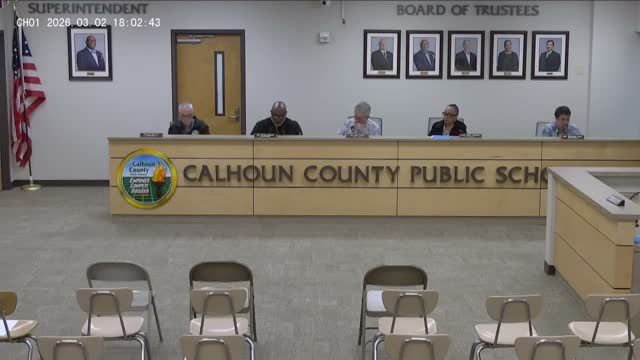
Ms. Keller told the board she was presenting a packet of policy updates and that the board should take a first reading on 15 policies, three administrative rules and one file. “I stand before you to give first reading on 15 policies, 3 administrative rules, and 1 file,” Ms. Keller said.
Why it matters: the policies cover special education services, gifted and talented programs, career-transition supports, summer school, Advanced Placement, and homeschooling rules that affect whether, when and where homeschooled students take state assessments.
During a detailed review, Ms. Keller explained the changes shown in the packet: text highlighted in red should be removed and yellow indicates the proposed additions. She summarized Policy IHBA on services for students with exceptional education needs and Policy IHBB establishing gifted and talented programs for grades 3 through 12. She also reviewed proposed language on advanced placement, summer school operations, before- and after-school childcare and adult community education.
Board members focused most on Policy IHBG, the homeschooling policy and its application form. Miss Murdaugh explained three pathways for homeschooling and the district's role in each: district homeschooling (option 1), an approved homeschool association (option 2), or a cluster model (option 3). “If a student or if a parent and a student chooses option 2 and option 3, they are not required to come back into our schools to test because they are no longer with us as students,” Miss Murdaugh said, adding that only students who remain enrolled through the district must return to the home school building for state assessments.
Board members asked whether the district receives funding for homeschool students under any option; a board member stated there is no funding for those students. Ms. Keller also noted edits to the IHBG-E application and asked the board to review formatting and capitalization changes.
Members briefly debated formatting for the file title and agreed to add a hyphen ("at-home instruction") to make the phrase clearer, a stylistic change that does not alter policy substance. Mr. Jenkins moved that the board take first reading on the full packet; the motion was seconded, put to a voice vote and carried.
The first-reading action does not adopt the policies; it advances the packet for further consideration under board procedures. The board acknowledged Ms. Keller and Miss Murdaugh for the presentation and scheduled follow-up under the regular meeting process.
Why it matters: the policies cover special education services, gifted and talented programs, career-transition supports, summer school, Advanced Placement, and homeschooling rules that affect whether, when and where homeschooled students take state assessments.
During a detailed review, Ms. Keller explained the changes shown in the packet: text highlighted in red should be removed and yellow indicates the proposed additions. She summarized Policy IHBA on services for students with exceptional education needs and Policy IHBB establishing gifted and talented programs for grades 3 through 12. She also reviewed proposed language on advanced placement, summer school operations, before- and after-school childcare and adult community education.
Board members focused most on Policy IHBG, the homeschooling policy and its application form. Miss Murdaugh explained three pathways for homeschooling and the district's role in each: district homeschooling (option 1), an approved homeschool association (option 2), or a cluster model (option 3). “If a student or if a parent and a student chooses option 2 and option 3, they are not required to come back into our schools to test because they are no longer with us as students,” Miss Murdaugh said, adding that only students who remain enrolled through the district must return to the home school building for state assessments.
Board members asked whether the district receives funding for homeschool students under any option; a board member stated there is no funding for those students. Ms. Keller also noted edits to the IHBG-E application and asked the board to review formatting and capitalization changes.
Members briefly debated formatting for the file title and agreed to add a hyphen ("at-home instruction") to make the phrase clearer, a stylistic change that does not alter policy substance. Mr. Jenkins moved that the board take first reading on the full packet; the motion was seconded, put to a voice vote and carried.
The first-reading action does not adopt the policies; it advances the packet for further consideration under board procedures. The board acknowledged Ms. Keller and Miss Murdaugh for the presentation and scheduled follow-up under the regular meeting process.
View the Full Meeting & All Its Details
This article offers just a summary. Unlock complete video, transcripts, and insights as a Founder Member.
✓
Watch full, unedited meeting videos
✓
Search every word spoken in unlimited transcripts
✓
AI summaries & real-time alerts (all government levels)
✓
Permanent access to expanding government content
30-day money-back guarantee
