Fortis Capital seeks $1 million from Minnesota to expand gap lending for underserved entrepreneurs
March 03, 2026 | 2026 Legislature MN, Minnesota
This article was created by AI summarizing key points discussed. AI makes mistakes, so for full details and context, please refer to the video of the full meeting. Please report any errors so we can fix them. Report an error »
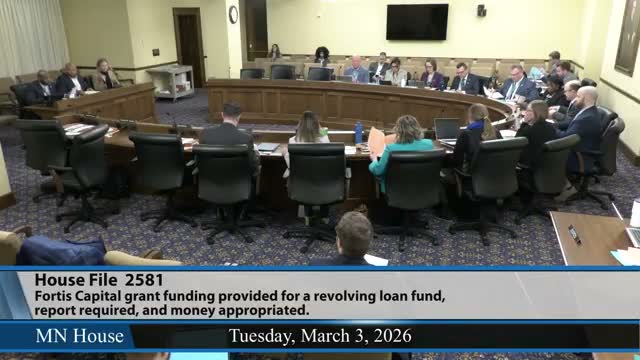
Fortis Capital told the House Workforce, Labor and Economic Development Committee that a $1,000,000 state investment would expand its lending to entrepreneurs who lack traditional collateral or credit history. Representative Frazier, who carried House File 2,581, said mission‑driven capital complements traditional banks and can help residents in communities historically excluded from mainstream finance.
"Access to capital is one of the most important pathways to wealth building in our economy," Representative Frazier said, urging support for entrepreneurs who lack collateral, generational wealth or proximity to major financial institutions.
Brian Smith, co‑founder and CEO of Fortis Capital, described a model that partners with community organizations, CDFIs and banks to provide flexible debt products and fill financing gaps. Smith said Fortis has deployed 37 loans totaling just over $4,000,000 since 2021, leveraged roughly $29,500,000 in additional capital, and reported two defaults during that period. He requested $1,000,000 in state funding to increase lending capacity and "unlock significantly more private capital alongside state dollars."
Smith said Fortis's highest interest rate to date was 8.5% (on a bridge loan), its lowest product is 2% (interest‑only), and the organization’s average rate is about 6.5%.
Committee members pressed agency staff from the Department of Employment and Economic Development about how Fortis would fit with existing state programs. DEED's government relations director said that while programs such as an emerging entrepreneur loan program exist, Fortis itself is often not eligible to receive grant funds because those grants typically go directly to borrowers rather than lenders. Fortis representatives said their product is a revolving loan fund that uses some interest to support operations and is structured so capital can be redeployed.
Representative Dave Baker noted Fortis takes on risk that other lenders do not, and asked about defaults and how the fund is intended to revolve; Smith confirmed the fund is structured to revolve and that prior appropriations (a $300,000 award) have already been deployed.
After questions and closing remarks, the chair laid over House File 2,581 for possible inclusion in a budget bill; the committee did not adopt the appropriation during the hearing.
What happens next: The bill was laid over for possible inclusion in a budget bill; proponents and agency staff indicated more work remains to align the request with state procurement and competitive‑grant requirements.
"Access to capital is one of the most important pathways to wealth building in our economy," Representative Frazier said, urging support for entrepreneurs who lack collateral, generational wealth or proximity to major financial institutions.
Brian Smith, co‑founder and CEO of Fortis Capital, described a model that partners with community organizations, CDFIs and banks to provide flexible debt products and fill financing gaps. Smith said Fortis has deployed 37 loans totaling just over $4,000,000 since 2021, leveraged roughly $29,500,000 in additional capital, and reported two defaults during that period. He requested $1,000,000 in state funding to increase lending capacity and "unlock significantly more private capital alongside state dollars."
Smith said Fortis's highest interest rate to date was 8.5% (on a bridge loan), its lowest product is 2% (interest‑only), and the organization’s average rate is about 6.5%.
Committee members pressed agency staff from the Department of Employment and Economic Development about how Fortis would fit with existing state programs. DEED's government relations director said that while programs such as an emerging entrepreneur loan program exist, Fortis itself is often not eligible to receive grant funds because those grants typically go directly to borrowers rather than lenders. Fortis representatives said their product is a revolving loan fund that uses some interest to support operations and is structured so capital can be redeployed.
Representative Dave Baker noted Fortis takes on risk that other lenders do not, and asked about defaults and how the fund is intended to revolve; Smith confirmed the fund is structured to revolve and that prior appropriations (a $300,000 award) have already been deployed.
After questions and closing remarks, the chair laid over House File 2,581 for possible inclusion in a budget bill; the committee did not adopt the appropriation during the hearing.
What happens next: The bill was laid over for possible inclusion in a budget bill; proponents and agency staff indicated more work remains to align the request with state procurement and competitive‑grant requirements.
View the Full Meeting & All Its Details
This article offers just a summary. Unlock complete video, transcripts, and insights as a Founder Member.
✓
Watch full, unedited meeting videos
✓
Search every word spoken in unlimited transcripts
✓
AI summaries & real-time alerts (all government levels)
✓
Permanent access to expanding government content
30-day money-back guarantee
