Committee advances bill to codify accommodations process after witnesses warn federal rollback could strip protections
March 03, 2026 | 2026 Legislature MN, Minnesota
This article was created by AI summarizing key points discussed. AI makes mistakes, so for full details and context, please refer to the video of the full meeting. Please report any errors so we can fix them. Report an error »
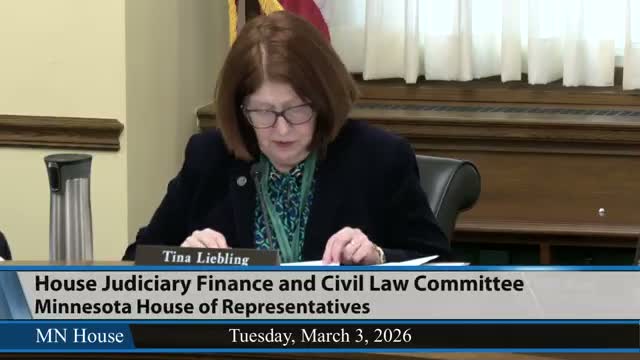
The Judiciary, Finance and Civil Law Committee on March 3 voted unanimously to place House File 2380 on the General Register, a bill that would clarify how reasonable accommodations are treated under Minnesota law.
Representative Hicks presented the bill and a delete‑everything amendment (DE1) that sponsors said aligns the proposal with existing statutory frameworks while reinforcing that failure to participate in the interactive process to determine accommodations "may be considered discriminatory." The amendment passed by voice vote and the committee later approved moving the bill to the General Register by recorded vote, 13–0.
Speakers representing disability organizations framed the bill as insurance against a possible weakening of federal protections. Ellen Smart, a staff attorney with the Minnesota Disability Law Center, cited federal developments and litigation including Texas v. Kennedy and urged Minnesota to enshrine protections in state law so that Section 504–style protections survive any federal rollback.
Jillian Nelson, policy director at the Autism Society of Minnesota, described HF2380 as a step to ensure access to education, health care, employment and community life for people with disabilities: "Without accommodations, we lose access to education, health care, transportation, employment, and more," she said.
Joel Runnels of the Minnesota Council on Disabilities said the bill clarifies the public‑policy section of the Minnesota Human Rights Act (Minn. Stat. ch. 363A) to emphasize that failure to engage in the accommodations process may itself be an unfair discriminatory practice. Multiple witnesses asked the legislature to act because, they said, administrative channels alone have not ensured consistent engagement.
Committee members asked technical questions about placement in statute and potential unintended interactions (for example, with 14(c) wage exemptions). Representative Hicks said the language uses "may" expressly to avoid creating absolutes while clarifying that refusal to engage in the interactive process can be discriminatory depending on the circumstances.
After questions and remarks from members, Representative Curran requested a roll call. The recorded vote to move HF2380 to the General Register was 13 Aye, 0 Nay. Sponsors and advocates said they planned continued stakeholder work as the bill proceeds through the legislative process.
The committee’s vote sends HF2380 to the next stage of consideration in the House during this session.
Representative Hicks presented the bill and a delete‑everything amendment (DE1) that sponsors said aligns the proposal with existing statutory frameworks while reinforcing that failure to participate in the interactive process to determine accommodations "may be considered discriminatory." The amendment passed by voice vote and the committee later approved moving the bill to the General Register by recorded vote, 13–0.
Speakers representing disability organizations framed the bill as insurance against a possible weakening of federal protections. Ellen Smart, a staff attorney with the Minnesota Disability Law Center, cited federal developments and litigation including Texas v. Kennedy and urged Minnesota to enshrine protections in state law so that Section 504–style protections survive any federal rollback.
Jillian Nelson, policy director at the Autism Society of Minnesota, described HF2380 as a step to ensure access to education, health care, employment and community life for people with disabilities: "Without accommodations, we lose access to education, health care, transportation, employment, and more," she said.
Joel Runnels of the Minnesota Council on Disabilities said the bill clarifies the public‑policy section of the Minnesota Human Rights Act (Minn. Stat. ch. 363A) to emphasize that failure to engage in the accommodations process may itself be an unfair discriminatory practice. Multiple witnesses asked the legislature to act because, they said, administrative channels alone have not ensured consistent engagement.
Committee members asked technical questions about placement in statute and potential unintended interactions (for example, with 14(c) wage exemptions). Representative Hicks said the language uses "may" expressly to avoid creating absolutes while clarifying that refusal to engage in the interactive process can be discriminatory depending on the circumstances.
After questions and remarks from members, Representative Curran requested a roll call. The recorded vote to move HF2380 to the General Register was 13 Aye, 0 Nay. Sponsors and advocates said they planned continued stakeholder work as the bill proceeds through the legislative process.
The committee’s vote sends HF2380 to the next stage of consideration in the House during this session.
View the Full Meeting & All Its Details
This article offers just a summary. Unlock complete video, transcripts, and insights as a Founder Member.
✓
Watch full, unedited meeting videos
✓
Search every word spoken in unlimited transcripts
✓
AI summaries & real-time alerts (all government levels)
✓
Permanent access to expanding government content
30-day money-back guarantee
