State Rep. Nolan West announces bill to require cameras and 28-day retention in state-funded child-care infant and toddler rooms
March 03, 2026 | 2026 Legislature MN, Minnesota
This article was created by AI summarizing key points discussed. AI makes mistakes, so for full details and context, please refer to the video of the full meeting. Please report any errors so we can fix them. Report an error »
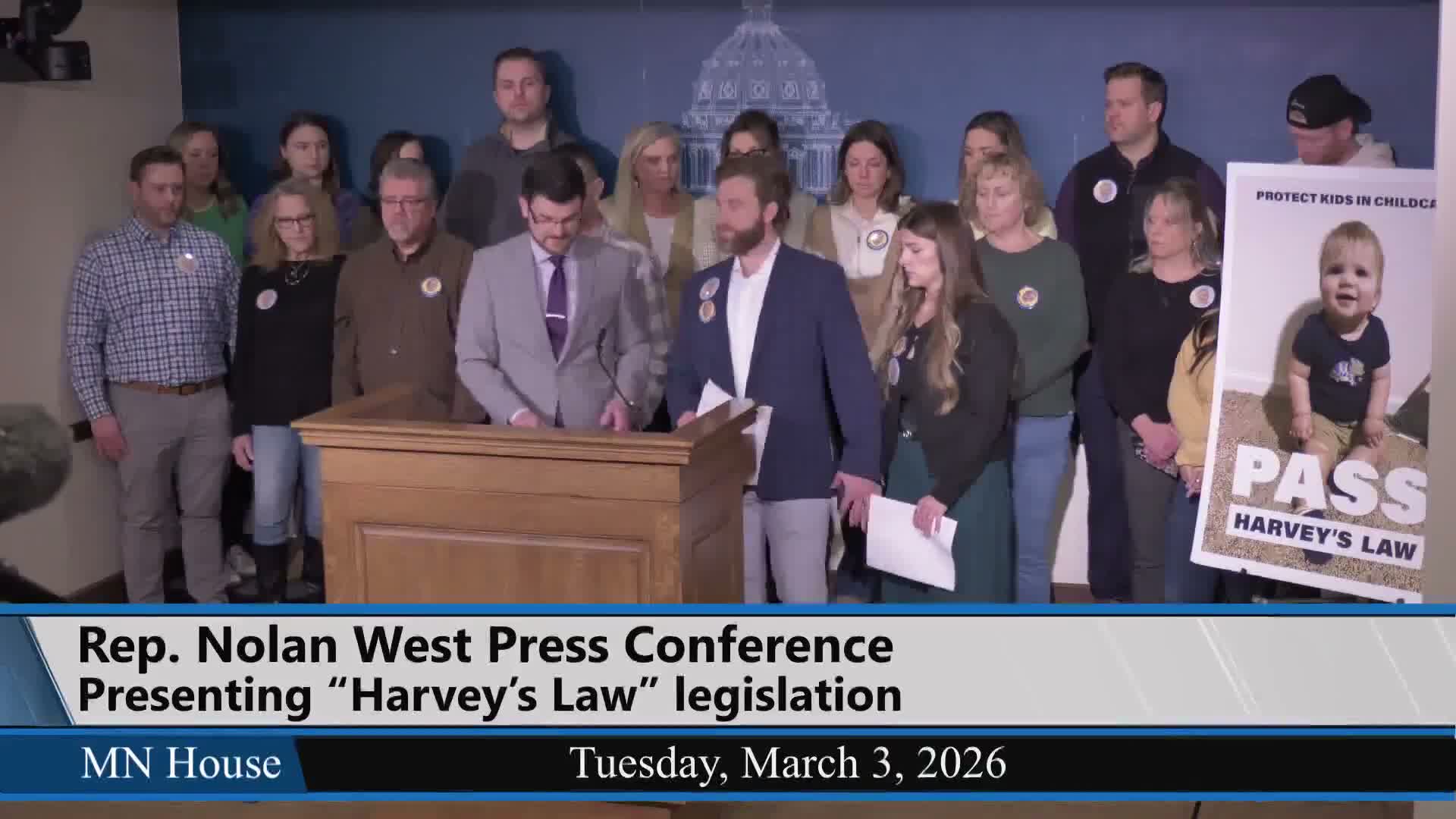
State Representative Nolan West announced legislation he calls "Harvey's Law" to require child-care centers that receive state funding to install cameras in infant and toddler rooms and retain video for 28 days, citing a Blaine police investigation in 2024 in which potentially relevant footage was deleted after the vendor's seven-day retention period.
At a press event, Representative Nolan West said he is introducing the bill after meeting with Catherine and Hunter Mucklebust, whose son Harvey Jean Mucklebust died last year. "We need to pass Harvey's law," West said, arguing that extended retention and comprehensive coverage would make it possible to identify wrongdoing and hold perpetrators accountable.
The proposal would apply to centers that receive state assistance through CCAP, early learning scholarships, or Great Start compensation, West said. "It says that any childcare center that receives state funding through CCAP, early learning scholarships, or Great Start compensation must install cameras in all infant and toddler rooms and retain the footage for 28 days," he said. West described the measure as an expansion of provisions referenced during last year's session tied to House File 1915, which he said had required cameras only after maltreatment violations.
Catherine Mucklebust recounted the events that prompted the bill. "Our son, Harvey Jean Mucklebust, was 5 days short of his first birthday when he was murdered at day care," she said, and she argued that "Harvey's death was completely avoidable if cameras were installed." Her husband, Hunter Mucklebust, said the family will continue to press for the measure even if the enacted law falls short of their full proposal.
Representative West read a statement from Captain Mark Borboom of the Blaine Police Department that described a 2024 case in which investigators found the center's video system retained footage for just seven days, and by the time concerns were reported the potentially relevant footage had been lost. The statement, as read by West, said that inadequate retention "may compromise" the opportunity to identify and understand significant events involving a child.
West addressed privacy and cybersecurity concerns raised by questioners, saying the bill mandates closed-circuit systems, audit logs and access controls. "When somebody hacks into a network, usually it's just a stupid password or a phishing attempt," West said. He added that the bill's technology standards and forthcoming testimony from cybersecurity experts are intended to limit unauthorized access.
On parental access to live streams or footage, West noted that last year's changes restricted broad parent access: under the existing rules he described, access is limited unless there is a criminal investigation and centers designate who may view footage; facilities that had cameras in place before July 1 are exempt from those particular restrictions and may continue their prior arrangements. West said he did not plan to mandate live streaming and that his priority was ensuring cameras are present and that footage is retained long enough to be useful to investigators.
Procedurally, West said the bill was at the reviser's office at the time of the event and he expected it to be heard March 10; he said he is seeking coauthors in the Senate. He also clarified the measure is distinct from an unrelated bill on CCAP fraud that was scheduled for a separate hearing.
The Mucklebusts and West urged lawmakers to act, saying the broader goal is accountability and protection for children in settings where parents rely on providers. The committee hearing is expected to include cybersecurity experts and further testimony; West said he hopes to introduce the bill formally soon.
At a press event, Representative Nolan West said he is introducing the bill after meeting with Catherine and Hunter Mucklebust, whose son Harvey Jean Mucklebust died last year. "We need to pass Harvey's law," West said, arguing that extended retention and comprehensive coverage would make it possible to identify wrongdoing and hold perpetrators accountable.
The proposal would apply to centers that receive state assistance through CCAP, early learning scholarships, or Great Start compensation, West said. "It says that any childcare center that receives state funding through CCAP, early learning scholarships, or Great Start compensation must install cameras in all infant and toddler rooms and retain the footage for 28 days," he said. West described the measure as an expansion of provisions referenced during last year's session tied to House File 1915, which he said had required cameras only after maltreatment violations.
Catherine Mucklebust recounted the events that prompted the bill. "Our son, Harvey Jean Mucklebust, was 5 days short of his first birthday when he was murdered at day care," she said, and she argued that "Harvey's death was completely avoidable if cameras were installed." Her husband, Hunter Mucklebust, said the family will continue to press for the measure even if the enacted law falls short of their full proposal.
Representative West read a statement from Captain Mark Borboom of the Blaine Police Department that described a 2024 case in which investigators found the center's video system retained footage for just seven days, and by the time concerns were reported the potentially relevant footage had been lost. The statement, as read by West, said that inadequate retention "may compromise" the opportunity to identify and understand significant events involving a child.
West addressed privacy and cybersecurity concerns raised by questioners, saying the bill mandates closed-circuit systems, audit logs and access controls. "When somebody hacks into a network, usually it's just a stupid password or a phishing attempt," West said. He added that the bill's technology standards and forthcoming testimony from cybersecurity experts are intended to limit unauthorized access.
On parental access to live streams or footage, West noted that last year's changes restricted broad parent access: under the existing rules he described, access is limited unless there is a criminal investigation and centers designate who may view footage; facilities that had cameras in place before July 1 are exempt from those particular restrictions and may continue their prior arrangements. West said he did not plan to mandate live streaming and that his priority was ensuring cameras are present and that footage is retained long enough to be useful to investigators.
Procedurally, West said the bill was at the reviser's office at the time of the event and he expected it to be heard March 10; he said he is seeking coauthors in the Senate. He also clarified the measure is distinct from an unrelated bill on CCAP fraud that was scheduled for a separate hearing.
The Mucklebusts and West urged lawmakers to act, saying the broader goal is accountability and protection for children in settings where parents rely on providers. The committee hearing is expected to include cybersecurity experts and further testimony; West said he hopes to introduce the bill formally soon.
Don't Miss a Word: See the Full Meeting!
Go beyond summaries. Unlock every video, transcript, and key insight with a Founder Membership.
✓
Get instant access to full meeting videos
✓
Search and clip any phrase from complete transcripts
✓
Receive AI-powered summaries & custom alerts
✓
Enjoy lifetime, unrestricted access to government data
30-day money-back guarantee
