Commission delays decision on Happy Valley hillside home after neighbors cite drainage and retaining‑wall concerns
March 03, 2026 | Lafayette, Contra Costa County, California
This article was created by AI summarizing key points discussed. AI makes mistakes, so for full details and context, please refer to the video of the full meeting. Please report any errors so we can fix them. Report an error »
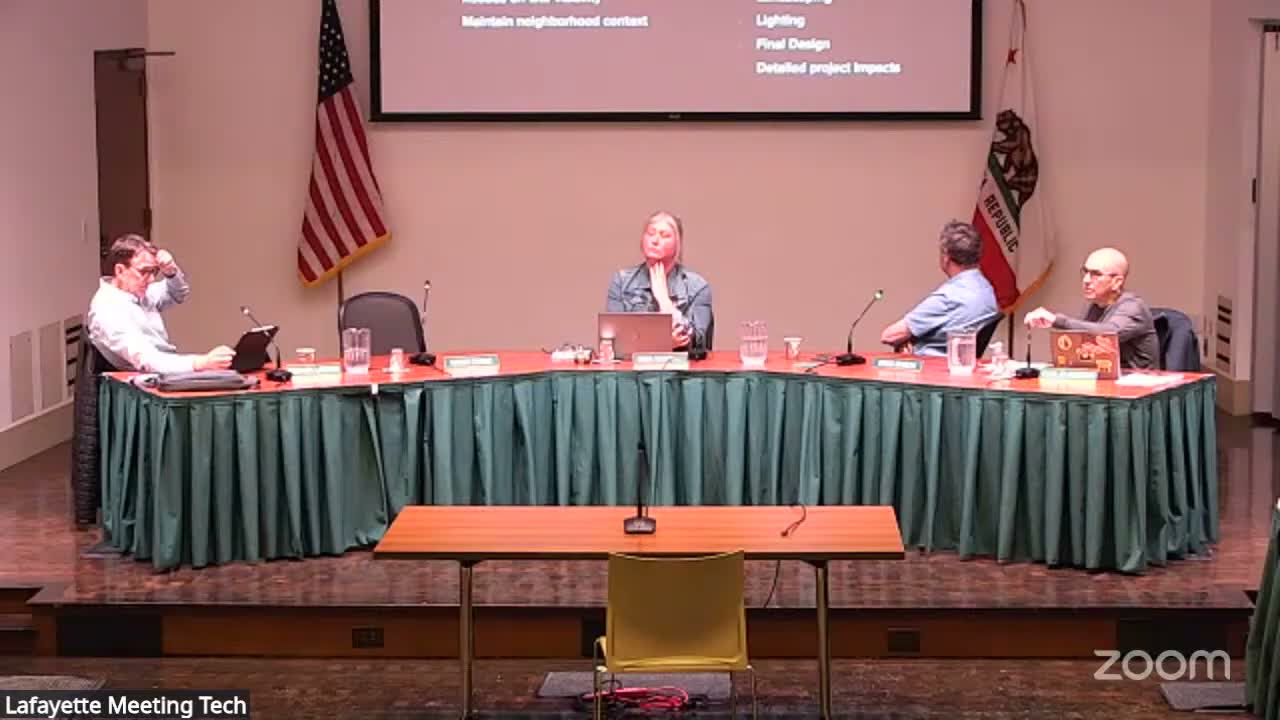
The Lafayette Planning Commission continued a phase‑1 hillside development permit application on March 2 after extended public comment and commissioner questioning about subsurface drainage, large retaining walls and inadequate visual context.
Staff presented a phase‑1 request for a lot‑line adjustment and siting of a proposed 6,160‑square‑foot two‑story residence on a 7.93‑acre hillside parcel in the R‑40 zoning district, noting prior application history, tree‑protection rules and that a geotechnical and hydrology report had been submitted. The staff presentation included a recommended finding that the project is exempt from CEQA under the AB 130 statutory exemption as described in the staff report.
Neighbors and technical critics asked for stronger evidence. "What we need is cores, samplings, something that gives us a bonafide hydrology report that tells us where the subterranean flows are and where they're going to go," neighbor Paul Sachs said during the public comment period, urging an independent peer review of the hydrology given repeated history of flooding and slides in the area.
Other speakers and commissioners highlighted uncertainty about retaining‑wall dimensions and the visual impact along Happy Valley Road. Several speakers referenced prior denials and long application history and asked that mailed notice lists be rechecked to ensure neighbors were notified. Commissioners asked that the applicant provide clearer plan sections showing existing and finished grades, elevations depicting retaining‑wall heights from the public road, and that the hydrology and geotechnical reports be included in the next staff packet for commission review.
Applicant architect Edward Patmont said the new proposal is intended to reduce massing, follow natural grade with an embedded garage and use modern geotechnical methods. He summarized mitigation measures including subdrains, on‑site bioretention and pier foundations and said the site’s sandstone bench makes it geotechnically suitable.
Continuance and next steps: Commissioner LaBonge moved — and Commissioner DiGiorgio seconded — to continue the matter to a date certain of April 20 with the requested additional materials (hydrology and geotechnical reports included in the packet, plan sections and elevations showing retaining‑wall heights, visual massing from the public roadway, and confirmation of mailed notices). The motion passed 4‑0 (Vice Chair Deming absent). The commission directed staff to include the existing hydrology and geotechnical reports in the next package and to work with the applicant on clearer visual exhibits for massing and retaining walls.
What’s next: The item will return to the Planning Commission on April 20 with the additional materials; staff indicated the item may also be reviewed by the Design Review Commission in phase‑2 design review and that the commission can condition the phase‑1 approval to require specific phase‑2 outcomes.
Staff presented a phase‑1 request for a lot‑line adjustment and siting of a proposed 6,160‑square‑foot two‑story residence on a 7.93‑acre hillside parcel in the R‑40 zoning district, noting prior application history, tree‑protection rules and that a geotechnical and hydrology report had been submitted. The staff presentation included a recommended finding that the project is exempt from CEQA under the AB 130 statutory exemption as described in the staff report.
Neighbors and technical critics asked for stronger evidence. "What we need is cores, samplings, something that gives us a bonafide hydrology report that tells us where the subterranean flows are and where they're going to go," neighbor Paul Sachs said during the public comment period, urging an independent peer review of the hydrology given repeated history of flooding and slides in the area.
Other speakers and commissioners highlighted uncertainty about retaining‑wall dimensions and the visual impact along Happy Valley Road. Several speakers referenced prior denials and long application history and asked that mailed notice lists be rechecked to ensure neighbors were notified. Commissioners asked that the applicant provide clearer plan sections showing existing and finished grades, elevations depicting retaining‑wall heights from the public road, and that the hydrology and geotechnical reports be included in the next staff packet for commission review.
Applicant architect Edward Patmont said the new proposal is intended to reduce massing, follow natural grade with an embedded garage and use modern geotechnical methods. He summarized mitigation measures including subdrains, on‑site bioretention and pier foundations and said the site’s sandstone bench makes it geotechnically suitable.
Continuance and next steps: Commissioner LaBonge moved — and Commissioner DiGiorgio seconded — to continue the matter to a date certain of April 20 with the requested additional materials (hydrology and geotechnical reports included in the packet, plan sections and elevations showing retaining‑wall heights, visual massing from the public roadway, and confirmation of mailed notices). The motion passed 4‑0 (Vice Chair Deming absent). The commission directed staff to include the existing hydrology and geotechnical reports in the next package and to work with the applicant on clearer visual exhibits for massing and retaining walls.
What’s next: The item will return to the Planning Commission on April 20 with the additional materials; staff indicated the item may also be reviewed by the Design Review Commission in phase‑2 design review and that the commission can condition the phase‑1 approval to require specific phase‑2 outcomes.
Don't Miss a Word: See the Full Meeting!
Go beyond summaries. Unlock every video, transcript, and key insight with a Founder Membership.
✓
Get instant access to full meeting videos
✓
Search and clip any phrase from complete transcripts
✓
Receive AI-powered summaries & custom alerts
✓
Enjoy lifetime, unrestricted access to government data
30-day money-back guarantee
