Lafayette commission reviews downtown parking study, pushes staff to prioritize inventory, shared parking and simpler time limits
March 03, 2026 | Lafayette, Contra Costa County, California
This article was created by AI summarizing key points discussed. AI makes mistakes, so for full details and context, please refer to the video of the full meeting. Please report any errors so we can fix them. Report an error »
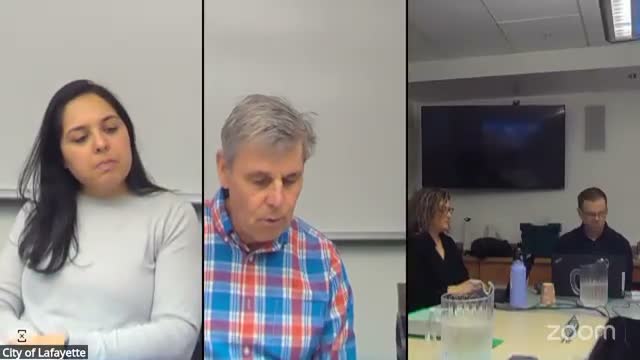
The City of Lafayette Transportation and Circulation Commission on March 2 reviewed a consultant’s Downtown Lafayette parking management study and gave staff direction to prioritize near‑term operational fixes — notably a full inventory of parking supply, negotiated shared‑parking agreements and simpler, more consistent time limits.
Terry O'Connor, an Alta Planning consultant, told commissioners the study is focused on managing the existing system rather than building new parking, and that data and public outreach drove the recommendations. O'Connor said peak occupancy in downtown streets and lots generally runs at about 52–55% and that roughly 1,100 spaces remain unused at peak times, evidence the problem is distribution and management, not total supply. "This study is not about building new parking. However, it is about managing what already exists more effectively," the consultant said.
Commissioners and staff framed a three‑phase sequencing approach for implementation: Phase 1 would emphasize visible operational changes — employee parking strategies, shared‑use agreements with private lot owners, enforcement consistency, clearer signage and a data‑driven management program; Phase 2 would address governance and policy alignment; Phase 3 would reserve advanced tools such as a unified management platform and expanded permanent programs if data later show a need.
During Q&A, commissioners pressed for clarity on who would coordinate privately owned lots, whether the Chamber of Commerce or a private sector consortium could help, and whether the city should drive shared‑parking deals or act as a facilitator. The consultant said outreach to private owners is needed to enumerate available supply and that voluntary permit programs or third‑party management could be used. One commissioner suggested starting with a system inventory before negotiating agreements; others stressed shared responsibility between businesses and the city.
Commissioners also discussed enforcement capacity and meter technology. Staff and the consultant said an analysis is needed to determine whether citation revenue would cover enforcement labor and noted the city and vendors are moving toward more tech‑enabled pay options (for example, app‑based payment pilots like ParkMobile). The consultant recommended typical on‑street short‑term durations of about two to three hours in Lafayette and cautioned that dynamic pricing is more complex and may be appropriate at a later stage.
Public commenters pressed the commission on future supply pressures from new housing. Bill Frazier warned that recent and proposed downtown housing projects — including redevelopment at the temporary city lot at 949 Moraga (Miranda Road, adjacent to Lafayette Elementary) — will remove surface parking and intensify demand. A Zoom commenter identified as Mr. Lavoie said conversions of city lots and private lots to housing will make parking tight in prime commercial spots and asked where displaced parkers will be directed.
Staff noted the study was funded with a Metropolitan Transportation Commission (MTC) parking‑management planning grant and that state and regional policies — referenced in the presentation as "AB 2,097" and MTC's Transit‑Oriented Communities policy — push communities toward demand management, shared parking and multimodal access around transit hubs. Staff said the commission’s feedback would be used to shape a recommended management approach to bring to City Council, including identification of near‑term actions and any future budget request.
The commission did not adopt policy changes at the meeting; instead members gave guidance on Phase 1 priorities and asked staff to return to council with a recommended implementation program. The meeting closed after staff reminders and a note that the commission will present to City Council on March 9.
Terry O'Connor, an Alta Planning consultant, told commissioners the study is focused on managing the existing system rather than building new parking, and that data and public outreach drove the recommendations. O'Connor said peak occupancy in downtown streets and lots generally runs at about 52–55% and that roughly 1,100 spaces remain unused at peak times, evidence the problem is distribution and management, not total supply. "This study is not about building new parking. However, it is about managing what already exists more effectively," the consultant said.
Commissioners and staff framed a three‑phase sequencing approach for implementation: Phase 1 would emphasize visible operational changes — employee parking strategies, shared‑use agreements with private lot owners, enforcement consistency, clearer signage and a data‑driven management program; Phase 2 would address governance and policy alignment; Phase 3 would reserve advanced tools such as a unified management platform and expanded permanent programs if data later show a need.
During Q&A, commissioners pressed for clarity on who would coordinate privately owned lots, whether the Chamber of Commerce or a private sector consortium could help, and whether the city should drive shared‑parking deals or act as a facilitator. The consultant said outreach to private owners is needed to enumerate available supply and that voluntary permit programs or third‑party management could be used. One commissioner suggested starting with a system inventory before negotiating agreements; others stressed shared responsibility between businesses and the city.
Commissioners also discussed enforcement capacity and meter technology. Staff and the consultant said an analysis is needed to determine whether citation revenue would cover enforcement labor and noted the city and vendors are moving toward more tech‑enabled pay options (for example, app‑based payment pilots like ParkMobile). The consultant recommended typical on‑street short‑term durations of about two to three hours in Lafayette and cautioned that dynamic pricing is more complex and may be appropriate at a later stage.
Public commenters pressed the commission on future supply pressures from new housing. Bill Frazier warned that recent and proposed downtown housing projects — including redevelopment at the temporary city lot at 949 Moraga (Miranda Road, adjacent to Lafayette Elementary) — will remove surface parking and intensify demand. A Zoom commenter identified as Mr. Lavoie said conversions of city lots and private lots to housing will make parking tight in prime commercial spots and asked where displaced parkers will be directed.
Staff noted the study was funded with a Metropolitan Transportation Commission (MTC) parking‑management planning grant and that state and regional policies — referenced in the presentation as "AB 2,097" and MTC's Transit‑Oriented Communities policy — push communities toward demand management, shared parking and multimodal access around transit hubs. Staff said the commission’s feedback would be used to shape a recommended management approach to bring to City Council, including identification of near‑term actions and any future budget request.
The commission did not adopt policy changes at the meeting; instead members gave guidance on Phase 1 priorities and asked staff to return to council with a recommended implementation program. The meeting closed after staff reminders and a note that the commission will present to City Council on March 9.
View the Full Meeting & All Its Details
This article offers just a summary. Unlock complete video, transcripts, and insights as a Founder Member.
✓
Watch full, unedited meeting videos
✓
Search every word spoken in unlimited transcripts
✓
AI summaries & real-time alerts (all government levels)
✓
Permanent access to expanding government content
30-day money-back guarantee
