Brimfield trustees adopt multiple zoning text amendments to clarify building heights, add town‑center lighting and limit PRDs
March 03, 2026 | Brimfield Board of Trustees, Brimfield Town, Portage County, Ohio
This article was created by AI summarizing key points discussed. AI makes mistakes, so for full details and context, please refer to the video of the full meeting. Please report any errors so we can fix them. Report an error »
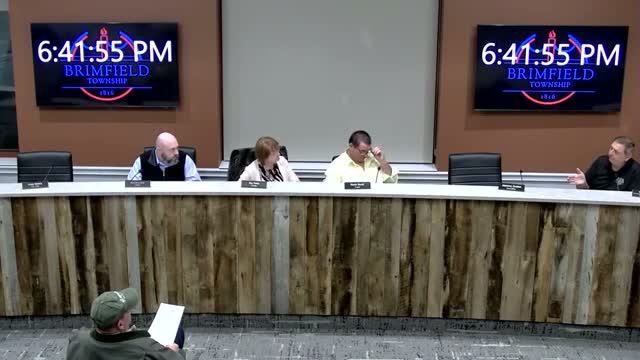
The Brimfield Board of Trustees voted unanimously Wednesday evening to approve a package of zoning text amendments that municipal staff and the zoning commission said will clarify measurement rules, standardize town‑center lighting and make it harder for large PRD (planned residential development) subdivisions to create quarter‑acre lots.
The board approved an amendment to chapter 10 that tightens the definition of "building height" so the full structure — measured from the average proposed finished grade to the eave and to parapet/roof line where applicable — is subject to the same 40‑foot limit. Michael Ladd, the staff member presenting the change, said the revision was prompted by a hotel architect measuring only the front eave and allowing the rear of a building to be taller. "This makes this uniform so the whole building is 40 feet so that our fire department can safely get people out if needed," Ladd said.
Trustees also adopted a new Appendix F establishing lighting standards for the town center. Ladd said two zoning‑commission members, Bill Anderson and Robert Reslovich, led the year‑long effort to create a uniform lighting district "so they're always looking the same," and regional planning had approved the proposal.
On subdivision rules, the board voted to remove the option for planned residential developments within the R‑2 district. Under the change, a developer using R‑2 would default to 1‑acre lots rather than the quarter‑acre lots allowed under PRDs, a change the zoning commission said will help preserve agricultural character and encourage custom building. Ladd described PRD removal as a tool to "hold on to more agriculture" and said the change will not ban subdivision entirely — developers may still seek variances through the BZA but such appeals will be harder to win.
Finally, trustees removed an extra, district‑specific restriction that had required a two‑acre minimum for certain medical uses (section 400.1(b)(51)), saying it duplicated existing district requirements and had forced unnecessary variances — for example, an oral surgery center at 1.95 acres had to apply for relief. The board was told the zoning changes are subject to a statutory 30‑day appeal period.
All of the amendments were advertised and reviewed by regional planning and the zoning commission before the board votes. Each motion passed on roll call with the trustees voting yes.
The board approved an amendment to chapter 10 that tightens the definition of "building height" so the full structure — measured from the average proposed finished grade to the eave and to parapet/roof line where applicable — is subject to the same 40‑foot limit. Michael Ladd, the staff member presenting the change, said the revision was prompted by a hotel architect measuring only the front eave and allowing the rear of a building to be taller. "This makes this uniform so the whole building is 40 feet so that our fire department can safely get people out if needed," Ladd said.
Trustees also adopted a new Appendix F establishing lighting standards for the town center. Ladd said two zoning‑commission members, Bill Anderson and Robert Reslovich, led the year‑long effort to create a uniform lighting district "so they're always looking the same," and regional planning had approved the proposal.
On subdivision rules, the board voted to remove the option for planned residential developments within the R‑2 district. Under the change, a developer using R‑2 would default to 1‑acre lots rather than the quarter‑acre lots allowed under PRDs, a change the zoning commission said will help preserve agricultural character and encourage custom building. Ladd described PRD removal as a tool to "hold on to more agriculture" and said the change will not ban subdivision entirely — developers may still seek variances through the BZA but such appeals will be harder to win.
Finally, trustees removed an extra, district‑specific restriction that had required a two‑acre minimum for certain medical uses (section 400.1(b)(51)), saying it duplicated existing district requirements and had forced unnecessary variances — for example, an oral surgery center at 1.95 acres had to apply for relief. The board was told the zoning changes are subject to a statutory 30‑day appeal period.
All of the amendments were advertised and reviewed by regional planning and the zoning commission before the board votes. Each motion passed on roll call with the trustees voting yes.
View the Full Meeting & All Its Details
This article offers just a summary. Unlock complete video, transcripts, and insights as a Founder Member.
✓
Watch full, unedited meeting videos
✓
Search every word spoken in unlimited transcripts
✓
AI summaries & real-time alerts (all government levels)
✓
Permanent access to expanding government content
30-day money-back guarantee
