Appeals panel hears dispute over $710,000 and whether a constructive trust was proper in Chicago Title v. Esig
March 03, 2026 | Legislative Ethics Board, Legislative Agencies, Legislative Sessions, Washington
This article was created by AI summarizing key points discussed. AI makes mistakes, so for full details and context, please refer to the video of the full meeting. Please report any errors so we can fix them. Report an error »
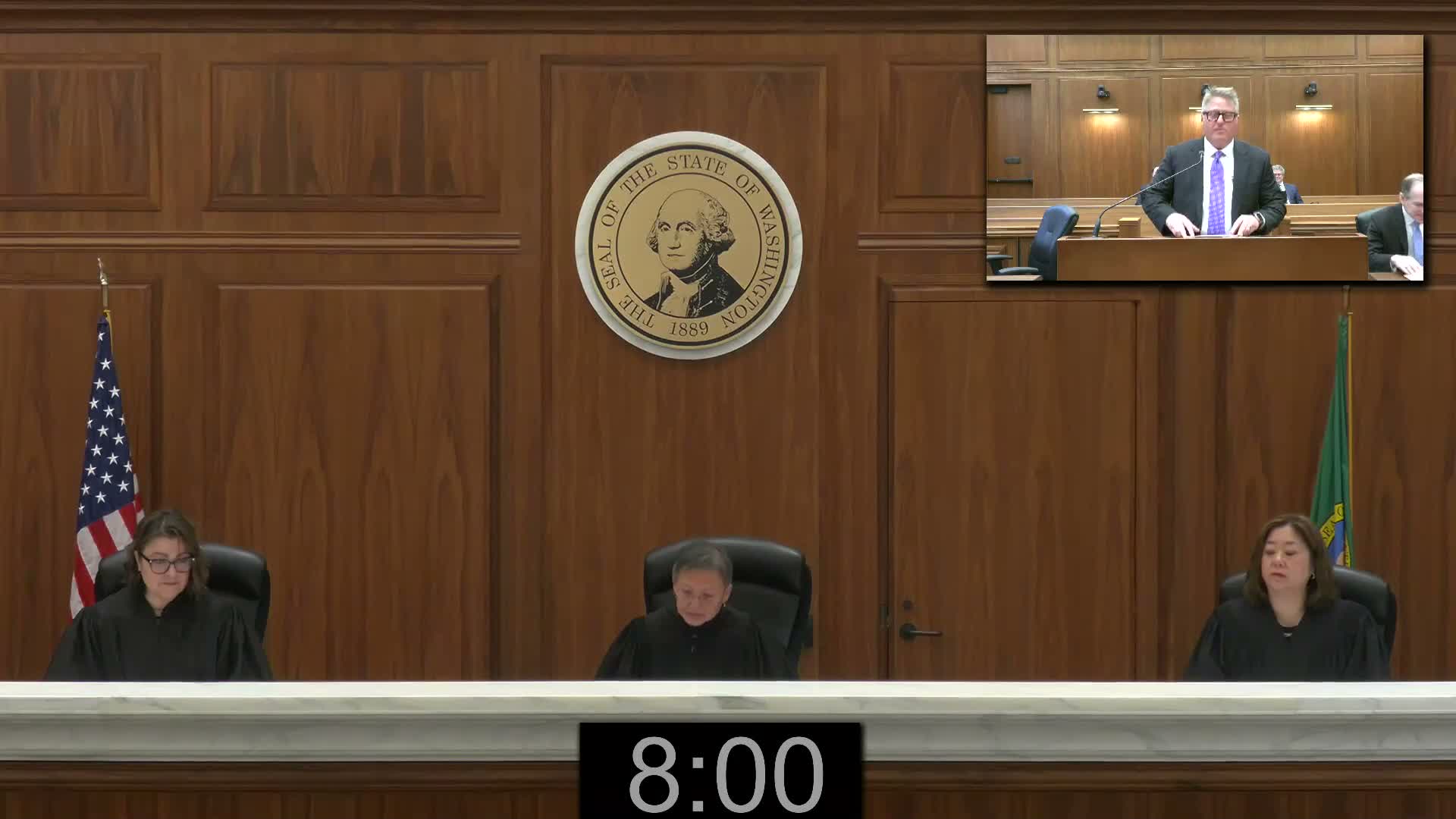
At an appellate argument, attorneys debated whether a trial court properly imposed a constructive trust on funds Chicago Title says came from a fraudulent loan.
Mark Thompson, counsel for the appellant David Esig, told the panel his client suffered an "inequitable reversal of fortune" when the trial court imposed a constructive trust rather than permitting a judgment directly against the alleged wrongdoer, Michael Lai. Thompson urged the court to review whether the record shows necessary legal elements for such a remedy and questioned whether the panel should treat parts of the trial court's ruling as findings of fact limited to substantial-evidence review or as legal conclusions subject to de novo review.
Brian Menehan, counsel for respondents Chicago Title Insurance Company and Chicago Title of Washington, asked the court to affirm. Menehan said "Appellant David Esig and his attorney Brian Keeley received facts and communications on at least 4 occasions demonstrating Michael Lai, who they knew to be a fraud perpetrator since 2015, committed fraud against lender Miller Bates and deposited $710,000 of the proceeds of that fraud in the court registry." He argued those facts and the failure to notify Miller Bates before withdrawing registry funds made Esig's retention unjust and supported imposition of a constructive trust.
The panel focused much of its questioning on two related issues: whether the trial court’s conclusion that attorney Keeley’s knowledge could be imputed to Esig is a factual finding or legal conclusion, and whether the modern case law the parties invoked requires proof of wrongdoing or permits constructive trusts where retention of property is inequitable. Counsel debated the interplay between Skamanski (an older line of cases that the panel noted allows constructive trusts even without wrongful acquisition where equity demands it) and later language in Baker v. Leonard, with Thompson arguing the record here does not show the level of wrongdoing Baker contemplates and Menehan emphasizing concealment, unjust enrichment and other circumstances that the Baker court described.
Respondents described a factual timeline the trial court found relevant: notices and communications in December informing counsel that Lai was applying for a loan to satisfy the judgment; discovery on Jan. 1 of a $3,000,000 loan and interbank transfers (US Bank to Cathay Bank) that preceded a roughly $710,000 deposit to the court registry; and a subsequent withdrawal without notice to Miller Bates, Chicago Title says, that left the lender and its title insurer harmed. Respondents also cited investigative details (Rick Spoonmore's analysis) showing money movement among banks.
Panel members repeatedly pressed whether proactive notice to the alleged victim or other steps by Esig would alter the equities. Menehan told the court the trial court found actual knowledge by Esig and Keeley that the funds were proceeds of a fraudulent loan and that knowledge made the taking unjust (he cited paragraph 11 of the trial court’s findings). Thompson maintained the core dispute is whether the record contains sufficient evidence to support imputation of knowledge and the constructive-trust conclusion.
The panel concluded questioning and the case was submitted for decision.
Next steps: the appellate court will issue a written opinion resolving whether the constructive trust was properly imposed and, if so, whether the trial court’s findings as to knowledge and wrongdoing are supported by the record.
Mark Thompson, counsel for the appellant David Esig, told the panel his client suffered an "inequitable reversal of fortune" when the trial court imposed a constructive trust rather than permitting a judgment directly against the alleged wrongdoer, Michael Lai. Thompson urged the court to review whether the record shows necessary legal elements for such a remedy and questioned whether the panel should treat parts of the trial court's ruling as findings of fact limited to substantial-evidence review or as legal conclusions subject to de novo review.
Brian Menehan, counsel for respondents Chicago Title Insurance Company and Chicago Title of Washington, asked the court to affirm. Menehan said "Appellant David Esig and his attorney Brian Keeley received facts and communications on at least 4 occasions demonstrating Michael Lai, who they knew to be a fraud perpetrator since 2015, committed fraud against lender Miller Bates and deposited $710,000 of the proceeds of that fraud in the court registry." He argued those facts and the failure to notify Miller Bates before withdrawing registry funds made Esig's retention unjust and supported imposition of a constructive trust.
The panel focused much of its questioning on two related issues: whether the trial court’s conclusion that attorney Keeley’s knowledge could be imputed to Esig is a factual finding or legal conclusion, and whether the modern case law the parties invoked requires proof of wrongdoing or permits constructive trusts where retention of property is inequitable. Counsel debated the interplay between Skamanski (an older line of cases that the panel noted allows constructive trusts even without wrongful acquisition where equity demands it) and later language in Baker v. Leonard, with Thompson arguing the record here does not show the level of wrongdoing Baker contemplates and Menehan emphasizing concealment, unjust enrichment and other circumstances that the Baker court described.
Respondents described a factual timeline the trial court found relevant: notices and communications in December informing counsel that Lai was applying for a loan to satisfy the judgment; discovery on Jan. 1 of a $3,000,000 loan and interbank transfers (US Bank to Cathay Bank) that preceded a roughly $710,000 deposit to the court registry; and a subsequent withdrawal without notice to Miller Bates, Chicago Title says, that left the lender and its title insurer harmed. Respondents also cited investigative details (Rick Spoonmore's analysis) showing money movement among banks.
Panel members repeatedly pressed whether proactive notice to the alleged victim or other steps by Esig would alter the equities. Menehan told the court the trial court found actual knowledge by Esig and Keeley that the funds were proceeds of a fraudulent loan and that knowledge made the taking unjust (he cited paragraph 11 of the trial court’s findings). Thompson maintained the core dispute is whether the record contains sufficient evidence to support imputation of knowledge and the constructive-trust conclusion.
The panel concluded questioning and the case was submitted for decision.
Next steps: the appellate court will issue a written opinion resolving whether the constructive trust was properly imposed and, if so, whether the trial court’s findings as to knowledge and wrongdoing are supported by the record.
Don't Miss a Word: See the Full Meeting!
Go beyond summaries. Unlock every video, transcript, and key insight with a Founder Membership.
✓
Get instant access to full meeting videos
✓
Search and clip any phrase from complete transcripts
✓
Receive AI-powered summaries & custom alerts
✓
Enjoy lifetime, unrestricted access to government data
30-day money-back guarantee
