Committee votes to produce bill authorizing oral‑fluid impaired‑driving testing
March 02, 2026 | 2026 Legislature ME, Maine
This article was created by AI summarizing key points discussed. AI makes mistakes, so for full details and context, please refer to the video of the full meeting. Please report any errors so we can fix them. Report an error »
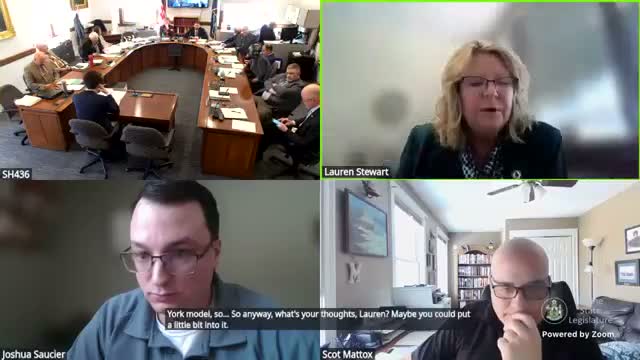
The Criminal Justice and Public Safety Committee voted to produce a committee bill based on its oral‑fluid testing report (appendix A contains draft language previously introduced as LD1135). The report and discussion addressed both statutory authority for oral‑fluid testing and the practical implementation needs for the state forensic laboratory and highway‑safety enforcement.
Highway Safety Director Lauren Stewart and laboratory staff described the tradeoffs: oral‑fluid sampling is less invasive than blood and can be collected by officers in the field, but laboratory validation and instrument procurement require one‑time and ongoing costs. Laboratory testimony estimated instrument purchase and validation at roughly $700,000 and two chemist positions to validate and maintain the test in the lab in the $300,000–$400,000 range — producing an upfront cost in the ballpark of $1.1 million and ongoing annual personnel costs.
Committee members debated whether to include statutory language now and seek funding later or to submit a single bill that pairs the statutory change with a fiscal note requesting implementation dollars. Supporters argued that placing the authority in statute prepares the state for rapid implementation should funds become available; others asked for the fiscal note and said the testing program should be submitted as a paired bill.
After caucus, the committee voted by hand to report out a committee bill that would place oral‑fluid testing authority into statute and to bring that committee bill back to this committee for a public hearing. The committee also approved the motion that the committee bill be referred to the Criminal Justice and Public Safety Committee for a public hearing rather than sent straight to the floor.
Next steps: Draft committee bill to be circulated to members; the committee will schedule a public hearing and a work session and requested that lab and highway safety staff prepare a fiscal estimate and options for funding.
Highway Safety Director Lauren Stewart and laboratory staff described the tradeoffs: oral‑fluid sampling is less invasive than blood and can be collected by officers in the field, but laboratory validation and instrument procurement require one‑time and ongoing costs. Laboratory testimony estimated instrument purchase and validation at roughly $700,000 and two chemist positions to validate and maintain the test in the lab in the $300,000–$400,000 range — producing an upfront cost in the ballpark of $1.1 million and ongoing annual personnel costs.
Committee members debated whether to include statutory language now and seek funding later or to submit a single bill that pairs the statutory change with a fiscal note requesting implementation dollars. Supporters argued that placing the authority in statute prepares the state for rapid implementation should funds become available; others asked for the fiscal note and said the testing program should be submitted as a paired bill.
After caucus, the committee voted by hand to report out a committee bill that would place oral‑fluid testing authority into statute and to bring that committee bill back to this committee for a public hearing. The committee also approved the motion that the committee bill be referred to the Criminal Justice and Public Safety Committee for a public hearing rather than sent straight to the floor.
Next steps: Draft committee bill to be circulated to members; the committee will schedule a public hearing and a work session and requested that lab and highway safety staff prepare a fiscal estimate and options for funding.
View the Full Meeting & All Its Details
This article offers just a summary. Unlock complete video, transcripts, and insights as a Founder Member.
✓
Watch full, unedited meeting videos
✓
Search every word spoken in unlimited transcripts
✓
AI summaries & real-time alerts (all government levels)
✓
Permanent access to expanding government content
30-day money-back guarantee
