Gilroy council adopts SB 707 rules for remote public participation, requires translation and disruption policy
March 02, 2026 | Gilroy, Santa Clara County, California
This article was created by AI summarizing key points discussed. AI makes mistakes, so for full details and context, please refer to the video of the full meeting. Please report any errors so we can fix them. Report an error »
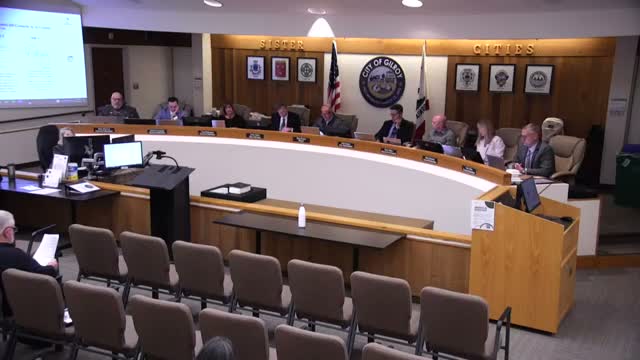
The Gilroy City Council voted 7-0 to adopt a policy to implement changes to the Ralph M. Brown Act under Senate Bill 707, after a staff presentation that detailed new teleconferencing categories, public-participation requirements and a required disruption policy for internet or telecommunication outages.
Andy, representing the city attorney’s office, summarized SB 707’s three teleconferencing pathways: the traditional prearranged remote-location option, an expanded “Just Cause” category (limited to five non-disability uses per member annually and requiring audio-visual participation), and a disability-based pathway that requires reasonable accommodation and carries no numeric limit. “Disability is required as assuming the city would make a reasonable accommodation,” Andy said, noting that disability teleconferencing treats the remote member as present for quorum purposes.
Andy and Kim outlined remote public-participation duties effective July 1: the city must provide two-way audio-visual or telephonic participation for the public, make agendas available in applicable languages (for Gilroy that requires Spanish translations), and offer non-disruptive live translation when requested. Kim said the agenda itself (not necessarily the full packet) must be translated in languages meeting the 20% population threshold and the city’s current Wordly service meets the requirement.
The staff-recommended disruption policy requires halting open session immediately if remote participation is interrupted and not resuming open session until at least one hour has passed or service is restored, unless the council makes an on-the-record finding that good-faith efforts to restore service were made and the public interest in resuming outweighs the interest in remote participation. Andy noted council could continue in closed session in some cases and that cutting off disruptive remote participants is permitted after an on-record warning.
Councilmembers asked about infrastructure and costs; staff estimated a one-time equipment upgrade of about $6,000 and a Zoom-webinar subscription estimated at about $3,800 per year. Staff also reported plans to add redundant fiber feeds for resilience. Ron Kirkish spoke during public comment to clarify that blocking disruptive behavior is permitted and not simply a geographic exclusion.
Councilmember Klein moved to receive the report and adopt the disruption policy; Councilmember Ramirez seconded and the motion passed by roll-call vote, 7-0. Staff will proceed with equipment upgrades and implementation steps to meet the July 1 requirement.
Andy, representing the city attorney’s office, summarized SB 707’s three teleconferencing pathways: the traditional prearranged remote-location option, an expanded “Just Cause” category (limited to five non-disability uses per member annually and requiring audio-visual participation), and a disability-based pathway that requires reasonable accommodation and carries no numeric limit. “Disability is required as assuming the city would make a reasonable accommodation,” Andy said, noting that disability teleconferencing treats the remote member as present for quorum purposes.
Andy and Kim outlined remote public-participation duties effective July 1: the city must provide two-way audio-visual or telephonic participation for the public, make agendas available in applicable languages (for Gilroy that requires Spanish translations), and offer non-disruptive live translation when requested. Kim said the agenda itself (not necessarily the full packet) must be translated in languages meeting the 20% population threshold and the city’s current Wordly service meets the requirement.
The staff-recommended disruption policy requires halting open session immediately if remote participation is interrupted and not resuming open session until at least one hour has passed or service is restored, unless the council makes an on-the-record finding that good-faith efforts to restore service were made and the public interest in resuming outweighs the interest in remote participation. Andy noted council could continue in closed session in some cases and that cutting off disruptive remote participants is permitted after an on-record warning.
Councilmembers asked about infrastructure and costs; staff estimated a one-time equipment upgrade of about $6,000 and a Zoom-webinar subscription estimated at about $3,800 per year. Staff also reported plans to add redundant fiber feeds for resilience. Ron Kirkish spoke during public comment to clarify that blocking disruptive behavior is permitted and not simply a geographic exclusion.
Councilmember Klein moved to receive the report and adopt the disruption policy; Councilmember Ramirez seconded and the motion passed by roll-call vote, 7-0. Staff will proceed with equipment upgrades and implementation steps to meet the July 1 requirement.
View the Full Meeting & All Its Details
This article offers just a summary. Unlock complete video, transcripts, and insights as a Founder Member.
✓
Watch full, unedited meeting videos
✓
Search every word spoken in unlimited transcripts
✓
AI summaries & real-time alerts (all government levels)
✓
Permanent access to expanding government content
30-day money-back guarantee
