Negotiated rulemaking panels reach consensus; public comment windows and DOJ accessibility rules pose tight timelines for colleges
February 27, 2026 | Higher Education Coordinating Board (THECB), Departments and Agencies, Executive, Texas
This article was created by AI summarizing key points discussed. AI makes mistakes, so for full details and context, please refer to the video of the full meeting. Please report any errors so we can fix them. Report an error »
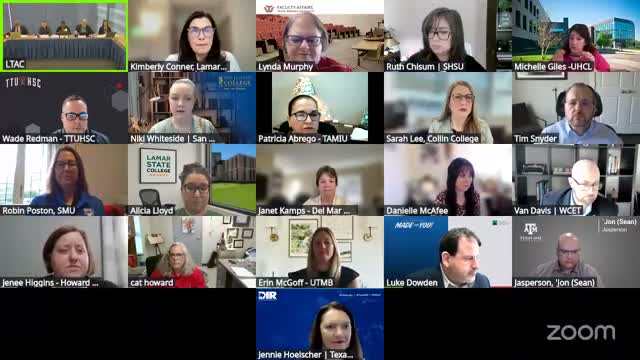
Representatives from WCET told the committee that two negotiated-rulemaking committees convened by the U.S. Department of Education—RISE and AHEAD—have reached committee consensus and that the department is expected to publish Notices of Proposed Rulemaking for public comment in the coming weeks.
Dr. Van Davis, introduced by LTAC as a WCET representative, said RISE, which focuses on loan limits, reached consensus and its public-comment period is open. "That 30-day public comment period actually ends on March 2," he said, and reported that "46,485 public comments have been received" as of his review. Davis summarized the current statutory frame described in OB 3: professional degrees are treated differently under the law, with a $200,000 loan limit for narrowly defined professional programs and a $100,000 limit for other graduate degrees.
On AHEAD(accountability and workforce Pell), Davis said the committee addressed two accountability benchmarks: for baccalaureate programs, 4-year post-completion median earnings must exceed the regional median for high-school graduates; for graduate programs, earnings are compared to baccalaureate graduates in the same CIP code. He described a "70/70" rule for short-term workforce Pell programs (70% completion within 150% time and 70% job placement within 180 days) and warned of the penalties if programs fail the earnings tests for multiple years: loss of program-level eligibility for federal student aid could follow.
Davis also flagged AIM (Accreditation, Innovation, and Modernization) as potentially contentious. The department has signaled a desire to change the role of accreditors; Davis quoted department leadership that accreditors are "either at the table or be on the menu." AIM will convene rulemaking sessions in March and April and may result in significant regulatory changes affecting both institutional and programmatic accreditation.
Separately, committee members discussed Department of Justice Title II accessibility regulations set to take effect in April. The WCAG 2.1 AA standard and requirements such as rich audio descriptions for video were highlighted as raising the bar for compliance. Davis warned institutions that the DOJ rules are likely to be enforced through litigation and private suits as much as agency action, and urged campuses to document plans and progress toward compliance.
Why it matters: Colleges and universities will face compressed comment periods and fast turnarounds if the department moves from negotiated consensus to formal rulemaking. The rules under consideration could change eligibility for federal student aid for programs and add new legal exposure for institutions that do not meet accessibility standards. LTAC members were urged to monitor the NPRMs and prepare institutional responses and action plans.
Next steps: Committee staff said they would circulate the consensus language when available and share links to federal postings; members were advised to consider institutional legal counsel and compliance planning as the NPRMs and DOJ rules move forward.
Dr. Van Davis, introduced by LTAC as a WCET representative, said RISE, which focuses on loan limits, reached consensus and its public-comment period is open. "That 30-day public comment period actually ends on March 2," he said, and reported that "46,485 public comments have been received" as of his review. Davis summarized the current statutory frame described in OB 3: professional degrees are treated differently under the law, with a $200,000 loan limit for narrowly defined professional programs and a $100,000 limit for other graduate degrees.
On AHEAD(accountability and workforce Pell), Davis said the committee addressed two accountability benchmarks: for baccalaureate programs, 4-year post-completion median earnings must exceed the regional median for high-school graduates; for graduate programs, earnings are compared to baccalaureate graduates in the same CIP code. He described a "70/70" rule for short-term workforce Pell programs (70% completion within 150% time and 70% job placement within 180 days) and warned of the penalties if programs fail the earnings tests for multiple years: loss of program-level eligibility for federal student aid could follow.
Davis also flagged AIM (Accreditation, Innovation, and Modernization) as potentially contentious. The department has signaled a desire to change the role of accreditors; Davis quoted department leadership that accreditors are "either at the table or be on the menu." AIM will convene rulemaking sessions in March and April and may result in significant regulatory changes affecting both institutional and programmatic accreditation.
Separately, committee members discussed Department of Justice Title II accessibility regulations set to take effect in April. The WCAG 2.1 AA standard and requirements such as rich audio descriptions for video were highlighted as raising the bar for compliance. Davis warned institutions that the DOJ rules are likely to be enforced through litigation and private suits as much as agency action, and urged campuses to document plans and progress toward compliance.
Why it matters: Colleges and universities will face compressed comment periods and fast turnarounds if the department moves from negotiated consensus to formal rulemaking. The rules under consideration could change eligibility for federal student aid for programs and add new legal exposure for institutions that do not meet accessibility standards. LTAC members were urged to monitor the NPRMs and prepare institutional responses and action plans.
Next steps: Committee staff said they would circulate the consensus language when available and share links to federal postings; members were advised to consider institutional legal counsel and compliance planning as the NPRMs and DOJ rules move forward.
Don't Miss a Word: See the Full Meeting!
Go beyond summaries. Unlock every video, transcript, and key insight with a Founder Membership.
✓
Get instant access to full meeting videos
✓
Search and clip any phrase from complete transcripts
✓
Receive AI-powered summaries & custom alerts
✓
Enjoy lifetime, unrestricted access to government data
30-day money-back guarantee
