Committee rejects statewide ‘bell‑to‑bell’ school cell‑phone ban
March 03, 2026 | 2026 Legislature SD, South Dakota
This article was created by AI summarizing key points discussed. AI makes mistakes, so for full details and context, please refer to the video of the full meeting. Please report any errors so we can fix them. Report an error »
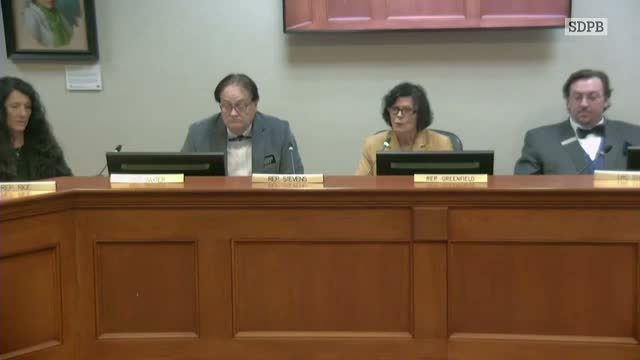
The House Education Committee on Jan. 26 voted 8–7 to send Senate Bill 198 — a proposed statewide “bell‑to‑bell” ban on student cell‑phone use — to the 40th legislative day, a procedural move that removed it from immediate consideration.
Representative Taylor Rayfelt, the bill’s House sponsor, told the committee she brought the measure as “a mom and a nurse” and said research shows constant access to smartphones undermines classroom focus and student mental health. “When teachers are policing phones, they’re not teaching reading,” Rayfelt said, urging a uniform state standard that would include medical and individualized education program exceptions.
Senator Chris Carr, a co‑sponsor, said a state framework would create consistent protections across districts and remove ambiguity about device rules. Proponents cited research and implementation examples in other states, and Melissa McKay of the Digital Childhood Institute described North Dakota’s recent experience and polling data showing broad voter support for similar policies.
Opponents — including Joe Graves, South Dakota’s secretary of education, and Rob Munson, an executive director representing school administrators — argued the bill would override local control and eliminate flexibility that districts need to adapt rules by grade level, building layout or educational program. Colby Shuck, a Kadoka principal, and Lindsay Fecki, an Avon principal, said local policies already limit phone use during instruction and permit supervised, instructional or emergency uses.
Committee members asked sponsors how the bill would handle smartwatches, educational uses and accommodations. Sponsors said districts would set enforcement details and could preserve supervised, instructional exceptions. Several members said the bill left open questions about what constitutes an academic exemption and how enforcement would work in practice.
Representative Jordan offered a substitute motion to send the bill to the 40th legislative day; the roll call recorded 8 yays and 7 nays. The chair later announced that SB198 had failed to advance. The committee declined a motion to recall the bill from the 40th day.
The committee’s action leaves device‑policy decisions with local school boards for now; sponsors said they may return with clarifying language if they pursue the bill again.
Representative Taylor Rayfelt, the bill’s House sponsor, told the committee she brought the measure as “a mom and a nurse” and said research shows constant access to smartphones undermines classroom focus and student mental health. “When teachers are policing phones, they’re not teaching reading,” Rayfelt said, urging a uniform state standard that would include medical and individualized education program exceptions.
Senator Chris Carr, a co‑sponsor, said a state framework would create consistent protections across districts and remove ambiguity about device rules. Proponents cited research and implementation examples in other states, and Melissa McKay of the Digital Childhood Institute described North Dakota’s recent experience and polling data showing broad voter support for similar policies.
Opponents — including Joe Graves, South Dakota’s secretary of education, and Rob Munson, an executive director representing school administrators — argued the bill would override local control and eliminate flexibility that districts need to adapt rules by grade level, building layout or educational program. Colby Shuck, a Kadoka principal, and Lindsay Fecki, an Avon principal, said local policies already limit phone use during instruction and permit supervised, instructional or emergency uses.
Committee members asked sponsors how the bill would handle smartwatches, educational uses and accommodations. Sponsors said districts would set enforcement details and could preserve supervised, instructional exceptions. Several members said the bill left open questions about what constitutes an academic exemption and how enforcement would work in practice.
Representative Jordan offered a substitute motion to send the bill to the 40th legislative day; the roll call recorded 8 yays and 7 nays. The chair later announced that SB198 had failed to advance. The committee declined a motion to recall the bill from the 40th day.
The committee’s action leaves device‑policy decisions with local school boards for now; sponsors said they may return with clarifying language if they pursue the bill again.
View the Full Meeting & All Its Details
This article offers just a summary. Unlock complete video, transcripts, and insights as a Founder Member.
✓
Watch full, unedited meeting videos
✓
Search every word spoken in unlimited transcripts
✓
AI summaries & real-time alerts (all government levels)
✓
Permanent access to expanding government content
30-day money-back guarantee
