Attorney general bill targets nonconsensual sexually explicit 'deepfakes'; committee advances it
March 03, 2026 | 2026 Legislature SD, South Dakota
This article was created by AI summarizing key points discussed. AI makes mistakes, so for full details and context, please refer to the video of the full meeting. Please report any errors so we can fix them. Report an error »
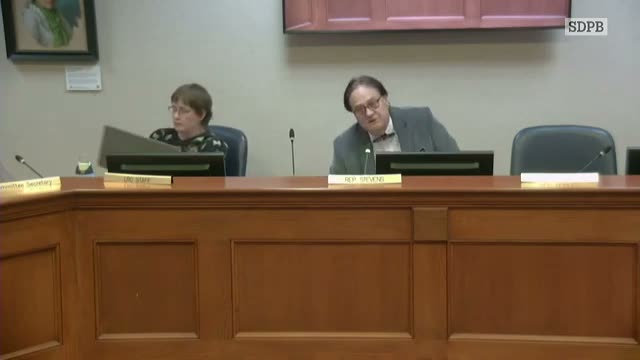
Attorney General Marty Jackley told the House Judiciary Committee that Senate Bill 41 updates criminal invasion‑of‑privacy law to cover digitally fabricated sexual material (deepfakes) depicting identifiable adults and would make certain AI‑generated images a class‑5 felony.
"We now see AI being inappropriately used on adults," Jackley said, describing a pending local case and arguing the law must define and criminalize intentional creation or distribution of fabricated sexual images without consent.
Prosecutors’ groups and police chiefs supported the bill as a tool to protect victims. Eric Erickson of the State’s Attorneys Association and Savannah Cruz of the Police Chiefs Association urged the committee to adopt the bill, saying it would help investigators and hold perpetrators accountable.
Tara Larson, a lawyer representing criminal‑defense interests, opposed the measure as drafted and urged caution on the AI subsection. Larson argued the proposed classification (a class‑5 felony for AI‑generated images) could sweep too broadly, criminalize casual or joking uses of generative models and create disparate outcomes compared with existing misdemeanor standards for analogous conduct.
Jackley replied that the statute requires lack of consent, intent to gratify or harass and harm to the depicted individual; he said the draft’s definitions are designed to distinguish trivial or consensual uses from harmful deepfakes.
After committee discussion, the House Judiciary Committee voted 8–3 in favor of a due‑pass motion for SB41. Members said they may refine language later, but several expressed support for stronger tools to punish exploitative uses of AI to fabricate sexual images.
"We now see AI being inappropriately used on adults," Jackley said, describing a pending local case and arguing the law must define and criminalize intentional creation or distribution of fabricated sexual images without consent.
Prosecutors’ groups and police chiefs supported the bill as a tool to protect victims. Eric Erickson of the State’s Attorneys Association and Savannah Cruz of the Police Chiefs Association urged the committee to adopt the bill, saying it would help investigators and hold perpetrators accountable.
Tara Larson, a lawyer representing criminal‑defense interests, opposed the measure as drafted and urged caution on the AI subsection. Larson argued the proposed classification (a class‑5 felony for AI‑generated images) could sweep too broadly, criminalize casual or joking uses of generative models and create disparate outcomes compared with existing misdemeanor standards for analogous conduct.
Jackley replied that the statute requires lack of consent, intent to gratify or harass and harm to the depicted individual; he said the draft’s definitions are designed to distinguish trivial or consensual uses from harmful deepfakes.
After committee discussion, the House Judiciary Committee voted 8–3 in favor of a due‑pass motion for SB41. Members said they may refine language later, but several expressed support for stronger tools to punish exploitative uses of AI to fabricate sexual images.
View the Full Meeting & All Its Details
This article offers just a summary. Unlock complete video, transcripts, and insights as a Founder Member.
✓
Watch full, unedited meeting videos
✓
Search every word spoken in unlimited transcripts
✓
AI summaries & real-time alerts (all government levels)
✓
Permanent access to expanding government content
30-day money-back guarantee
