Resilient Woods Hole details sea‑level risks and local fixes to Falmouth emergency planners
March 03, 2026 | Town of Falmouth, Barnstable County, Massachusetts
This article was created by AI summarizing key points discussed. AI makes mistakes, so for full details and context, please refer to the video of the full meeting. Please report any errors so we can fix them. Report an error »
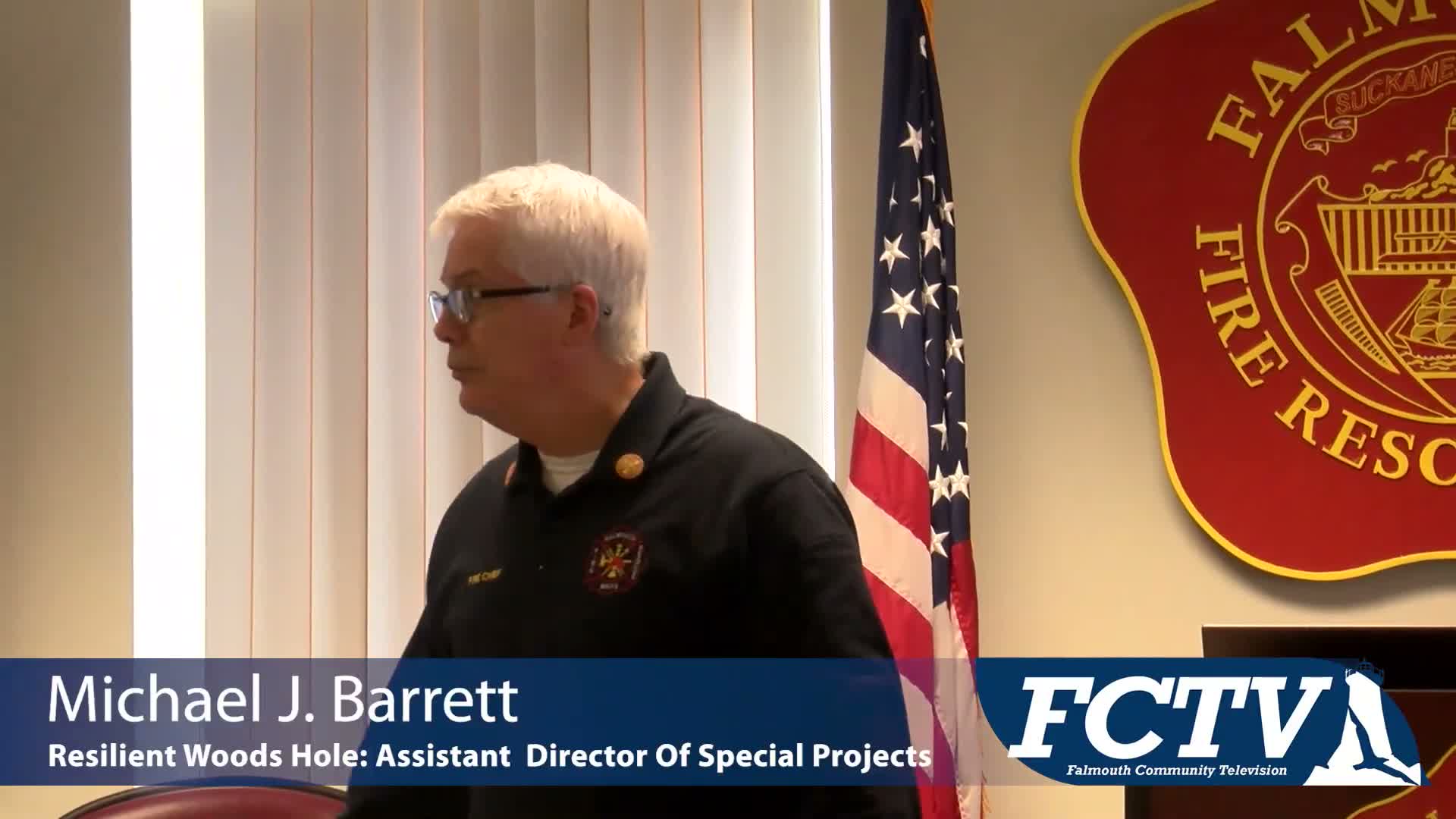
Mike Barrett, a HUI employee and presenter with Resilient Woods Hole, told the Town of Falmouth’s Local Emergency Planning Committee that Woods Hole has already recorded about 1 foot of sea‑level rise since the 1930s and that state‑approved flood modeling shows large parts of the village face annual inundation risks under future scenarios.
The presentation, given at the committee meeting, outlined a multi‑phase effort: an institutional inventory of at‑risk buildings, a roads and parcel vulnerability analysis, and sustained community outreach that includes a 3‑D model and a climate walking tour. Barrett said the group’s goal is to give institutions and residents tools to prioritize protective measures and to help the town apply for state and federal grant funding where eligible.
"We are a private–public initiative to ensure the vibrant and productive village of Woods Hole prospers well into the future," Barrett said, describing the partnership among major local institutions and town officials. He noted the group uses the state‑approved flood model and the Woods Hole Group’s technical work to produce maps that, in Barrett’s words, ‘‘show that anything you see in black … has a one‑in‑three chance or more that these areas are going to flood every year.’’
Barrett described four program phases. Phase 1 cataloged building‑level vulnerability at major institutions to identify priorities such as the Lily Lab and other high‑value facilities. Phase 2 expanded to the greater village and assessed which roads and parcels are most likely to flood. Phase 3 focused on outreach—open houses, online mapping tools, volunteer‑led tours and one‑on‑one consultations to help homeowners and businesses understand site‑specific risk. Barrett said roughly 3,000 people have taken the group’s climate tour since mid‑2023.
As a near‑term, tested response, Barrett showed a deployable aluminum barrier and a portable seawall the institutions have used on the waterfront. He described the system as light, modular and quick to install, and said a deployed seawall spans about 150 feet between building openings and can be assembled in roughly an hour by trained crews. Barrett added such barriers are designed for rising water rather than sustained battering waves.
Barrett also promoted nature‑based measures. He said a targeted dune‑raising project at Stony Beach—about 2 feet of elevation in strategic locations—could close an important flood pathway for many storms while preserving public access, and noted accessibility mats can balance protection with ADA access.
The presentation included a short list of town priorities developed at a recent half‑day workshop with department heads. Barrett said one high‑priority, low‑cost item was a retrofit to the Waterfront Park pump station to prevent saltwater from incapacitating the town’s water system; Barrett said that repair "got approved" at a recent town meeting and the group is coordinating timing with town staff.
Audience members asked technical questions. One attendee asked whether the portable seawall resists battering waves; Barrett replied it is intended mainly for rising water inside the channel, not for heavy wave battering. Another asked whether Resilient Woods Hole had modeled historical storms under present‑day sea‑level conditions; Barrett said the group had not yet done that study but agreed it would be a useful case study.
In a facilities exchange, Brian, who identified himself as working in facilities, said many key systems (boiler units, elevator machine rooms) are in low basement spaces and must be manually removed ahead of flooding, and that equipment upgrades face design challenges tied to pit depth and groundwater.
Chair (speaker 1) opened and closed the meeting and reminded participants that the LEPC will monitor a pending storm and could stand up the emergency operations center if needed; he also announced internal personnel changes, saying Chad Abston will be acting chief and that he and fire inspector de Mello are retiring.
The committee received Barrett’s presentation materials and was asked to follow up on implementation timing for the pump‑station retrofit, culvert clearing options and grant‑funding opportunities. Barrett recommended further feasibility studies for culvert replacement and suggested continued regional cooperation with towns such as Nantucket and Chatham to identify funding and technical lessons learned.
Next steps reported at the meeting included coordination with the town’s coastal specialist to finalize grant applications, pursuing short‑term culvert clearing with mosquito control as a stopgap measure, and planning additional community outreach events. The LEPC’s next meeting date was announced at the end of the session.
The presentation, given at the committee meeting, outlined a multi‑phase effort: an institutional inventory of at‑risk buildings, a roads and parcel vulnerability analysis, and sustained community outreach that includes a 3‑D model and a climate walking tour. Barrett said the group’s goal is to give institutions and residents tools to prioritize protective measures and to help the town apply for state and federal grant funding where eligible.
"We are a private–public initiative to ensure the vibrant and productive village of Woods Hole prospers well into the future," Barrett said, describing the partnership among major local institutions and town officials. He noted the group uses the state‑approved flood model and the Woods Hole Group’s technical work to produce maps that, in Barrett’s words, ‘‘show that anything you see in black … has a one‑in‑three chance or more that these areas are going to flood every year.’’
Barrett described four program phases. Phase 1 cataloged building‑level vulnerability at major institutions to identify priorities such as the Lily Lab and other high‑value facilities. Phase 2 expanded to the greater village and assessed which roads and parcels are most likely to flood. Phase 3 focused on outreach—open houses, online mapping tools, volunteer‑led tours and one‑on‑one consultations to help homeowners and businesses understand site‑specific risk. Barrett said roughly 3,000 people have taken the group’s climate tour since mid‑2023.
As a near‑term, tested response, Barrett showed a deployable aluminum barrier and a portable seawall the institutions have used on the waterfront. He described the system as light, modular and quick to install, and said a deployed seawall spans about 150 feet between building openings and can be assembled in roughly an hour by trained crews. Barrett added such barriers are designed for rising water rather than sustained battering waves.
Barrett also promoted nature‑based measures. He said a targeted dune‑raising project at Stony Beach—about 2 feet of elevation in strategic locations—could close an important flood pathway for many storms while preserving public access, and noted accessibility mats can balance protection with ADA access.
The presentation included a short list of town priorities developed at a recent half‑day workshop with department heads. Barrett said one high‑priority, low‑cost item was a retrofit to the Waterfront Park pump station to prevent saltwater from incapacitating the town’s water system; Barrett said that repair "got approved" at a recent town meeting and the group is coordinating timing with town staff.
Audience members asked technical questions. One attendee asked whether the portable seawall resists battering waves; Barrett replied it is intended mainly for rising water inside the channel, not for heavy wave battering. Another asked whether Resilient Woods Hole had modeled historical storms under present‑day sea‑level conditions; Barrett said the group had not yet done that study but agreed it would be a useful case study.
In a facilities exchange, Brian, who identified himself as working in facilities, said many key systems (boiler units, elevator machine rooms) are in low basement spaces and must be manually removed ahead of flooding, and that equipment upgrades face design challenges tied to pit depth and groundwater.
Chair (speaker 1) opened and closed the meeting and reminded participants that the LEPC will monitor a pending storm and could stand up the emergency operations center if needed; he also announced internal personnel changes, saying Chad Abston will be acting chief and that he and fire inspector de Mello are retiring.
The committee received Barrett’s presentation materials and was asked to follow up on implementation timing for the pump‑station retrofit, culvert clearing options and grant‑funding opportunities. Barrett recommended further feasibility studies for culvert replacement and suggested continued regional cooperation with towns such as Nantucket and Chatham to identify funding and technical lessons learned.
Next steps reported at the meeting included coordination with the town’s coastal specialist to finalize grant applications, pursuing short‑term culvert clearing with mosquito control as a stopgap measure, and planning additional community outreach events. The LEPC’s next meeting date was announced at the end of the session.
View the Full Meeting & All Its Details
This article offers just a summary. Unlock complete video, transcripts, and insights as a Founder Member.
✓
Watch full, unedited meeting videos
✓
Search every word spoken in unlimited transcripts
✓
AI summaries & real-time alerts (all government levels)
✓
Permanent access to expanding government content
30-day money-back guarantee
