Washington GOP leaders warn income tax and budget choices will hurt affordability
March 03, 2026 | Attorney General, Elected Officials, Executive, Washington
This article was created by AI summarizing key points discussed. AI makes mistakes, so for full details and context, please refer to the video of the full meeting. Please report any errors so we can fix them. Report an error »
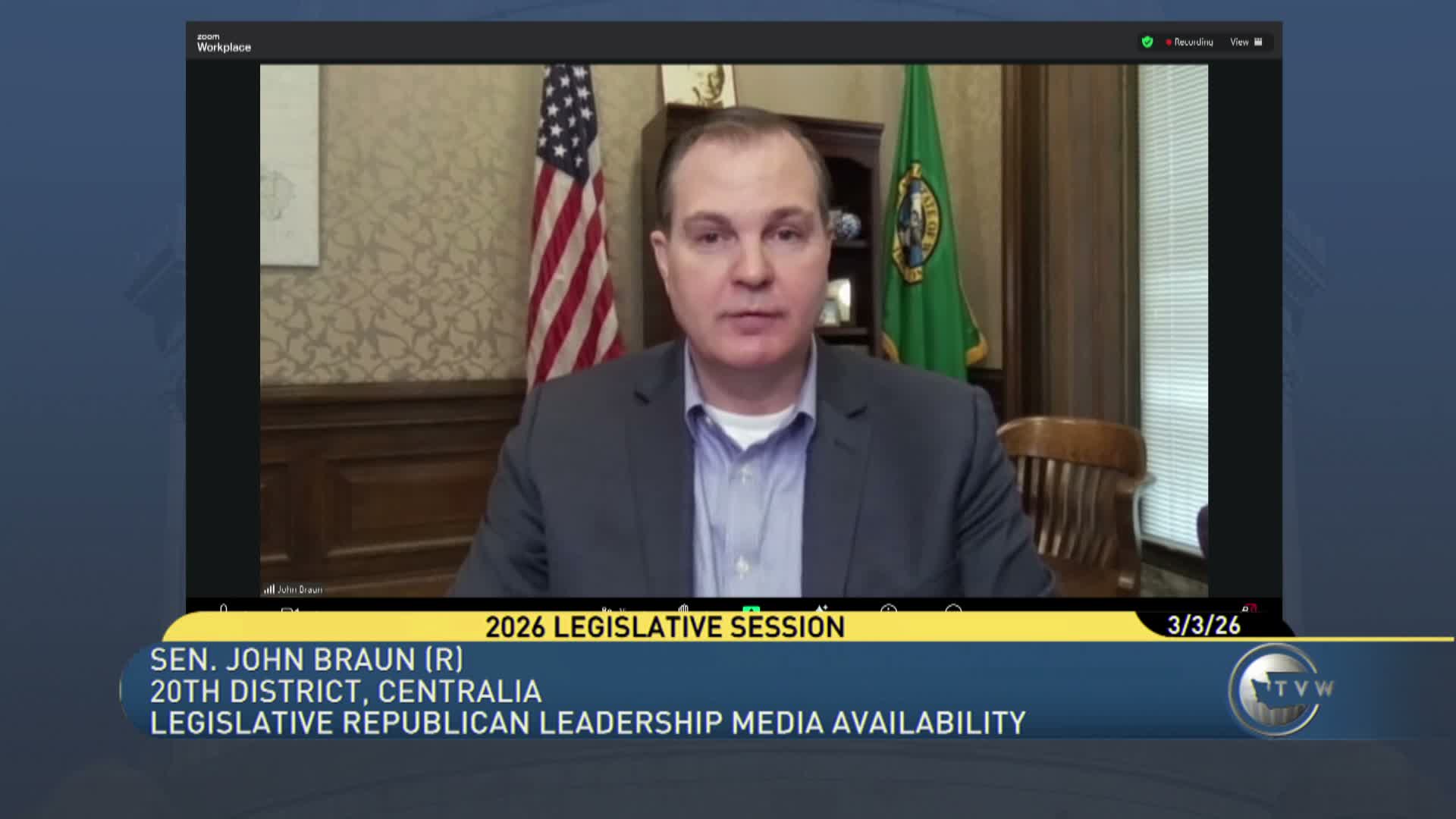
On a press call, Senate Republican Leader John Braun and House Republican floor leader April Connors said the operating and supplemental budget proposals would worsen affordability for Washington residents and risk future deficits.
"They spend $2,000,000,000 more, a total of $5,000,000,000 more than we have in revenue coming in," said Sen. John Braun, criticizing what he described as one-time revenue uses and an approach that, he said, will leave the state $8 billion to $10 billion short in the next biennium. Braun said the budgets rely on one-time money and optimistic agency underspending.
Rep. April Connors said House Republicans offered roughly 19–20 amendments to the operating budget aimed at affordability, including property-tax relief. "We did some amendments on the floor to give property tax relief," Connors said, and argued that several adopted measures still leave long-term cost pressures in place.
Both leaders focused on an income tax under consideration by the majority. Braun said the Democratic majority refused to add a constitutional barrier against future expansion of the tax and warned that the current "high earners" branding could be narrowed later. "There's an income tax who has a high threshold... They've refused saying that is the decision of future legislatures," Braun said.
Asked whether they would press the governor on the income tax in a planned meeting, Braun said he expected the topic to be raised and that Republicans will press for meaningful tax reductions. Connors said House Republicans hope the governor would veto an income-tax measure if passed.
Speakers on the call also raised a string of other tax and fee concerns they said would affect affordability, from nicotine and prescription-drug taxes to proposals such as a retail bag tax and a bottle-fee measure referenced on the call. "After coming off that large tax increase, to think that we have an appetite to continue to make Washington less affordable is just... our citizens... saying, please stop," Connors said.
GOP leaders repeatedly framed their budget critique around long-term fiscal risk rather than the technical details of any single provision. They warned that drawing down the rainy day fund and relying on one-time revenue sources leaves the state exposed if revenues flatten or a recession arrives.
The briefing closed with leaders reiterating affordability as the caucus's priority and promising to oppose the income tax in the final days of the session. "That's what we're gonna continue to work on," Connors said. "We'll be... fighting as hard as we can against the income tax coming forward."
"They spend $2,000,000,000 more, a total of $5,000,000,000 more than we have in revenue coming in," said Sen. John Braun, criticizing what he described as one-time revenue uses and an approach that, he said, will leave the state $8 billion to $10 billion short in the next biennium. Braun said the budgets rely on one-time money and optimistic agency underspending.
Rep. April Connors said House Republicans offered roughly 19–20 amendments to the operating budget aimed at affordability, including property-tax relief. "We did some amendments on the floor to give property tax relief," Connors said, and argued that several adopted measures still leave long-term cost pressures in place.
Both leaders focused on an income tax under consideration by the majority. Braun said the Democratic majority refused to add a constitutional barrier against future expansion of the tax and warned that the current "high earners" branding could be narrowed later. "There's an income tax who has a high threshold... They've refused saying that is the decision of future legislatures," Braun said.
Asked whether they would press the governor on the income tax in a planned meeting, Braun said he expected the topic to be raised and that Republicans will press for meaningful tax reductions. Connors said House Republicans hope the governor would veto an income-tax measure if passed.
Speakers on the call also raised a string of other tax and fee concerns they said would affect affordability, from nicotine and prescription-drug taxes to proposals such as a retail bag tax and a bottle-fee measure referenced on the call. "After coming off that large tax increase, to think that we have an appetite to continue to make Washington less affordable is just... our citizens... saying, please stop," Connors said.
GOP leaders repeatedly framed their budget critique around long-term fiscal risk rather than the technical details of any single provision. They warned that drawing down the rainy day fund and relying on one-time revenue sources leaves the state exposed if revenues flatten or a recession arrives.
The briefing closed with leaders reiterating affordability as the caucus's priority and promising to oppose the income tax in the final days of the session. "That's what we're gonna continue to work on," Connors said. "We'll be... fighting as hard as we can against the income tax coming forward."
View the Full Meeting & All Its Details
This article offers just a summary. Unlock complete video, transcripts, and insights as a Founder Member.
✓
Watch full, unedited meeting videos
✓
Search every word spoken in unlimited transcripts
✓
AI summaries & real-time alerts (all government levels)
✓
Permanent access to expanding government content
30-day money-back guarantee
