Nebraska hearing on DHHS 1115 waiver draws broad opposition from hospitals and providers
February 27, 2026 | 2026 Legislature NE, Nebraska
This article was created by AI summarizing key points discussed. AI makes mistakes, so for full details and context, please refer to the video of the full meeting. Please report any errors so we can fix them. Report an error »
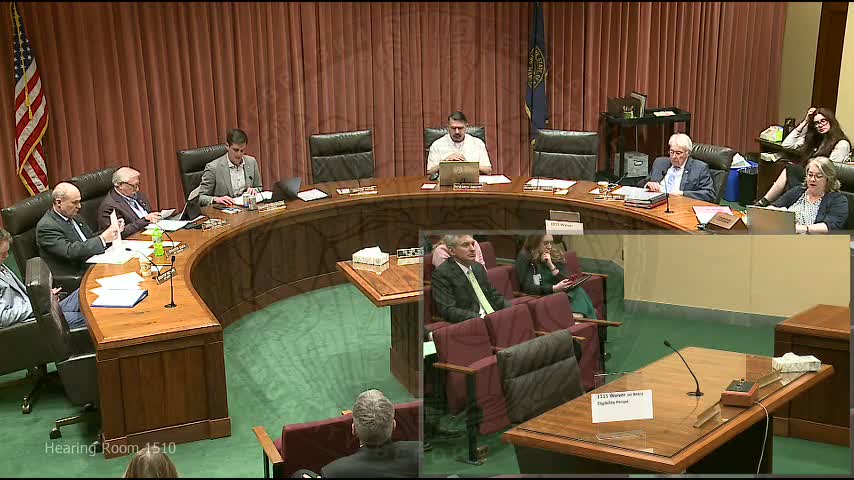
The Nebraska Health and Human Services Committee heard testimony on a Department of Health and Human Services proposal to submit a Section 1115 waiver that would eliminate Medicaid retroactive eligibility beyond the month of application.
John Mills, chief financial officer for DHHS, told the committee the department is seeking the waiver to "promote timely Medicaid enrollment and program sustainability" and to better align Medicaid with the commercial market. "We are currently in the public comment period and after this period we plan to submit the waiver for approval with an anticipated effective date of 10/01/2026," Mills said.
Supporters of the department's policy said the change would create a financial incentive for hospitals to enroll eligible people earlier. Mills and others described options DHHS is exploring, including presumptive eligibility or a limited exception for people who present in the last days of a month, and estimated modest state budget savings: going to zero retroactivity would reduce total program share by roughly $24 million annually and about $6.5 million to the state general fund on an ongoing basis, Mills said.
But hospital executives, rural providers and patient advocates urged the committee to reject or narrow the waiver. "Retroactive eligibility is not a loophole. It's a lifeline," said Arlan Johnson, chief executive officer of Howard County Medical Center, adding that eliminating retroactive coverage would leave people with "crushing medical debt" and shift significant costs onto providers.
Several hospital witnesses told the committee that losing retroactive coverage could threaten access and operations in rural areas. Mike Dewerff, chief financial officer for Bridal Health and a spokesperson for the Nebraska Hospital Association, said the modeled financial impact on providers from losing retroactive coverage and related changes to 340B and disproportionate share hospital (DISH) calculations could reach roughly $35 million annually for some systems. "Put plainly, the state is spending $2 of provider impact to generate $1 of state savings," Dewerff testified.
Post‑acute and rehabilitation providers said the change would complicate discharge planning and patient flow. Chris Lee, chief operating officer of Madonna Rehabilitation Hospitals, said many patients are medically unstable or rely on family members for documentation, and the gap between care and a completed Medicaid application can be weeks; removing retroactive coverage, Lee warned, would increase length of stay and reduce capacity.
Rural hospital leaders described operational constraints. Roger Reamer, CEO of Memorial Healthcare Systems, told the committee of a patient case that took "just over six weeks" to complete enrollment; he urged the committee to align Nebraska's rules with HR1 rather than eliminate retroactive coverage. Chelsea Russell, a director of nursing at a 16‑bed critical access hospital, said long‑term care facilities accept Medicaid‑pending patients today because retroactive eligibility provides assurance of coverage once approved; removing it would ‘‘create discharge backlogs across Nebraska.’’
Advocates also described direct harms to patients. Sarah Marsh of Nebraska Appleseed gave a personal example from a NICU stay that would have fallen into a waiver‑created gap: she said she would have been required to assemble paperwork ‘‘in just a few days’’ or face large out‑of‑pocket bills. Amy Bienke of the Health Center Association of Nebraska noted that community health centers rely on Medicaid ("38 percent of our patients are enrolled in Medicaid, including 66 percent of the children we serve") and argued the policy assumes a level of public awareness and administrative capacity many patients and small clinics do not have.
Committee members asked detailed questions about how the proposed rule would work in practice: whether eligibility completed at a clinic carries over to later emergency visits; how presumptive eligibility would be defined; the administrative cost of preparing a waiver (Mills estimated an average vendor submission cost of about $250,000); and whether other states had proposed full elimination of retroactive coverage (Mills said he was not aware of states publicly seeking full elimination). Mills said the department could write exceptions into a waiver for instances when applications cannot reasonably be completed before a billable date.
The hearing produced no committee vote. The department remains in its public comment period; DHHS staff said they will provide additional detail on presumptive eligibility definitions, a possible exception process for last‑day month arrivals, and other technical elements if the committee requests them. The committee closed the hearing without taking formal action.
What happens next: DHHS said it plans to submit the waiver after the public comment period; the committee did not indicate a floor vote or formal action during this hearing.
John Mills, chief financial officer for DHHS, told the committee the department is seeking the waiver to "promote timely Medicaid enrollment and program sustainability" and to better align Medicaid with the commercial market. "We are currently in the public comment period and after this period we plan to submit the waiver for approval with an anticipated effective date of 10/01/2026," Mills said.
Supporters of the department's policy said the change would create a financial incentive for hospitals to enroll eligible people earlier. Mills and others described options DHHS is exploring, including presumptive eligibility or a limited exception for people who present in the last days of a month, and estimated modest state budget savings: going to zero retroactivity would reduce total program share by roughly $24 million annually and about $6.5 million to the state general fund on an ongoing basis, Mills said.
But hospital executives, rural providers and patient advocates urged the committee to reject or narrow the waiver. "Retroactive eligibility is not a loophole. It's a lifeline," said Arlan Johnson, chief executive officer of Howard County Medical Center, adding that eliminating retroactive coverage would leave people with "crushing medical debt" and shift significant costs onto providers.
Several hospital witnesses told the committee that losing retroactive coverage could threaten access and operations in rural areas. Mike Dewerff, chief financial officer for Bridal Health and a spokesperson for the Nebraska Hospital Association, said the modeled financial impact on providers from losing retroactive coverage and related changes to 340B and disproportionate share hospital (DISH) calculations could reach roughly $35 million annually for some systems. "Put plainly, the state is spending $2 of provider impact to generate $1 of state savings," Dewerff testified.
Post‑acute and rehabilitation providers said the change would complicate discharge planning and patient flow. Chris Lee, chief operating officer of Madonna Rehabilitation Hospitals, said many patients are medically unstable or rely on family members for documentation, and the gap between care and a completed Medicaid application can be weeks; removing retroactive coverage, Lee warned, would increase length of stay and reduce capacity.
Rural hospital leaders described operational constraints. Roger Reamer, CEO of Memorial Healthcare Systems, told the committee of a patient case that took "just over six weeks" to complete enrollment; he urged the committee to align Nebraska's rules with HR1 rather than eliminate retroactive coverage. Chelsea Russell, a director of nursing at a 16‑bed critical access hospital, said long‑term care facilities accept Medicaid‑pending patients today because retroactive eligibility provides assurance of coverage once approved; removing it would ‘‘create discharge backlogs across Nebraska.’’
Advocates also described direct harms to patients. Sarah Marsh of Nebraska Appleseed gave a personal example from a NICU stay that would have fallen into a waiver‑created gap: she said she would have been required to assemble paperwork ‘‘in just a few days’’ or face large out‑of‑pocket bills. Amy Bienke of the Health Center Association of Nebraska noted that community health centers rely on Medicaid ("38 percent of our patients are enrolled in Medicaid, including 66 percent of the children we serve") and argued the policy assumes a level of public awareness and administrative capacity many patients and small clinics do not have.
Committee members asked detailed questions about how the proposed rule would work in practice: whether eligibility completed at a clinic carries over to later emergency visits; how presumptive eligibility would be defined; the administrative cost of preparing a waiver (Mills estimated an average vendor submission cost of about $250,000); and whether other states had proposed full elimination of retroactive coverage (Mills said he was not aware of states publicly seeking full elimination). Mills said the department could write exceptions into a waiver for instances when applications cannot reasonably be completed before a billable date.
The hearing produced no committee vote. The department remains in its public comment period; DHHS staff said they will provide additional detail on presumptive eligibility definitions, a possible exception process for last‑day month arrivals, and other technical elements if the committee requests them. The committee closed the hearing without taking formal action.
What happens next: DHHS said it plans to submit the waiver after the public comment period; the committee did not indicate a floor vote or formal action during this hearing.
View the Full Meeting & All Its Details
This article offers just a summary. Unlock complete video, transcripts, and insights as a Founder Member.
✓
Watch full, unedited meeting videos
✓
Search every word spoken in unlimited transcripts
✓
AI summaries & real-time alerts (all government levels)
✓
Permanent access to expanding government content
30-day money-back guarantee
