Sen. Terrell McKinney urges committee to advance bill guaranteeing high‑school‑level education for incarcerated youth
February 27, 2026 | 2026 Legislature NE, Nebraska
This article was created by AI summarizing key points discussed. AI makes mistakes, so for full details and context, please refer to the video of the full meeting. Please report any errors so we can fix them. Report an error »
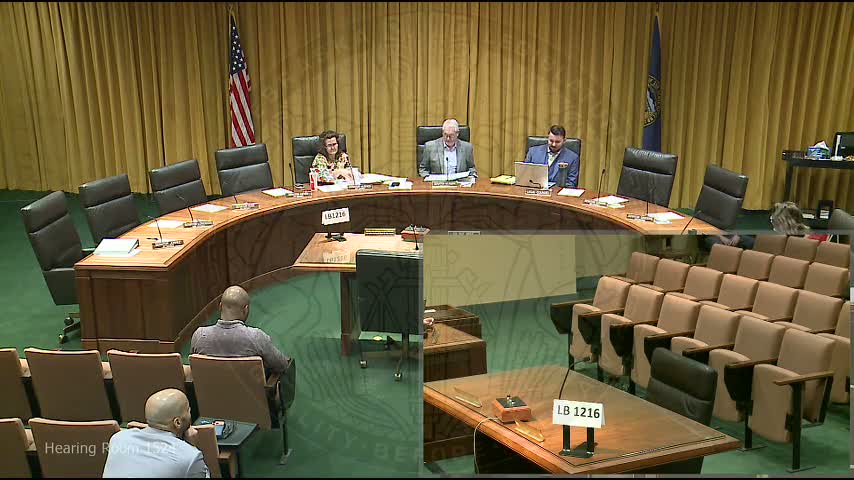
Sen. Terrell McKinney (Legislative District 11) told the Nebraska Legislature’s Education Committee that LB 1216 would ensure people under 21 in the state’s custody who have not earned a high‑school diploma or equivalency receive meaningful access to educational services aligned with State Department of Education minimum standards.
The bill, McKinney said in his introducer remarks, requires the director of the department responsible for people in custody to offer educational services — including core academics and, where appropriate, vocational training, computer instruction, arts and physical education — and to ensure special‑education services are provided as required by state and federal law. “By ensuring access to robust educational opportunities for young people in custody, this bill supports rehabilitation, enhances prospects for lawful employment upon release, and strengthens public safety,” McKinney said during opening remarks.
Supporters from advocacy organizations, youth‑service groups and the ACLU told the committee that current practice is uneven: some county facilities partner with local school districts, while others rely on outdated packets or primarily offer GED‑focused programming that may not meet the needs of students with disabilities. Lauren Misek Vargas, CEO of Education Rights Council, testified that “incarceration does not extinguish a young person's right to an appropriate educational services,” and urged the committee to align correctional instruction with protections in the Individuals with Disabilities Education Act (IDEA).
Witnesses described several recurring problems: schools’ records and credits sometimes fail to follow students across juvenile and adult placements; some facilities concentrate on college‑level programming or GED preparation rather than high‑school diplomas and individualized education plans (IEPs); and vocational and direct‑instruction programs that exist in model facilities (for example, the Kearney Youth Rehabilitation & Treatment Center) may be at risk if proposed administrative changes shift instruction online. Misek Vargas said the result is that some students with disabilities do not receive FAPE (free appropriate public education) while in custody.
Proponents also made a fiscal and public‑safety case: Kaelyn Kinnaman of Voices for Children in Nebraska argued that education in correctional settings improves employment prospects and lowers recidivism, producing net public benefit. Jason Witmer of the ACLU recounted his own experience, saying education helped him change course: “Education changed how I thought,” he told the committee, arguing that mandatory in‑custody education should be a baseline expectation.
Committee members asked technical questions about implementation and whether an added fiscal note would be required if facilities needed to expand services. McKinney said he believes the resources to offer programming exist and that the bill’s primary need is to clarify roles and accountability; he offered to provide clarifying amendment language requested by the committee. Chair Senator Dave Merman also noted the Department had filed neutral testimony rather than appearing in opposition.
The committee did not take a formal vote at the hearing. McKinney closed by restating his view that LB 1216 is appropriate for the consent calendar and said he would provide draft clarifying language. Chair Merman closed the hearing and recorded 20 proponents, seven opponents and one neutral filing.
The committee’s next procedural step — whether to place LB 1216 on the consent calendar, adopt clarifying language, or hold the bill for additional drafting — was not resolved at the hearing.
The bill, McKinney said in his introducer remarks, requires the director of the department responsible for people in custody to offer educational services — including core academics and, where appropriate, vocational training, computer instruction, arts and physical education — and to ensure special‑education services are provided as required by state and federal law. “By ensuring access to robust educational opportunities for young people in custody, this bill supports rehabilitation, enhances prospects for lawful employment upon release, and strengthens public safety,” McKinney said during opening remarks.
Supporters from advocacy organizations, youth‑service groups and the ACLU told the committee that current practice is uneven: some county facilities partner with local school districts, while others rely on outdated packets or primarily offer GED‑focused programming that may not meet the needs of students with disabilities. Lauren Misek Vargas, CEO of Education Rights Council, testified that “incarceration does not extinguish a young person's right to an appropriate educational services,” and urged the committee to align correctional instruction with protections in the Individuals with Disabilities Education Act (IDEA).
Witnesses described several recurring problems: schools’ records and credits sometimes fail to follow students across juvenile and adult placements; some facilities concentrate on college‑level programming or GED preparation rather than high‑school diplomas and individualized education plans (IEPs); and vocational and direct‑instruction programs that exist in model facilities (for example, the Kearney Youth Rehabilitation & Treatment Center) may be at risk if proposed administrative changes shift instruction online. Misek Vargas said the result is that some students with disabilities do not receive FAPE (free appropriate public education) while in custody.
Proponents also made a fiscal and public‑safety case: Kaelyn Kinnaman of Voices for Children in Nebraska argued that education in correctional settings improves employment prospects and lowers recidivism, producing net public benefit. Jason Witmer of the ACLU recounted his own experience, saying education helped him change course: “Education changed how I thought,” he told the committee, arguing that mandatory in‑custody education should be a baseline expectation.
Committee members asked technical questions about implementation and whether an added fiscal note would be required if facilities needed to expand services. McKinney said he believes the resources to offer programming exist and that the bill’s primary need is to clarify roles and accountability; he offered to provide clarifying amendment language requested by the committee. Chair Senator Dave Merman also noted the Department had filed neutral testimony rather than appearing in opposition.
The committee did not take a formal vote at the hearing. McKinney closed by restating his view that LB 1216 is appropriate for the consent calendar and said he would provide draft clarifying language. Chair Merman closed the hearing and recorded 20 proponents, seven opponents and one neutral filing.
The committee’s next procedural step — whether to place LB 1216 on the consent calendar, adopt clarifying language, or hold the bill for additional drafting — was not resolved at the hearing.
View the Full Meeting & All Its Details
This article offers just a summary. Unlock complete video, transcripts, and insights as a Founder Member.
✓
Watch full, unedited meeting videos
✓
Search every word spoken in unlimited transcripts
✓
AI summaries & real-time alerts (all government levels)
✓
Permanent access to expanding government content
30-day money-back guarantee
