Board approves variances for two Alta Vista lots after heated neighborhood debate
March 01, 2026 | Brookhaven, DeKalb County, Georgia
This article was created by AI summarizing key points discussed. AI makes mistakes, so for full details and context, please refer to the video of the full meeting. Please report any errors so we can fix them. Report an error »
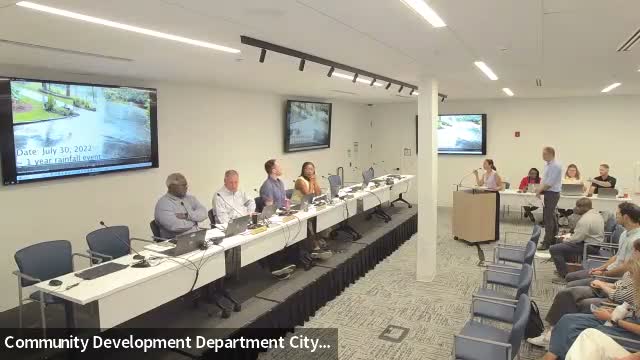
The Brookhaven Board of Appeals on Aug. 20 approved two variances requested by owners of two small Alta Vista lots, clearing the way for homes and a private stormwater system after a fraught public debate.
Supporters, including homeowner Tristan Ford Hutchinson, told the board the properties are suffering active erosion caused by a city‑owned stormwater pipe that funnels runoff from a 5.54‑acre watershed onto the lots. "This ditch is upwards of 10 to 12 feet wide and 4 feet 8 inches deep," Hutchinson said, adding the erosion has undermined trees and deposited mud downstream.
A consulting engineer for the applicant, Dr. Brian Wellington, presented a three‑part stormwater plan — riprap below the existing culvert, rain gardens and dry wells — and said the design would control the lots' runoff and reduce sediment transport. "Once these dry wells are installed as part of the system, the volume of water from the lot would only increase by about 0.012%, which is insignificant," Wellington said.
Neighbors disagreed on both the facts and the policy. Jared Freeman, who reviewed Brookhaven's code, questioned the hardship claim and pointed out the combined lot area is under the RS‑75 minimum of 10,000 square feet, arguing alternatives such as conservation easements or sales exist. "A denial is not necessarily a regulatory taking," Freeman said. Victor Herrick, another nearby resident, warned that clearing trees for construction could increase runoff for hundreds of downstream homes.
Board members debated how much the city pipe and broader watershed conditions could be considered in adjudicating side‑setback and stream‑buffer variances. City staff told the board the applicant had addressed prior staff comments and added a seventh condition: the owner must provide a licensed engineer's letter confirming erosion‑ and sediment‑control installations prior to preconstruction inspection.
After discussion the board approved each variance in separate motions, each carrying 3‑1, with the approvals conditioned on staff recommendations including the engineer preconstruction letter and standard erosion controls. The motions and votes were procedural and did not alter the city's existing authority to require maintenance or additional oversight. The board noted that broader stormwater policy or maintenance of city infrastructure is a separate issue for council or public‑works channels.
The approvals conclude the Board of Appeals' review for these two files; required permits and the listed conditions remain to be satisfied before work can proceed.
Supporters, including homeowner Tristan Ford Hutchinson, told the board the properties are suffering active erosion caused by a city‑owned stormwater pipe that funnels runoff from a 5.54‑acre watershed onto the lots. "This ditch is upwards of 10 to 12 feet wide and 4 feet 8 inches deep," Hutchinson said, adding the erosion has undermined trees and deposited mud downstream.
A consulting engineer for the applicant, Dr. Brian Wellington, presented a three‑part stormwater plan — riprap below the existing culvert, rain gardens and dry wells — and said the design would control the lots' runoff and reduce sediment transport. "Once these dry wells are installed as part of the system, the volume of water from the lot would only increase by about 0.012%, which is insignificant," Wellington said.
Neighbors disagreed on both the facts and the policy. Jared Freeman, who reviewed Brookhaven's code, questioned the hardship claim and pointed out the combined lot area is under the RS‑75 minimum of 10,000 square feet, arguing alternatives such as conservation easements or sales exist. "A denial is not necessarily a regulatory taking," Freeman said. Victor Herrick, another nearby resident, warned that clearing trees for construction could increase runoff for hundreds of downstream homes.
Board members debated how much the city pipe and broader watershed conditions could be considered in adjudicating side‑setback and stream‑buffer variances. City staff told the board the applicant had addressed prior staff comments and added a seventh condition: the owner must provide a licensed engineer's letter confirming erosion‑ and sediment‑control installations prior to preconstruction inspection.
After discussion the board approved each variance in separate motions, each carrying 3‑1, with the approvals conditioned on staff recommendations including the engineer preconstruction letter and standard erosion controls. The motions and votes were procedural and did not alter the city's existing authority to require maintenance or additional oversight. The board noted that broader stormwater policy or maintenance of city infrastructure is a separate issue for council or public‑works channels.
The approvals conclude the Board of Appeals' review for these two files; required permits and the listed conditions remain to be satisfied before work can proceed.
View the Full Meeting & All Its Details
This article offers just a summary. Unlock complete video, transcripts, and insights as a Founder Member.
✓
Watch full, unedited meeting videos
✓
Search every word spoken in unlimited transcripts
✓
AI summaries & real-time alerts (all government levels)
✓
Permanent access to expanding government content
30-day money-back guarantee
