Spalding County staff recommends launching stormwater utility to fund mandated inspections and repairs
March 02, 2026 | Spalding County, Georgia
This article was created by AI summarizing key points discussed. AI makes mistakes, so for full details and context, please refer to the video of the full meeting. Please report any errors so we can fix them. Report an error »
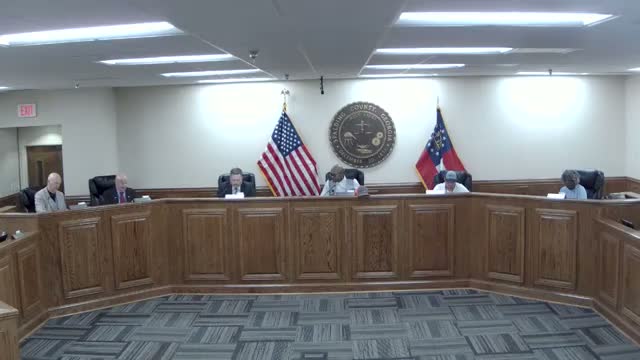
Spalding County public‑works staff and consultants presented Phase‑1 findings on March 2 and urged the Board of Commissioners to authorize Phase‑2 work to establish a stormwater utility that would fund required inspections, private‑pond oversight and ongoing maintenance.
The presentation, led by the county’s public‑works director, outlined how new federal and state MS4 reporting obligations and recent growth have left the existing, unfunded stormwater program substantially underfunded. Rebecca Lindsay, the county’s consulting engineer, said staff identified impervious surfaces across the county down to the square foot using GIS and aerial flyovers and showed multiple examples of failing detention ponds and eroded cross drains that have damaged roads.
"This is about funding the utility that’s currently in place," the presenter said, describing how inspection, inventory and corrective work for culverts, detention ponds and cross drains are already required by regulators. Consultants and staff said failing to meet MS4 inspection and reporting requirements could force the county to cede land‑disturbance permitting to state agencies, slowing development and raising costs for local projects.
Staff presented a funding model based on equivalent residential units (ERUs) — a common approach that bills properties according to impervious area — and outlined credit programs for property owners who implement on‑site stormwater controls. Examples compared estimated residential annual fees in nearby jurisdictions (Griffin at about $72/year) and noted that a countywide fee would exclude parcels inside Griffin city limits (the city already charges a stormwater fee).
Phase‑2 work, staff said, would build the ordinance language, finalize the ERU value, design credit rules, complete revenue forecasting, integrate billing software with tax assessments and conduct public outreach. The county has budgeted $120,000 in FY26 for Phase‑2 engineering; staff estimated total ongoing operating costs in the $2.5–$3.0 million range depending on service level.
Commissioners asked how the assessment would affect homeowners. Staff said the illustrative household bill could equal roughly $60–$72 per year (about $5–$6 per month), while the final cost will depend on ERU definitions and credits. The board discussed whether and how to reduce general‑fund support for stormwater as the fee is phased in and emphasized the need for extensive public education before bills are issued.
The board was asked to accept Phase‑1 work and authorize Phase‑2 to develop fees and credits for formal adoption later; the presentation closed with a recommended timeline that would allow a fee to appear on next tax‑billing cycles if the board advances the project through the ordinance schedule and public hearings.
What's next: staff asked the board to accept Phase‑1 and authorize Phase‑2 tasks (engineering, ordinance drafting and public outreach) so the county can return with recommended ERUs, credits and a revenue forecast for the board’s consideration.
The presentation, led by the county’s public‑works director, outlined how new federal and state MS4 reporting obligations and recent growth have left the existing, unfunded stormwater program substantially underfunded. Rebecca Lindsay, the county’s consulting engineer, said staff identified impervious surfaces across the county down to the square foot using GIS and aerial flyovers and showed multiple examples of failing detention ponds and eroded cross drains that have damaged roads.
"This is about funding the utility that’s currently in place," the presenter said, describing how inspection, inventory and corrective work for culverts, detention ponds and cross drains are already required by regulators. Consultants and staff said failing to meet MS4 inspection and reporting requirements could force the county to cede land‑disturbance permitting to state agencies, slowing development and raising costs for local projects.
Staff presented a funding model based on equivalent residential units (ERUs) — a common approach that bills properties according to impervious area — and outlined credit programs for property owners who implement on‑site stormwater controls. Examples compared estimated residential annual fees in nearby jurisdictions (Griffin at about $72/year) and noted that a countywide fee would exclude parcels inside Griffin city limits (the city already charges a stormwater fee).
Phase‑2 work, staff said, would build the ordinance language, finalize the ERU value, design credit rules, complete revenue forecasting, integrate billing software with tax assessments and conduct public outreach. The county has budgeted $120,000 in FY26 for Phase‑2 engineering; staff estimated total ongoing operating costs in the $2.5–$3.0 million range depending on service level.
Commissioners asked how the assessment would affect homeowners. Staff said the illustrative household bill could equal roughly $60–$72 per year (about $5–$6 per month), while the final cost will depend on ERU definitions and credits. The board discussed whether and how to reduce general‑fund support for stormwater as the fee is phased in and emphasized the need for extensive public education before bills are issued.
The board was asked to accept Phase‑1 work and authorize Phase‑2 to develop fees and credits for formal adoption later; the presentation closed with a recommended timeline that would allow a fee to appear on next tax‑billing cycles if the board advances the project through the ordinance schedule and public hearings.
What's next: staff asked the board to accept Phase‑1 and authorize Phase‑2 tasks (engineering, ordinance drafting and public outreach) so the county can return with recommended ERUs, credits and a revenue forecast for the board’s consideration.
Don't Miss a Word: See the Full Meeting!
Go beyond summaries. Unlock every video, transcript, and key insight with a Founder Membership.
✓
Get instant access to full meeting videos
✓
Search and clip any phrase from complete transcripts
✓
Receive AI-powered summaries & custom alerts
✓
Enjoy lifetime, unrestricted access to government data
30-day money-back guarantee
