Commission approves public-arts advisory committee and passes mural ordinance after debate over scope and outreach
February 27, 2026 | Palatka, Putnam County, Florida
This article was created by AI summarizing key points discussed. AI makes mistakes, so for full details and context, please refer to the video of the full meeting. Please report any errors so we can fix them. Report an error »
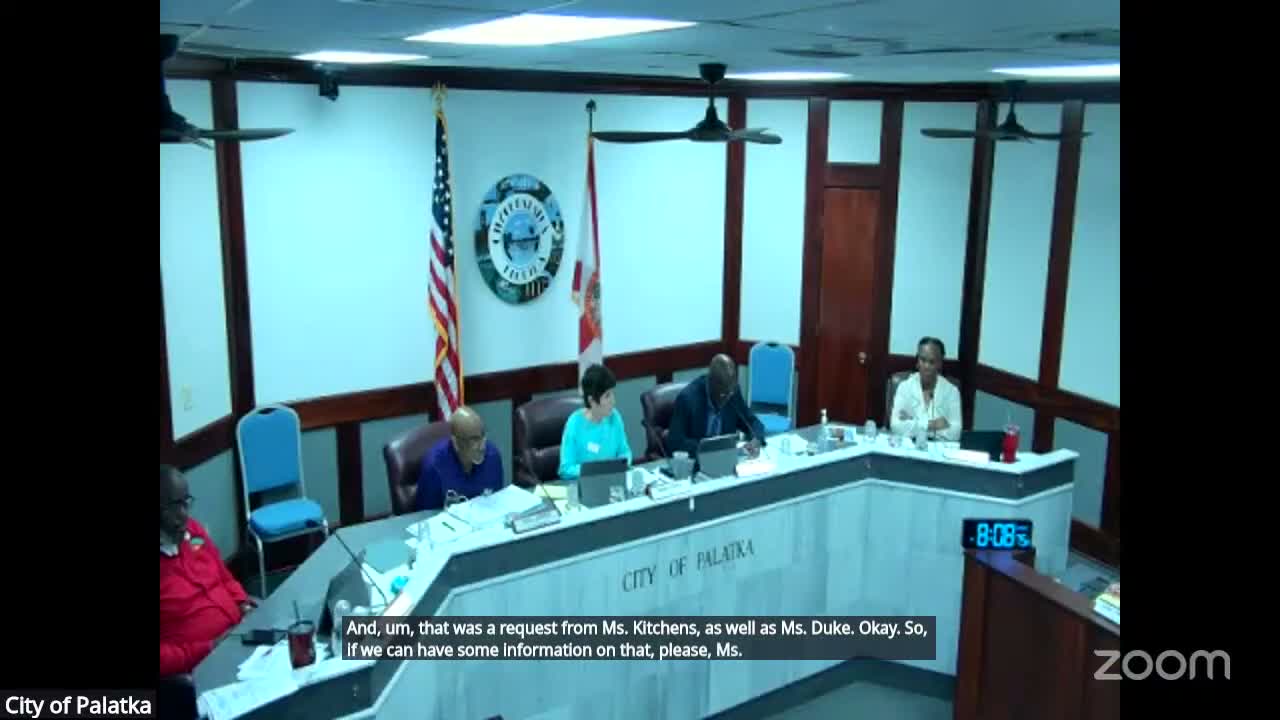
The Palatka City Commission on Feb. 26 approved a resolution creating a public arts advisory committee and voted in favor of an ordinance establishing permitting and maintenance rules for public murals after extensive public comment.
Resolution: Commissioners voted to create a seven-member public arts advisory committee to advise the city on planning, acquisition, placement, preservation and promotion of public art. The resolution originally called for two art-student members; during discussion commissioners amended the membership to include one art student and one general community member before voting to approve the committee.
Mural ordinance: Staff introduced Ordinance 2026-18 to provide a permitting pathway for public murals, set maintenance standards, and specify removal and restoration procedures. City counsel explained the ordinance is content-neutral to avoid First Amendment problems and that permitting language is intended to ensure long-term maintenance for murals that become public assets.
Public reaction: Several local arts leaders and residents—including Allegra Kitchens (speaker S19)—urged the commission to hold a stand-alone public workshop with local arts groups before finalizing the ordinance or creating the committee. Kitchens objected to a provision that applies to "all new murals proposed on exterior walls of both public and private buildings," saying the wording could constrain nonprofit and volunteer mural projects already planned. Other commenters recommended clearer exemptions for previously-commissioned pieces and more outreach to Palatka's long-standing arts organizations.
Commissioner and staff response: Counsel (speaker S16) and staff said the provisions are meant to provide guidance and require maintenance plans rather than to censor content; they emphasized that content regulation must stay within constitutional limits. The commission approved the mural ordinance on its second vote at the meeting by a 4-1 margin.
What to watch: The commission directed staff to move forward with the committee appointments and with implementation of the ordinance; arts groups requested a public workshop to discuss exemptions and commission-staff coordination before broad enforcement.
Resolution: Commissioners voted to create a seven-member public arts advisory committee to advise the city on planning, acquisition, placement, preservation and promotion of public art. The resolution originally called for two art-student members; during discussion commissioners amended the membership to include one art student and one general community member before voting to approve the committee.
Mural ordinance: Staff introduced Ordinance 2026-18 to provide a permitting pathway for public murals, set maintenance standards, and specify removal and restoration procedures. City counsel explained the ordinance is content-neutral to avoid First Amendment problems and that permitting language is intended to ensure long-term maintenance for murals that become public assets.
Public reaction: Several local arts leaders and residents—including Allegra Kitchens (speaker S19)—urged the commission to hold a stand-alone public workshop with local arts groups before finalizing the ordinance or creating the committee. Kitchens objected to a provision that applies to "all new murals proposed on exterior walls of both public and private buildings," saying the wording could constrain nonprofit and volunteer mural projects already planned. Other commenters recommended clearer exemptions for previously-commissioned pieces and more outreach to Palatka's long-standing arts organizations.
Commissioner and staff response: Counsel (speaker S16) and staff said the provisions are meant to provide guidance and require maintenance plans rather than to censor content; they emphasized that content regulation must stay within constitutional limits. The commission approved the mural ordinance on its second vote at the meeting by a 4-1 margin.
What to watch: The commission directed staff to move forward with the committee appointments and with implementation of the ordinance; arts groups requested a public workshop to discuss exemptions and commission-staff coordination before broad enforcement.
Don't Miss a Word: See the Full Meeting!
Go beyond summaries. Unlock every video, transcript, and key insight with a Founder Membership.
✓
Get instant access to full meeting videos
✓
Search and clip any phrase from complete transcripts
✓
Receive AI-powered summaries & custom alerts
✓
Enjoy lifetime, unrestricted access to government data
30-day money-back guarantee
