Committee advances bill barring local governments from mandating HOAs; moves HF2614 to housing
March 02, 2026 | 2026 Legislature MN, Minnesota
This article was created by AI summarizing key points discussed. AI makes mistakes, so for full details and context, please refer to the video of the full meeting. Please report any errors so we can fix them. Report an error »
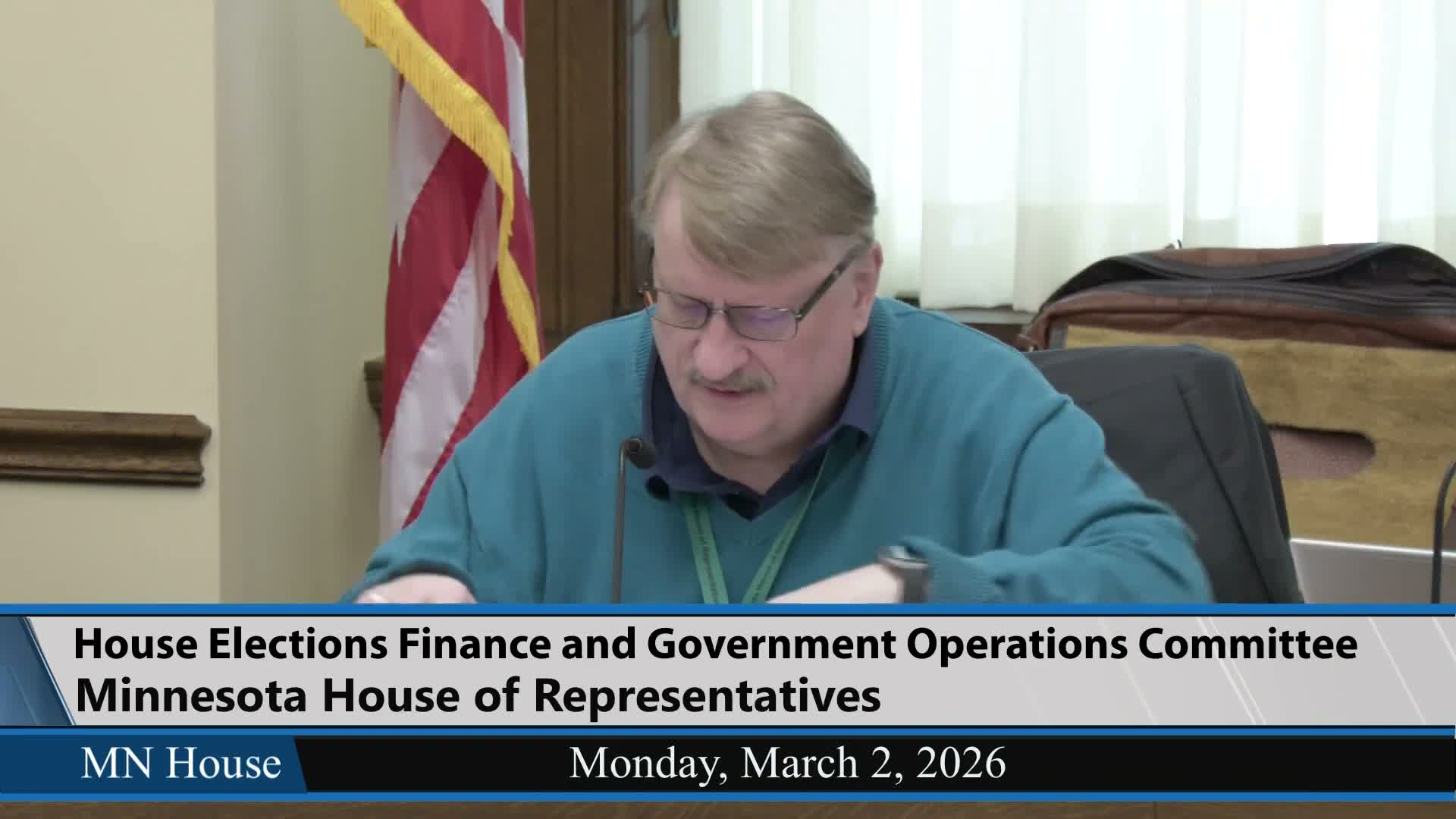
The Elections, Finance and Government Operations Committee approved House File 2614 as amended and sent the proposal to the Housing Committee after a roll call vote of 11–1.
Authors and supporters said the bill is aimed at preventing local governments from requiring developers to create common elements or amenities that then require a homeowners association (HOA). Representative Mecklen, an author, told the committee the change was negotiated with the League of Minnesota Cities and is a discrete piece of a broader effort to reform HOA law.
Why it matters: Proponents argued that unnecessary HOAs increase long-term housing costs and complicate homeownership. "Too frequently, the formation of common property and, therefore, an HOA is driven by local government requirements," Mark Foster, vice president of legislative and political affairs for Housing First Minnesota, said in testimony. Foster told the committee that more than 80% of new home construction in Minnesota now involves an HOA, a point he said the bill addresses.
Supportive testimony also came from Roxanne Young Kimball, president of the Minnesota Homeownership Center, who said some cities shift infrastructure costs—streets, curbs, sidewalks, or stormwater systems—onto homeowners through HOA requirements and cited Heritage Park as an example where dissolution of an unwanted HOA has proven difficult under current law.
Committee debate focused on where maintenance responsibility should lie. Representative Acum said prohibiting cities from requiring stormwater facilities could shift long-term maintenance costs to taxpayers; she asked that maintenance safeguards be incorporated. In response, authors and nonpartisan staff pointed to DE language (including lines added in the amendment) intended to preserve cities' ability to require or arrange maintenance or insurance for certain common elements and noted builders' existing warranty regimes and contract tools that can assign responsibility.
The motion that carried asked that HF2614 be "approved as amended and moved on to the Housing Committee." The roll call was read aloud; the committee chair recorded the outcome as an 11–1 vote in favor.
What happens next: HF2614 will be considered by the House Housing Committee, where members said additional drafting and stakeholder talks will continue. Proponents said they are open to further changes to address maintenance and local-government concerns while preserving the bill’s aim to curb municipal incentives to mandate HOAs.
Authors and supporters said the bill is aimed at preventing local governments from requiring developers to create common elements or amenities that then require a homeowners association (HOA). Representative Mecklen, an author, told the committee the change was negotiated with the League of Minnesota Cities and is a discrete piece of a broader effort to reform HOA law.
Why it matters: Proponents argued that unnecessary HOAs increase long-term housing costs and complicate homeownership. "Too frequently, the formation of common property and, therefore, an HOA is driven by local government requirements," Mark Foster, vice president of legislative and political affairs for Housing First Minnesota, said in testimony. Foster told the committee that more than 80% of new home construction in Minnesota now involves an HOA, a point he said the bill addresses.
Supportive testimony also came from Roxanne Young Kimball, president of the Minnesota Homeownership Center, who said some cities shift infrastructure costs—streets, curbs, sidewalks, or stormwater systems—onto homeowners through HOA requirements and cited Heritage Park as an example where dissolution of an unwanted HOA has proven difficult under current law.
Committee debate focused on where maintenance responsibility should lie. Representative Acum said prohibiting cities from requiring stormwater facilities could shift long-term maintenance costs to taxpayers; she asked that maintenance safeguards be incorporated. In response, authors and nonpartisan staff pointed to DE language (including lines added in the amendment) intended to preserve cities' ability to require or arrange maintenance or insurance for certain common elements and noted builders' existing warranty regimes and contract tools that can assign responsibility.
The motion that carried asked that HF2614 be "approved as amended and moved on to the Housing Committee." The roll call was read aloud; the committee chair recorded the outcome as an 11–1 vote in favor.
What happens next: HF2614 will be considered by the House Housing Committee, where members said additional drafting and stakeholder talks will continue. Proponents said they are open to further changes to address maintenance and local-government concerns while preserving the bill’s aim to curb municipal incentives to mandate HOAs.
View the Full Meeting & All Its Details
This article offers just a summary. Unlock complete video, transcripts, and insights as a Founder Member.
✓
Watch full, unedited meeting videos
✓
Search every word spoken in unlimited transcripts
✓
AI summaries & real-time alerts (all government levels)
✓
Permanent access to expanding government content
30-day money-back guarantee
