Tallmadge board hears mixed public reaction to three levy options as officials warn of cuts
January 17, 2026 | Tallmadge City, School Districts, Ohio
This article was created by AI summarizing key points discussed. AI makes mistakes, so for full details and context, please refer to the video of the full meeting. Please report any errors so we can fix them. Report an error »
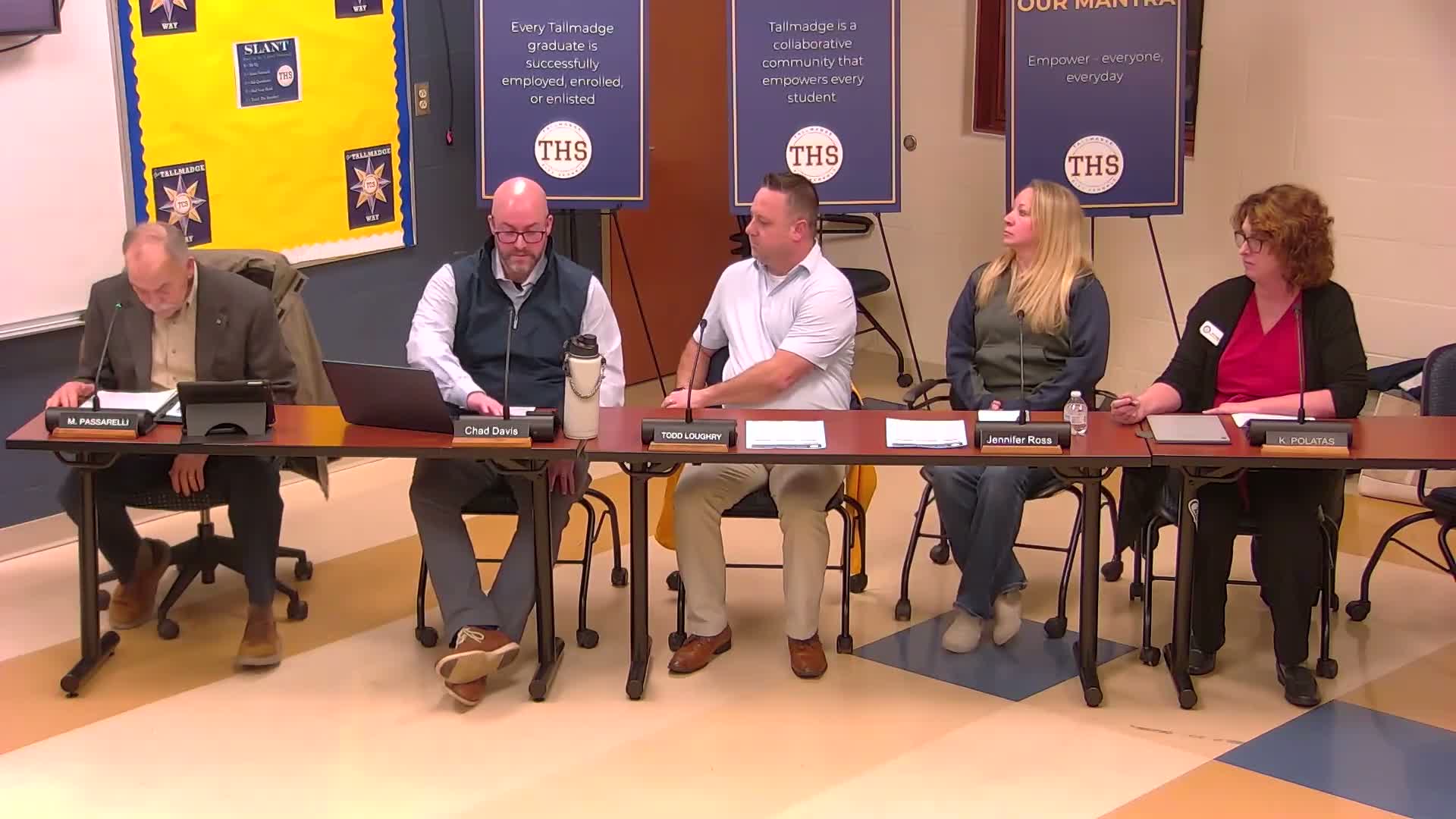
The Tallmadge Board of Education held a public work session on Jan. 14 to gather community input on three possible ways to raise local school revenue: a 5.6‑mill property levy, a 0.5% traditional base income tax and a 0.75% earned income tax. Vice President Chad Davis presented estimated revenue and household impacts and invited questions from residents.
“Between three choices, property, traditional income, or earned income taxes,” Chad Davis said, summarizing the options and who would be taxed under each model. Davis and district staff presented illustrative figures: a 5.6‑mill property levy would generate roughly $3.71 million; a 0.5% traditional base income tax would generate about $3.28 million; and a 0.75% earned income tax would generate about $3.7 million. The district used a median home value of about $220,000 and an average worker income of about $74,382 in those examples.
Board and staff framed the request as a response to two structural pressures: long‑standing limits on property millage that prevent local property taxes from automatically keeping pace with inflation, and reductions in state funding. “Our local share is 100% based on property tax… property taxes do not climb with inflation,” a district official said, explaining why the district periodically must ask voters for new revenue. The district also told residents its five‑year forecast shows the district could run a deficit in the 2027–28 school year without additional local revenue.
Residents who spoke at the session urged clearer explanations of trade‑offs, asked for demographic breakdowns and raised equity questions. Barbara Mays told the board she wanted to know “where you plan to cut” in addition to where the district wants new money. Several longtime residents warned that retirees on fixed incomes are especially vulnerable to property tax increases, while others said an earned income tax would shift more of the burden to working households and renters.
Speakers also focused on transportation and classroom impacts. The district said busing is a major cost — roughly $3.2 million to $3.4 million annually — and that it receives about $1.6 million of that back from the state. Officials warned that if new revenue is not secured, next‑year cuts could include moving to state‑minimum busing (which would eliminate high‑school busing and stop busing students who live within two miles of their school) and deeper staff reductions that would increase class sizes.
Residents pressed the board on timing and legal steps. District staff said collections would start in 2027 if an income tax is approved and that any required resolution must be filed with the board of elections 90 days before the election; staff cited February 4 as the administrative deadline for submitting paperwork. Several speakers urged the district to do more outreach to counter misinformation and to present concrete, line‑item consequences of a failed levy — for example, the district said it already eliminated three administrators and six teachers this year and is identifying further cuts if revenues do not improve.
Several residents suggested alternative approaches or combinations — for instance, one attendee recommended combining an earned income tax with a rollback of property tax to shift burdens for those who are house‑rich and cash‑poor. Others asked about reciprocity (whether residents who work in neighboring cities would face double withholding) and whether earned income levies are permanent or time‑limited; staff said income levies can be structured either as continuing or for a set number of years.
The board did not take any votes at the session. The meeting concluded after two hours of presentations and public comment; the board said it will continue to consider community input as it decides which levy option to pursue and, if any, what timing and ballot language to use.
“Between three choices, property, traditional income, or earned income taxes,” Chad Davis said, summarizing the options and who would be taxed under each model. Davis and district staff presented illustrative figures: a 5.6‑mill property levy would generate roughly $3.71 million; a 0.5% traditional base income tax would generate about $3.28 million; and a 0.75% earned income tax would generate about $3.7 million. The district used a median home value of about $220,000 and an average worker income of about $74,382 in those examples.
Board and staff framed the request as a response to two structural pressures: long‑standing limits on property millage that prevent local property taxes from automatically keeping pace with inflation, and reductions in state funding. “Our local share is 100% based on property tax… property taxes do not climb with inflation,” a district official said, explaining why the district periodically must ask voters for new revenue. The district also told residents its five‑year forecast shows the district could run a deficit in the 2027–28 school year without additional local revenue.
Residents who spoke at the session urged clearer explanations of trade‑offs, asked for demographic breakdowns and raised equity questions. Barbara Mays told the board she wanted to know “where you plan to cut” in addition to where the district wants new money. Several longtime residents warned that retirees on fixed incomes are especially vulnerable to property tax increases, while others said an earned income tax would shift more of the burden to working households and renters.
Speakers also focused on transportation and classroom impacts. The district said busing is a major cost — roughly $3.2 million to $3.4 million annually — and that it receives about $1.6 million of that back from the state. Officials warned that if new revenue is not secured, next‑year cuts could include moving to state‑minimum busing (which would eliminate high‑school busing and stop busing students who live within two miles of their school) and deeper staff reductions that would increase class sizes.
Residents pressed the board on timing and legal steps. District staff said collections would start in 2027 if an income tax is approved and that any required resolution must be filed with the board of elections 90 days before the election; staff cited February 4 as the administrative deadline for submitting paperwork. Several speakers urged the district to do more outreach to counter misinformation and to present concrete, line‑item consequences of a failed levy — for example, the district said it already eliminated three administrators and six teachers this year and is identifying further cuts if revenues do not improve.
Several residents suggested alternative approaches or combinations — for instance, one attendee recommended combining an earned income tax with a rollback of property tax to shift burdens for those who are house‑rich and cash‑poor. Others asked about reciprocity (whether residents who work in neighboring cities would face double withholding) and whether earned income levies are permanent or time‑limited; staff said income levies can be structured either as continuing or for a set number of years.
The board did not take any votes at the session. The meeting concluded after two hours of presentations and public comment; the board said it will continue to consider community input as it decides which levy option to pursue and, if any, what timing and ballot language to use.
View the Full Meeting & All Its Details
This article offers just a summary. Unlock complete video, transcripts, and insights as a Founder Member.
✓
Watch full, unedited meeting videos
✓
Search every word spoken in unlimited transcripts
✓
AI summaries & real-time alerts (all government levels)
✓
Permanent access to expanding government content
30-day money-back guarantee
