Board hears DCA human resources guide for annual executive‑officer appraisal and salary requests
March 02, 2026 | Respiratory Care Board of California, Boards and Commissions, Executive, California
This article was created by AI summarizing key points discussed. AI makes mistakes, so for full details and context, please refer to the video of the full meeting. Please report any errors so we can fix them. Report an error »
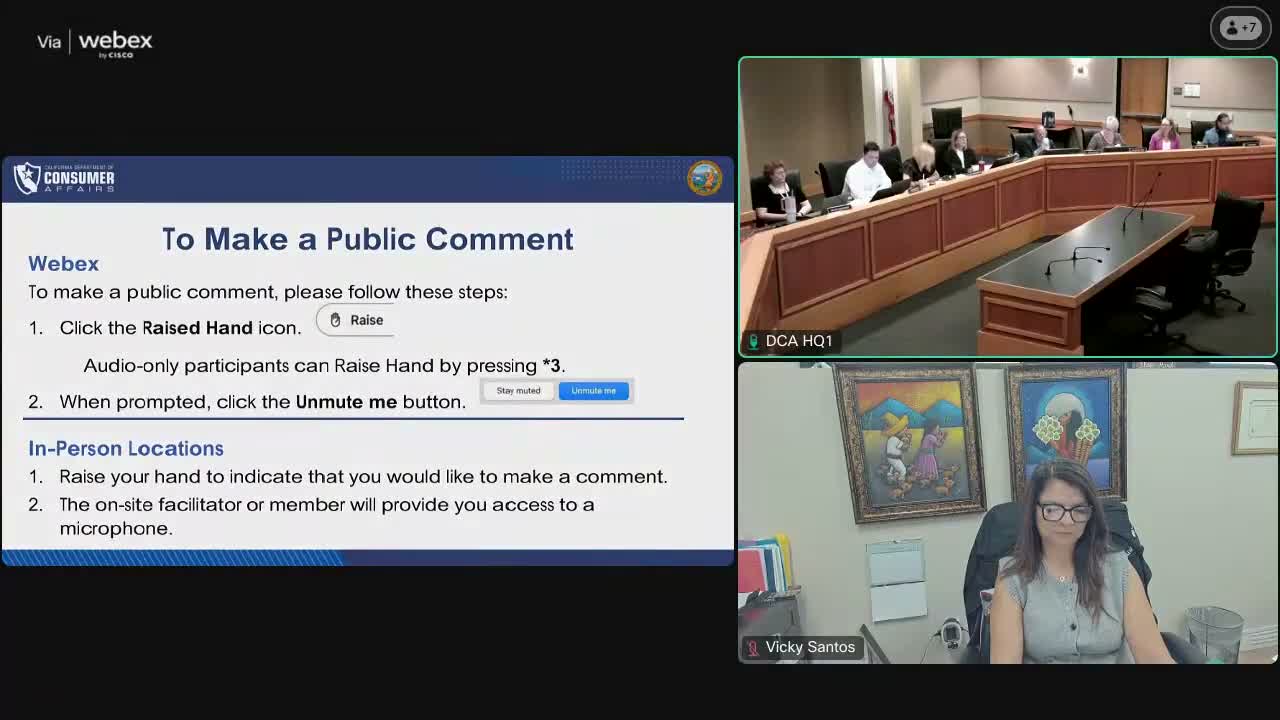
The California Board of Occupational Therapy on Feb. 27 received a step‑by‑step briefing from the Department of Consumer Affairs’ Office of Human Resources on how the board should conduct annual executive‑officer (EO) appraisals and pursue salary or exempt‑level increases.
Catherine Bachiller, who identified herself as an appointments and recruitment specialist in DCA’s Office of Human Resources, told the board that the appraisal process evaluates four main performance factors — relationship with the board, execution of board policy, administrative functions, and public liaison — and should be conducted in closed session under the Bagley‑Keene Open Meeting Act when discussing individual performance or salary adjustments. “The annual performance appraisal offers board members and DCA leadership the opportunity to evaluate the executive officer’s performance in a fair, impartial, and transparent manner,” Bachiller said.
Bachiller explained the distinction between two agency actions the board can request: an exempt salary increase (an adjustment within an existing exempt salary range for the incumbent) and an exempt level increase (a change to the classification level for the position, which expands the position’s salary range but does not automatically raise the current EO’s pay). She said any board request must be supported by a written justification and that DCA prepares an exempt position request (EPR) package that moves through DCA director review, the parent agency (Business, Consumer Services and Housing Agency), the governor’s office and CalHR. “CalHR is the final approving authority,” she said.
Board members asked logistical questions about timing and typical review windows. Bachiller said cost‑of‑living adjustments generally occur around July but noted they depend on bargaining agreements and are not guaranteed each year; she confirmed EO performance appraisals are annual. She added that CalHR sometimes requests additional justification for larger increases and that extended review times can delay final effective dates.
The presentation stressed confidentiality and process: board members should submit completed appraisal forms directly to the president or chair prior to closed‑session discussion (not circulate them among members), and OHR can meet with the president and EO in advance to prepare the justification and the EPR package. Bachiller said the board president and EO will be notified when an EPR package has been submitted and will be informed of approvals or denials through the usual administrative channels.
The board did not take a policy vote during the meeting; staff said they will follow up with materials and examples if the board decides to pursue a salary or level adjustment in a future meeting. The board moved on after a brief Q&A. The matter was informational and no immediate personnel action was recorded.
Catherine Bachiller, who identified herself as an appointments and recruitment specialist in DCA’s Office of Human Resources, told the board that the appraisal process evaluates four main performance factors — relationship with the board, execution of board policy, administrative functions, and public liaison — and should be conducted in closed session under the Bagley‑Keene Open Meeting Act when discussing individual performance or salary adjustments. “The annual performance appraisal offers board members and DCA leadership the opportunity to evaluate the executive officer’s performance in a fair, impartial, and transparent manner,” Bachiller said.
Bachiller explained the distinction between two agency actions the board can request: an exempt salary increase (an adjustment within an existing exempt salary range for the incumbent) and an exempt level increase (a change to the classification level for the position, which expands the position’s salary range but does not automatically raise the current EO’s pay). She said any board request must be supported by a written justification and that DCA prepares an exempt position request (EPR) package that moves through DCA director review, the parent agency (Business, Consumer Services and Housing Agency), the governor’s office and CalHR. “CalHR is the final approving authority,” she said.
Board members asked logistical questions about timing and typical review windows. Bachiller said cost‑of‑living adjustments generally occur around July but noted they depend on bargaining agreements and are not guaranteed each year; she confirmed EO performance appraisals are annual. She added that CalHR sometimes requests additional justification for larger increases and that extended review times can delay final effective dates.
The presentation stressed confidentiality and process: board members should submit completed appraisal forms directly to the president or chair prior to closed‑session discussion (not circulate them among members), and OHR can meet with the president and EO in advance to prepare the justification and the EPR package. Bachiller said the board president and EO will be notified when an EPR package has been submitted and will be informed of approvals or denials through the usual administrative channels.
The board did not take a policy vote during the meeting; staff said they will follow up with materials and examples if the board decides to pursue a salary or level adjustment in a future meeting. The board moved on after a brief Q&A. The matter was informational and no immediate personnel action was recorded.
View the Full Meeting & All Its Details
This article offers just a summary. Unlock complete video, transcripts, and insights as a Founder Member.
✓
Watch full, unedited meeting videos
✓
Search every word spoken in unlimited transcripts
✓
AI summaries & real-time alerts (all government levels)
✓
Permanent access to expanding government content
30-day money-back guarantee
