Manatee board hears school improvement progress and how $2M UNISIG funding will be used
August 30, 2024 | Manatee, School Districts, Florida
This article was created by AI summarizing key points discussed. AI makes mistakes, so for full details and context, please refer to the video of the full meeting. Please report any errors so we can fix them. Report an error »
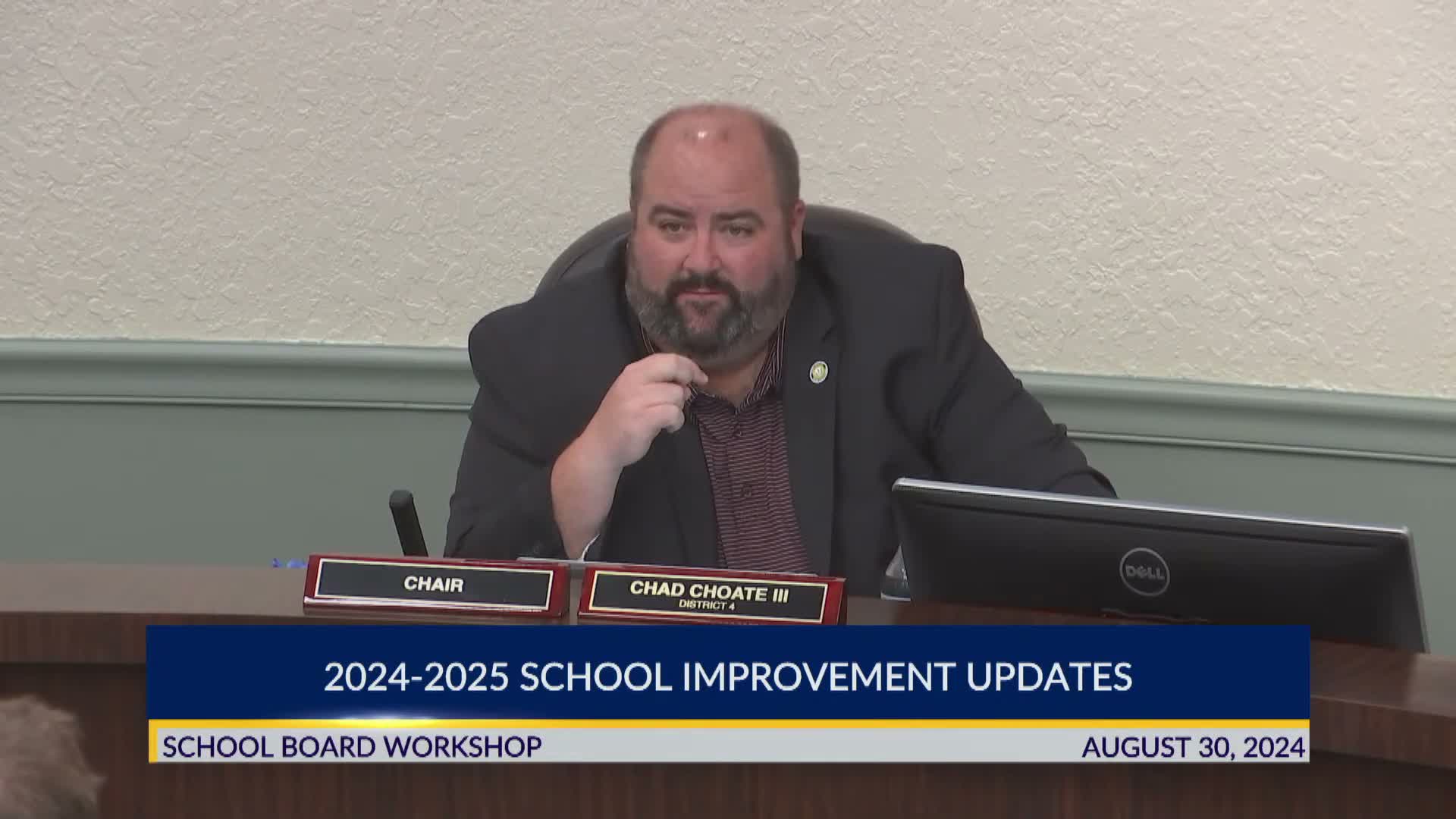
The School Board of Manatee County spent the morning reviewing the district's 2024–25 school improvement work and the state oversight that will guide support for four schools identified for comprehensive improvement.
Deputy Superintendent Derek Jensen opened the presentation, saying the district saw across‑the‑board gains in third grade reading, math and other indicators and is "on a positive trajectory." He listed four schools that received D grades — Samaset, Lincoln Middle, Bayshore High and the Manatee School for Arts & Sciences (charter) — and said the district's work will focus on supports for Samaset, Lincoln and Bayshore.
Kathea Johnson, the district's executive director for school improvement and the liaison with the Florida Department of Education's Bureau of School Improvement (BSI), walked trustees through the state's CSI (comprehensive support and improvement) process. She said CSI schools must submit school improvement plans in the state's Continuous Improvement Management System (SIMS), participate in instructional review visits and provide evidence of implementation at return visits in December and January.
"These plans are living documents," Johnson said, adding that the BSI team will conduct classroom walk‑throughs, data reviews and debriefs and that the district will submit quarterly data checks to the state.
Johnson also briefed the board on the district's UNISIG allocation for 2024–25, which she presented as $2,000,041,737.50 and said includes charter schools that receive UNISIG funds. That funding, she said, must be tied to each school's improvement plan and will be used to add positions, curriculum resources, professional learning, incentives for recruitment and retention where allowed by the grant, and extended learning opportunities for students.
Board members pressed staff for detail on how the grant would be allocated across schools. Jensen said the state provides an allocation by school and that the district will bring a breakdown to the board; he said some large comprehensive high schools (Bayshore, for example) received higher allocations due to size and need. He and Johnson repeatedly emphasized that any use of UNISIG funds must align to the school improvement plan and the state's allowable uses; needs that fall outside allowable grant uses will be paid for from the general fund or other local sources.
Principals from two turnaround campuses — James Tillman and Florence J. Abel elementary schools — described the instructional strategies that drove gains. Principal Marla Massey Blackmore and Principal Samantha Webb credited facilitated collaborative planning, frequent monitoring of student work, explicit instruction in writing across subjects and a culture of "calm urgency." Webb said her school relies on weekly professional learning communities, spiral review of math standards and data‑driven formative assessments.
Superintendent Dr. Wysong thanked the team and described reorganization that created a leadership position devoted to school improvement; he said that role, occupied by Johnson, was created by reassigning existing functions rather than adding a new administrator.
Next steps: staff said instructional reviews with the state BSI team will occur in the coming weeks and that the board will approve school improvement plans in October; those plans will be public records on Nov. 1. Trustees asked staff to return with a full UNISIG allocation breakdown by school in forthcoming board materials.
The board did not take a formal vote on funding uses at the workshop; staff will present grant allocations and related action items for future approval.
Deputy Superintendent Derek Jensen opened the presentation, saying the district saw across‑the‑board gains in third grade reading, math and other indicators and is "on a positive trajectory." He listed four schools that received D grades — Samaset, Lincoln Middle, Bayshore High and the Manatee School for Arts & Sciences (charter) — and said the district's work will focus on supports for Samaset, Lincoln and Bayshore.
Kathea Johnson, the district's executive director for school improvement and the liaison with the Florida Department of Education's Bureau of School Improvement (BSI), walked trustees through the state's CSI (comprehensive support and improvement) process. She said CSI schools must submit school improvement plans in the state's Continuous Improvement Management System (SIMS), participate in instructional review visits and provide evidence of implementation at return visits in December and January.
"These plans are living documents," Johnson said, adding that the BSI team will conduct classroom walk‑throughs, data reviews and debriefs and that the district will submit quarterly data checks to the state.
Johnson also briefed the board on the district's UNISIG allocation for 2024–25, which she presented as $2,000,041,737.50 and said includes charter schools that receive UNISIG funds. That funding, she said, must be tied to each school's improvement plan and will be used to add positions, curriculum resources, professional learning, incentives for recruitment and retention where allowed by the grant, and extended learning opportunities for students.
Board members pressed staff for detail on how the grant would be allocated across schools. Jensen said the state provides an allocation by school and that the district will bring a breakdown to the board; he said some large comprehensive high schools (Bayshore, for example) received higher allocations due to size and need. He and Johnson repeatedly emphasized that any use of UNISIG funds must align to the school improvement plan and the state's allowable uses; needs that fall outside allowable grant uses will be paid for from the general fund or other local sources.
Principals from two turnaround campuses — James Tillman and Florence J. Abel elementary schools — described the instructional strategies that drove gains. Principal Marla Massey Blackmore and Principal Samantha Webb credited facilitated collaborative planning, frequent monitoring of student work, explicit instruction in writing across subjects and a culture of "calm urgency." Webb said her school relies on weekly professional learning communities, spiral review of math standards and data‑driven formative assessments.
Superintendent Dr. Wysong thanked the team and described reorganization that created a leadership position devoted to school improvement; he said that role, occupied by Johnson, was created by reassigning existing functions rather than adding a new administrator.
Next steps: staff said instructional reviews with the state BSI team will occur in the coming weeks and that the board will approve school improvement plans in October; those plans will be public records on Nov. 1. Trustees asked staff to return with a full UNISIG allocation breakdown by school in forthcoming board materials.
The board did not take a formal vote on funding uses at the workshop; staff will present grant allocations and related action items for future approval.
View the Full Meeting & All Its Details
This article offers just a summary. Unlock complete video, transcripts, and insights as a Founder Member.
✓
Watch full, unedited meeting videos
✓
Search every word spoken in unlimited transcripts
✓
AI summaries & real-time alerts (all government levels)
✓
Permanent access to expanding government content
30-day money-back guarantee
