Washington Supreme Court hears challenge to King County ordinance over farm-zone uses and environmental review
May 21, 2024 | Supreme Court, Judicial , Washington
This article was created by AI summarizing key points discussed. AI makes mistakes, so for full details and context, please refer to the video of the full meeting. Please report any errors so we can fix them. Report an error »
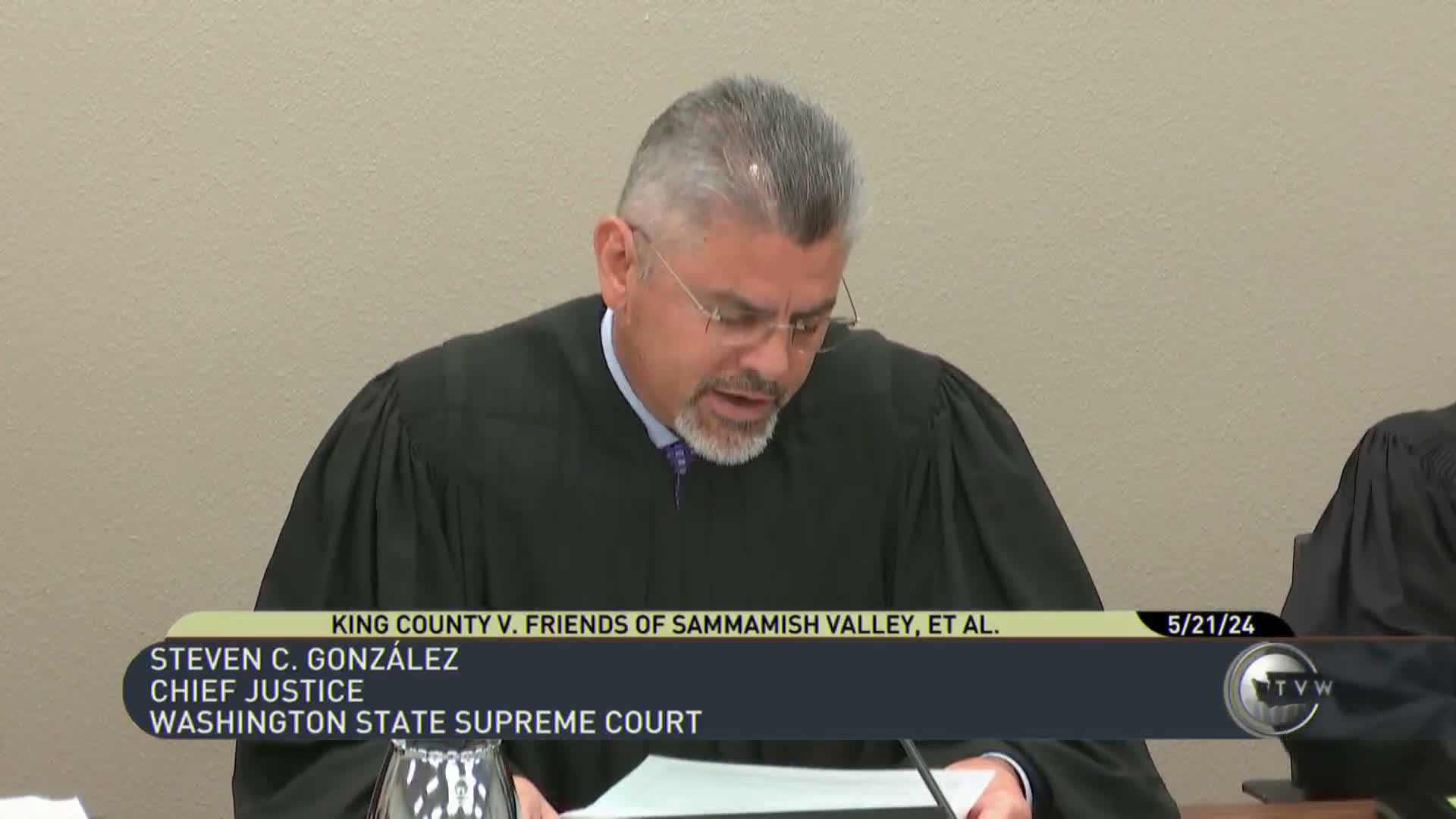
The Washington Supreme Court heard oral arguments on May 21, 2024, in King County v. Friends of Sammamish Valley over King County Ordinance 19030, which establishes licensing and development rules for wineries, breweries and distilleries in unincorporated county agricultural and rural zones.
Petitioners’ lead counsel Peter Eglick told the court the ordinance "manifestly transgresses" the statutory line between urban and rural uses under the Growth Management Act and conflicts with mandatory King County Comprehensive Plan policies (referred to in the record as r201 and r324). Eglick said the county’s 2019 determination of nonsignificance (DNS) and the later 2020 checklist were inadequate and that the Growth Management Hearing Board correctly invalidated the ordinance; he asked the court to uphold that invalidation rather than remanding for further process.
Eglick pressed two factual points in argument: that a significant portion of King County farming occurs on land designated RA (rural/agricultural) and that the ordinance permits uses and sourcing practices not tied to local agriculture. He also flagged public-health and environmental concerns, saying septic systems tied to winery operations in rural areas raise pollution risks in critical aquifer and spawning-habitat areas and that those impacts were not adequately analyzed in the county’s initial review.
County counsel Christy Craig, arguing for King County, urged the court to reverse the board’s ruling. Craig said the board "presumed" many existing winery, brewery and distillery uses were illegal when, in fact, before the ordinance most such businesses in unincorporated King County operated without county permits (some as home-occupation businesses). She said the ordinance instead creates a licensing regime, imposes event caps, and adds protections for the agricultural (A) and rural (RA) zones. "This ordinance does not violate the GMA," Craig told the court.
A central procedural dispute at argument concerned timing and sufficiency of environmental review: petitioners say the county relied improperly on a 2020 checklist prepared after the December 2019 ordinance and that the board properly found the DNS insufficient and that a full environmental impact statement (EIS) was likely required. The county countered that the responsible official’s 2019 memo and the plain language of the ordinance show no substantial increase in likely adverse impacts and that the board failed to apply the legal SEPA threshold correctly.
Justices repeatedly questioned counsel about the proper SEPA baseline (whether to compare to legal uses or the existing on-the-ground condition), the standard of review the Supreme Court should apply to the board’s factual findings, and how precedent — including the court’s Wildfish Conservancy decision cited by counsel — informs whether existing nonconforming uses should be treated as part of the baseline.
Both sides pointed to the administrative record: the county emphasized an extensive record the briefs describe as tens of thousands of pages, while petitioners identified county enforcement documents and a lobbying letter from an industry firm (referred to in the briefs as the Gallatin letter) as evidence relevant to whether current uses were noncompliant and whether the ordinance would change what is permitted.
Eglick closed in rebuttal by reiterating the need for a full EIS given the potential for increased events, changes to temporary-use and compatibility standards for wine/brew/distillery events, and possible septic-related pollution in sensitive areas; he asked the court to reverse the Court of Appeals and affirm the board’s invalidation. The court took the case under advisement and adjourned. No ruling was announced at the hearing.
The Supreme Court record in this matter will determine whether King County’s ordinance stands and whether additional environmental review is required before the ordinance’s provisions take full effect.
Petitioners’ lead counsel Peter Eglick told the court the ordinance "manifestly transgresses" the statutory line between urban and rural uses under the Growth Management Act and conflicts with mandatory King County Comprehensive Plan policies (referred to in the record as r201 and r324). Eglick said the county’s 2019 determination of nonsignificance (DNS) and the later 2020 checklist were inadequate and that the Growth Management Hearing Board correctly invalidated the ordinance; he asked the court to uphold that invalidation rather than remanding for further process.
Eglick pressed two factual points in argument: that a significant portion of King County farming occurs on land designated RA (rural/agricultural) and that the ordinance permits uses and sourcing practices not tied to local agriculture. He also flagged public-health and environmental concerns, saying septic systems tied to winery operations in rural areas raise pollution risks in critical aquifer and spawning-habitat areas and that those impacts were not adequately analyzed in the county’s initial review.
County counsel Christy Craig, arguing for King County, urged the court to reverse the board’s ruling. Craig said the board "presumed" many existing winery, brewery and distillery uses were illegal when, in fact, before the ordinance most such businesses in unincorporated King County operated without county permits (some as home-occupation businesses). She said the ordinance instead creates a licensing regime, imposes event caps, and adds protections for the agricultural (A) and rural (RA) zones. "This ordinance does not violate the GMA," Craig told the court.
A central procedural dispute at argument concerned timing and sufficiency of environmental review: petitioners say the county relied improperly on a 2020 checklist prepared after the December 2019 ordinance and that the board properly found the DNS insufficient and that a full environmental impact statement (EIS) was likely required. The county countered that the responsible official’s 2019 memo and the plain language of the ordinance show no substantial increase in likely adverse impacts and that the board failed to apply the legal SEPA threshold correctly.
Justices repeatedly questioned counsel about the proper SEPA baseline (whether to compare to legal uses or the existing on-the-ground condition), the standard of review the Supreme Court should apply to the board’s factual findings, and how precedent — including the court’s Wildfish Conservancy decision cited by counsel — informs whether existing nonconforming uses should be treated as part of the baseline.
Both sides pointed to the administrative record: the county emphasized an extensive record the briefs describe as tens of thousands of pages, while petitioners identified county enforcement documents and a lobbying letter from an industry firm (referred to in the briefs as the Gallatin letter) as evidence relevant to whether current uses were noncompliant and whether the ordinance would change what is permitted.
Eglick closed in rebuttal by reiterating the need for a full EIS given the potential for increased events, changes to temporary-use and compatibility standards for wine/brew/distillery events, and possible septic-related pollution in sensitive areas; he asked the court to reverse the Court of Appeals and affirm the board’s invalidation. The court took the case under advisement and adjourned. No ruling was announced at the hearing.
The Supreme Court record in this matter will determine whether King County’s ordinance stands and whether additional environmental review is required before the ordinance’s provisions take full effect.
View the Full Meeting & All Its Details
This article offers just a summary. Unlock complete video, transcripts, and insights as a Founder Member.
✓
Watch full, unedited meeting videos
✓
Search every word spoken in unlimited transcripts
✓
AI summaries & real-time alerts (all government levels)
✓
Permanent access to expanding government content
30-day money-back guarantee
