Washington Supreme Court hears dispute over tax deduction for investment-derived income
May 21, 2024 | Supreme Court, Judicial , Washington
This article was created by AI summarizing key points discussed. AI makes mistakes, so for full details and context, please refer to the video of the full meeting. Please report any errors so we can fix them. Report an error »
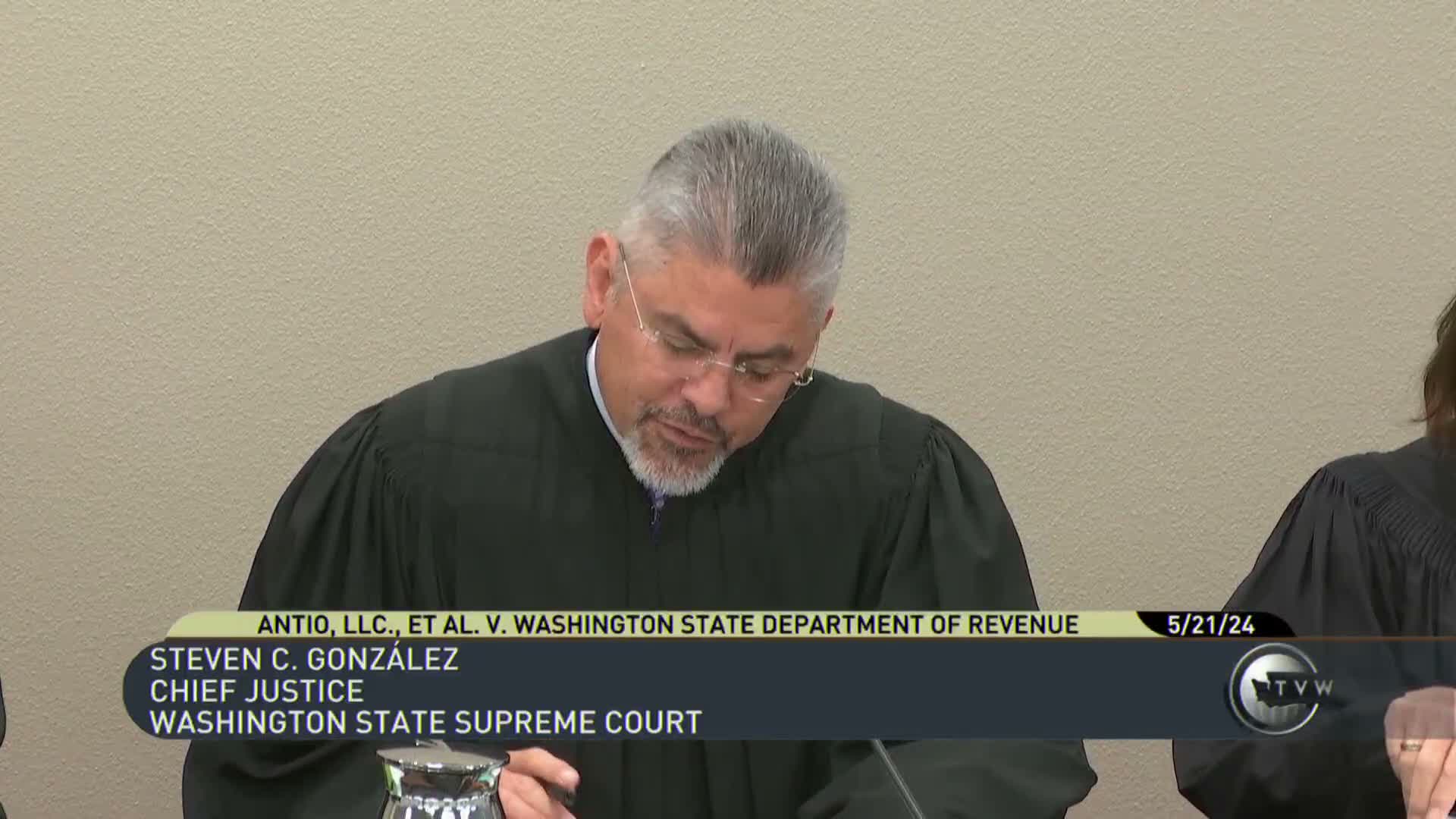
The Washington Supreme Court heard oral argument on May 21, 2024, in Antio LLC v. Washington State Department of Revenue over the proper scope of RCW 82.04.4281, which allows deductions for amounts "derived from investments." Counsel for the petitioners, Jason Harn, asked the court to apply the statute’s plain meaning and to allow investment-driven LLCs to claim the deduction; the Department’s lawyer, Assistant Attorney General Chuck Zaleski, urged a narrower interpretation grounded in this court’s O'Leary precedent.
Why it matters: The case tests whether the business-and-occupation tax deduction applies only to incidental investment income — such as excess cash placed in a money-market account — or also to income that is the primary business activity of entities that buy distressed debt and securitize returns. A ruling for the petitioners could reduce tax liabilities for funds and collective-investment vehicles operating in Washington; a ruling for the Department would preserve a narrower, precedent-based limit tied to incidental investment income.
Petitioner’s argument: Jason Harn told the court that the statutory text reads broadly: RCW 82.04.4281 permits deductions for amounts derived from investments and lists only four discrete exceptions. "Investment means investment," Harn argued, and nothing in the statute requires that the taxpayer’s main business not be investment-driven. Harn said the 2002 statutory reorganization and task force work reflected the result of earlier cases but did not create a new, narrowed definition of "investment," so the court should apply plain meaning.
Department’s response: Assistant Attorney General Chuck Zaleski countered that the deduction has long been applied narrowly to "the incidental investment of excess or surplus funds," and that the statute’s structure and case law support that limit. "In order to claim a deduction, you have to show your gross income and list your deduction," Zaleski said, adding that the legislature expressly disqualified certain businesses (banks, lending businesses, security businesses) from claiming the deduction while leaving other taxpayers able to claim a deduction for incidental investment activity.
Precedent and legislative history: Much of the argument turned on how to read O'Leary and related decisions (Selin, Simpson, Rainier Bancorp) together with the 2002 amendments. The Department argued that O'Leary — and later citations, including the 2010 JLARC report — support a limiting definition that excludes income from a taxpayer’s primary investment business. The petitioners replied that O'Leary produced a result rather than a dictionary-style definition, and that the 2002 amendments and the task force record do not show legislative acquiescence to a narrowed, incidental-only meaning.
Fact pattern and application: The parties and justices discussed the underlying facts accepted at summary judgment: the LLCs purchase distressed consumer debts, generate cash flows and then sell securities to third-party investors. The Department emphasized a facts-and-circumstances inquiry and drew a distinction between incidental investment returns (e.g., overnight cash management) and income that constitutes the taxpayer’s ordinary business activity.
What happened next: After rebuttal from petitioner counsel reiterating the plain-meaning argument and raising equitable-reliance concerns, the court recessed for 10 minutes. The justices did not announce a decision at the hearing.
What to watch: The court’s eventual opinion will clarify whether Washington’s B&O tax deduction for "amounts derived from investments" is limited to incidental investment income or can extend to entities whose primary activity is investing and securitizing debt. That resolution could affect taxation of collective-investment vehicles and similar funds doing business in the state.
Attributions: Quotes and attributions in this report come from the court transcript of the May 21, 2024 oral argument and map to counsel Jason Harn (petitioners) and Assistant Attorney General Chuck Zaleski (respondent).
Why it matters: The case tests whether the business-and-occupation tax deduction applies only to incidental investment income — such as excess cash placed in a money-market account — or also to income that is the primary business activity of entities that buy distressed debt and securitize returns. A ruling for the petitioners could reduce tax liabilities for funds and collective-investment vehicles operating in Washington; a ruling for the Department would preserve a narrower, precedent-based limit tied to incidental investment income.
Petitioner’s argument: Jason Harn told the court that the statutory text reads broadly: RCW 82.04.4281 permits deductions for amounts derived from investments and lists only four discrete exceptions. "Investment means investment," Harn argued, and nothing in the statute requires that the taxpayer’s main business not be investment-driven. Harn said the 2002 statutory reorganization and task force work reflected the result of earlier cases but did not create a new, narrowed definition of "investment," so the court should apply plain meaning.
Department’s response: Assistant Attorney General Chuck Zaleski countered that the deduction has long been applied narrowly to "the incidental investment of excess or surplus funds," and that the statute’s structure and case law support that limit. "In order to claim a deduction, you have to show your gross income and list your deduction," Zaleski said, adding that the legislature expressly disqualified certain businesses (banks, lending businesses, security businesses) from claiming the deduction while leaving other taxpayers able to claim a deduction for incidental investment activity.
Precedent and legislative history: Much of the argument turned on how to read O'Leary and related decisions (Selin, Simpson, Rainier Bancorp) together with the 2002 amendments. The Department argued that O'Leary — and later citations, including the 2010 JLARC report — support a limiting definition that excludes income from a taxpayer’s primary investment business. The petitioners replied that O'Leary produced a result rather than a dictionary-style definition, and that the 2002 amendments and the task force record do not show legislative acquiescence to a narrowed, incidental-only meaning.
Fact pattern and application: The parties and justices discussed the underlying facts accepted at summary judgment: the LLCs purchase distressed consumer debts, generate cash flows and then sell securities to third-party investors. The Department emphasized a facts-and-circumstances inquiry and drew a distinction between incidental investment returns (e.g., overnight cash management) and income that constitutes the taxpayer’s ordinary business activity.
What happened next: After rebuttal from petitioner counsel reiterating the plain-meaning argument and raising equitable-reliance concerns, the court recessed for 10 minutes. The justices did not announce a decision at the hearing.
What to watch: The court’s eventual opinion will clarify whether Washington’s B&O tax deduction for "amounts derived from investments" is limited to incidental investment income or can extend to entities whose primary activity is investing and securitizing debt. That resolution could affect taxation of collective-investment vehicles and similar funds doing business in the state.
Attributions: Quotes and attributions in this report come from the court transcript of the May 21, 2024 oral argument and map to counsel Jason Harn (petitioners) and Assistant Attorney General Chuck Zaleski (respondent).
View the Full Meeting & All Its Details
This article offers just a summary. Unlock complete video, transcripts, and insights as a Founder Member.
✓
Watch full, unedited meeting videos
✓
Search every word spoken in unlimited transcripts
✓
AI summaries & real-time alerts (all government levels)
✓
Permanent access to expanding government content
30-day money-back guarantee
