Washington Supreme Court hears challenge over juror bias standard in State v. Smith
May 16, 2024 | Supreme Court, Judicial , Washington
This article was created by AI summarizing key points discussed. AI makes mistakes, so for full details and context, please refer to the video of the full meeting. Please report any errors so we can fix them. Report an error »
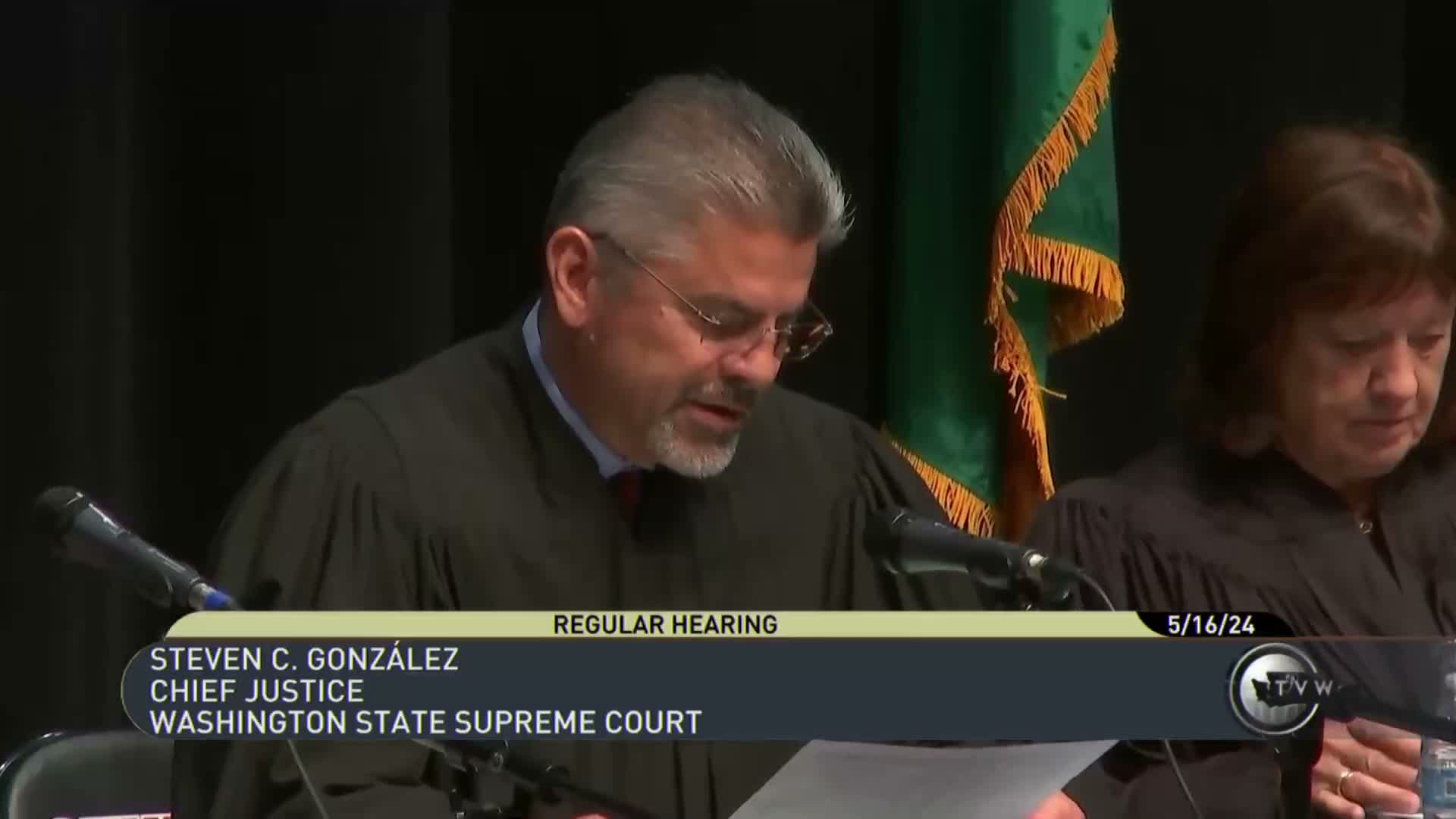
The Washington Supreme Court heard oral argument May 16 in State of Washington v. Nathan Smith, a case that asks when a juror’s statements during voir dire rise to actual bias and require a trial judge to remove the juror.
May it please the court, Matthew Pittman, a deputy prosecuting attorney with Snohomish County, argued for the state that appellate courts must respect a trial judge’s ability to assess demeanor and nuance and that precedent requires a showing of a probability of actual bias, not just a possibility. "What this case concerns is how do we determine when a juror is biased?" Pittman told the bench.
Kate Huber, appearing for the respondent through the Washington Appellate Project, said juror 27 repeatedly indicated she might "go along with the group" if she were "on the fence," which Huber said showed an inability to follow the presumption of innocence. "A juror who admits that they could go along with the group... is not an impartial juror," Huber said.
The central factual dispute concerns two parts of the voir dire. Huber urged the court to rely on an early individual exchange in which juror 27 said she might change her vote to align with others when uncertain; she argued that later answers in small-group questioning underscored the juror’s misunderstanding of the burden of proof. Pittman countered that the record shows multiple opportunities to raise challenges, that defense counsel had peremptory challenges available at critical times, and that reasonable minds could differ about how a trial judge interpreted the juror’s statements.
Justices pressed both sides on several issues: whether seating an actually biased juror is structural error that requires automatic reversal, whether an appellant can be charged with waiver if peremptory strikes were used earlier in selection, and whether the juror’s phrasing—"on the fence"—is reasonably susceptible to a benign interpretation tied to ordinary deliberative change of mind. Huber argued the court of appeals correctly concluded the juror’s answers showed a probability of bias; Pittman urged deference to the trial judge, citing Nolte and related Washington cases.
Counsel also discussed practical context: voir dire took place during the COVID period, with jurors brought in in smaller clusters and preliminary instructions provided earlier; both sides noted that the trial judge had opportunities to observe juror demeanor and to rehabilitate a juror by further instruction or questioning.
The bench did not issue a decision from the bench. After argument the chief justice said the case was submitted for decision.
Why it matters: The Court’s ruling could clarify how appellate courts balance deference to trial judges’ firsthand observations against the constitutional right to an impartial jury and could refine how Washington applies precedent on actual bias and waiver of objections during jury selection.
The court completed argument and then held a public question-and-answer session as part of its traveling-court program; no ruling was announced at the session.
May it please the court, Matthew Pittman, a deputy prosecuting attorney with Snohomish County, argued for the state that appellate courts must respect a trial judge’s ability to assess demeanor and nuance and that precedent requires a showing of a probability of actual bias, not just a possibility. "What this case concerns is how do we determine when a juror is biased?" Pittman told the bench.
Kate Huber, appearing for the respondent through the Washington Appellate Project, said juror 27 repeatedly indicated she might "go along with the group" if she were "on the fence," which Huber said showed an inability to follow the presumption of innocence. "A juror who admits that they could go along with the group... is not an impartial juror," Huber said.
The central factual dispute concerns two parts of the voir dire. Huber urged the court to rely on an early individual exchange in which juror 27 said she might change her vote to align with others when uncertain; she argued that later answers in small-group questioning underscored the juror’s misunderstanding of the burden of proof. Pittman countered that the record shows multiple opportunities to raise challenges, that defense counsel had peremptory challenges available at critical times, and that reasonable minds could differ about how a trial judge interpreted the juror’s statements.
Justices pressed both sides on several issues: whether seating an actually biased juror is structural error that requires automatic reversal, whether an appellant can be charged with waiver if peremptory strikes were used earlier in selection, and whether the juror’s phrasing—"on the fence"—is reasonably susceptible to a benign interpretation tied to ordinary deliberative change of mind. Huber argued the court of appeals correctly concluded the juror’s answers showed a probability of bias; Pittman urged deference to the trial judge, citing Nolte and related Washington cases.
Counsel also discussed practical context: voir dire took place during the COVID period, with jurors brought in in smaller clusters and preliminary instructions provided earlier; both sides noted that the trial judge had opportunities to observe juror demeanor and to rehabilitate a juror by further instruction or questioning.
The bench did not issue a decision from the bench. After argument the chief justice said the case was submitted for decision.
Why it matters: The Court’s ruling could clarify how appellate courts balance deference to trial judges’ firsthand observations against the constitutional right to an impartial jury and could refine how Washington applies precedent on actual bias and waiver of objections during jury selection.
The court completed argument and then held a public question-and-answer session as part of its traveling-court program; no ruling was announced at the session.
Don't Miss a Word: See the Full Meeting!
Go beyond summaries. Unlock every video, transcript, and key insight with a Founder Membership.
✓
Get instant access to full meeting videos
✓
Search and clip any phrase from complete transcripts
✓
Receive AI-powered summaries & custom alerts
✓
Enjoy lifetime, unrestricted access to government data
30-day money-back guarantee
